- TikTok operates as a search engine where videos rank based on topical relevance, watch time, and engagement rather than follower count or account age.
- TikTok indexes keywords from captions, on-screen text, spoken audio, hashtags, and early user behavior within the first 24–72 hours after posting.
- Search-optimized TikTok videos generate compounding, long-term discovery traffic that persists beyond initial For You Page distribution.
Search behavior on TikTok has fundamentally changed. Today, TikTok SEO is no longer a growth “hack”; it’s the foundation for sustainable visibility, search traffic, and demand generation on the platform.
If you’re a brand, creator, or growth team trying to win organic reach in 2026, understanding how TikTok SEO actually works is no longer optional. TikTok has evolved into a full-fledged search engine, and content that isn’t optimized for TikTok search is quietly losing compounding traffic every day.
This guide breaks down TikTok SEO from a strategic, execution-level perspective: how TikTok’s search algorithm works, how content gets indexed and ranked, and how to build search-optimized videos that generate long-term discovery, not just short-lived FYP spikes.
In this guide, you’ll learn:
- What TikTok SEO actually is (and how it differs from traditional SEO)
- How TikTok’s search algorithm ranks videos
- How to do TikTok keyword research that drives real traffic
- Where and how TikTok indexes keywords
- How to structure videos for TikTok search and retention
- Proven TikTok SEO strategies and real-world case studies
- Common TikTok SEO mistakes that suppress reach
- How brands can turn TikTok SEO into a repeatable growth channel
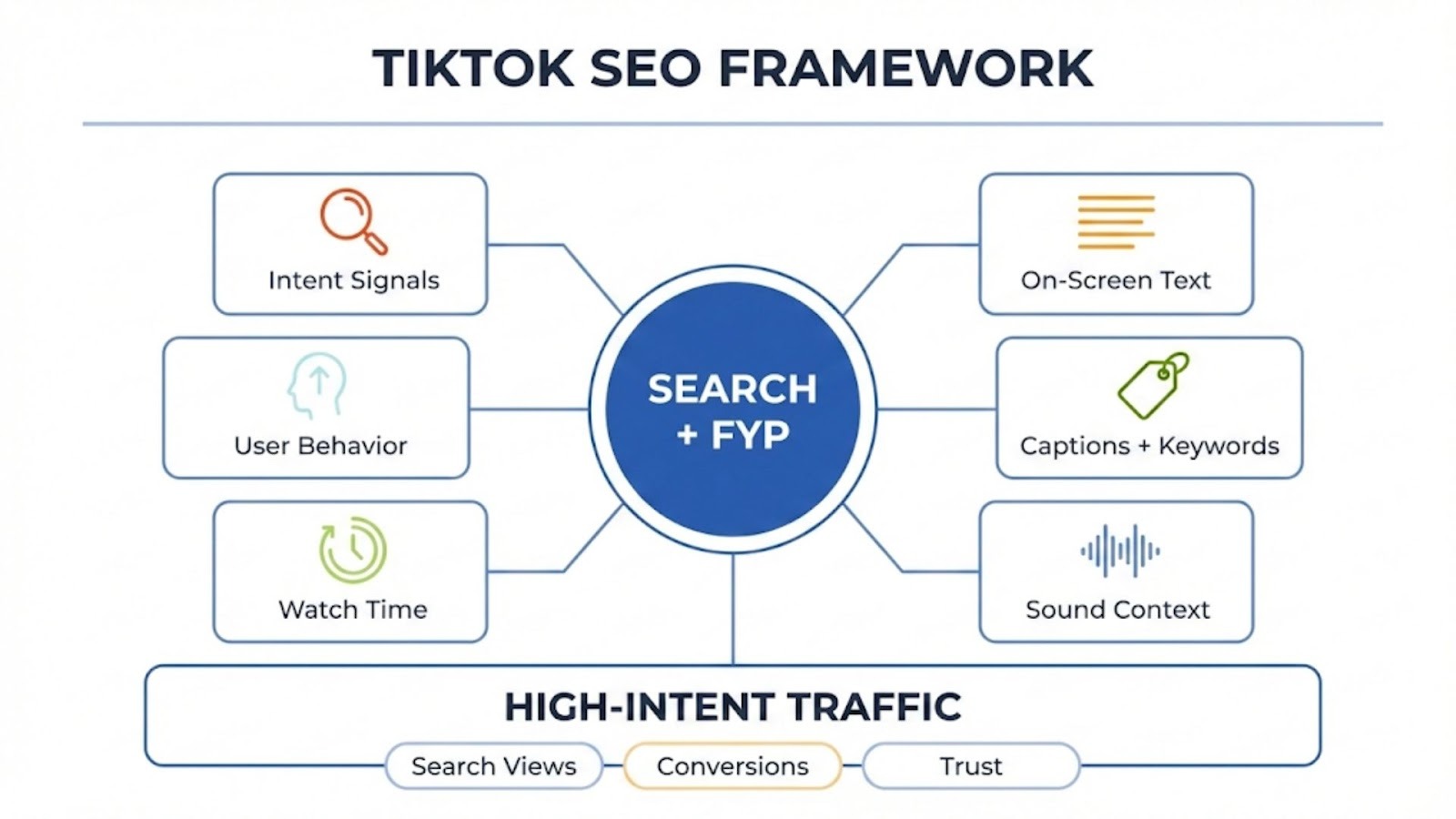
What Is TikTok SEO? (And How TikTok Search Optimization Actually Works)
TikTok SEO is the strategic process of making your content discoverable through TikTok’s native search and its algorithmic distribution, most notably on the For You Page (FYP). And I don’t mean “add a few hashtags and hope for the best.” I mean aligning every signal, text, sound, on-screen context, watch time, caption structure, with search intent and behavioral triggers.
Why does this matter? Because TikTok has become the search engine for hundreds of millions of users. Gen Z, in particular, is already bypassing Google and heading to TikTok to search for:
- Product reviews
- How-to content
- Restaurant or travel recommendations
- Personal stories and real-world opinions
If you aren’t optimizing your content for search visibility inside TikTok, you’re ceding that traffic to someone else. And that traffic is high-conversion.
This isn’t hypothetical, I’ve seen search-optimized TikToks generate 70%+ of their total views from search traffic, not the FYP. That’s not a fluke. That’s strategy.
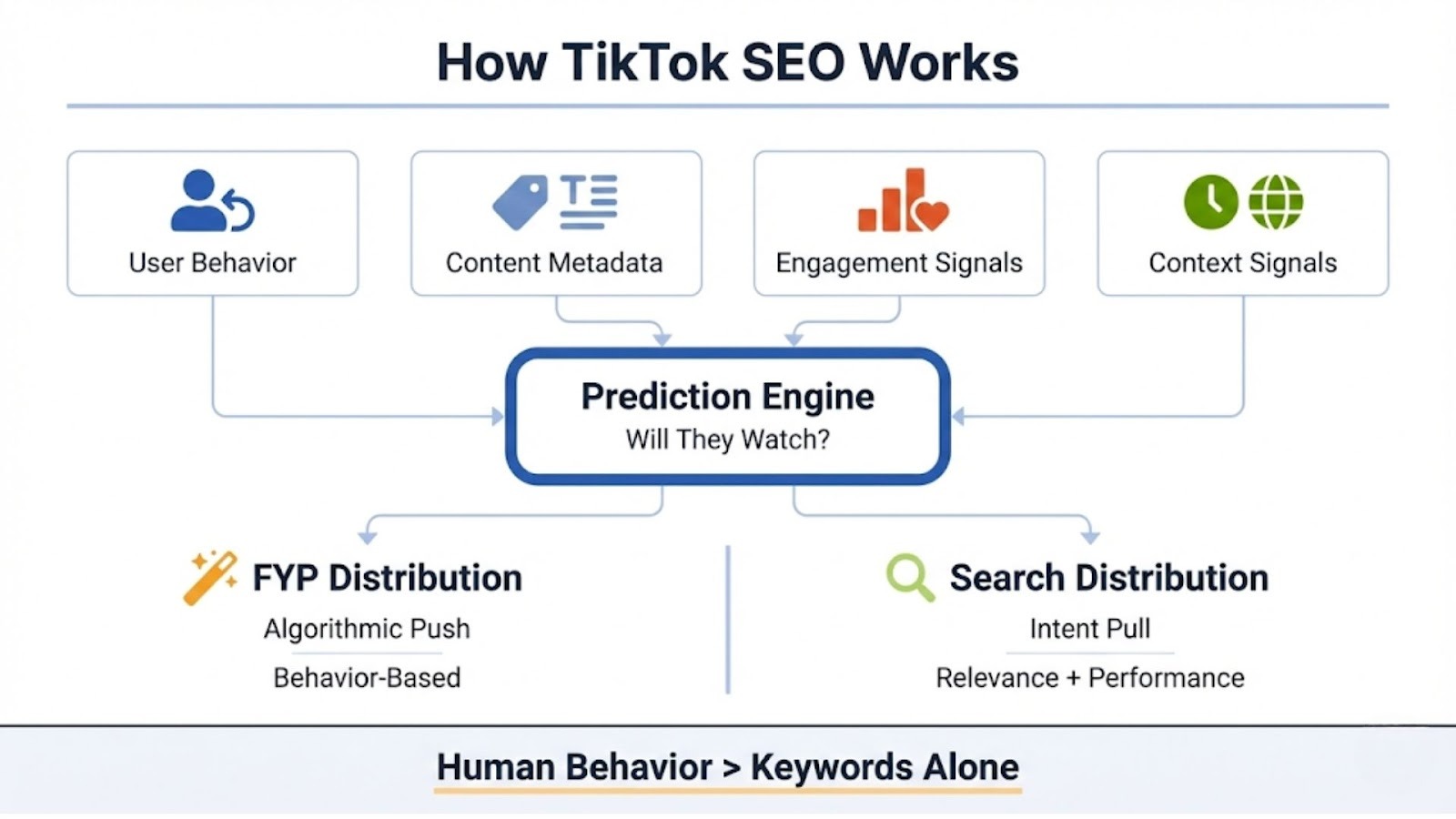
How TikTok SEO Works: Inside TikTok’s Search and Recommendation Algorithm
Let’s start by aligning on how the engine underneath the hood operates.
Core Ranking Signals
TikTok’s recommendation and search algorithm runs on a blend of:
- User behavior: past views, likes, shares, comments, rewatches
- Content metadata: captions, hashtags, sounds, on-screen text, voice
- Engagement performance: retention, watch time, comment velocity, shares
- Technical and contextual signals: device settings, language, time of day
If you’ve done YouTube or Google SEO before, you might expect a heavy emphasis on authority or backlinks, or age. TikTok doesn’t care about domain history. It cares about whether your content is engaging, immediate, and relevant right now.
And here’s where it diverges from other platforms: TikTok’s algorithm isn’t just trying to understand your video’s topic. It’s trying to predict who will watch it to the end. That’s a massive shift in how search works. It means optimization must serve human behavior, not just keyword logic.
TikTok SEO vs FYP Distribution: Search Traffic vs Algorithmic Push
TikTok has two major distribution surfaces:
- FYP is an algorithmic push: the system shows content based on behavioral prediction.
- Search is intent-driven pull: users actively type in keywords, and TikTok ranks videos based on both relevance and performance.
Both systems share signals, but search puts more weight on topical relevance, which is where structured SEO shines.
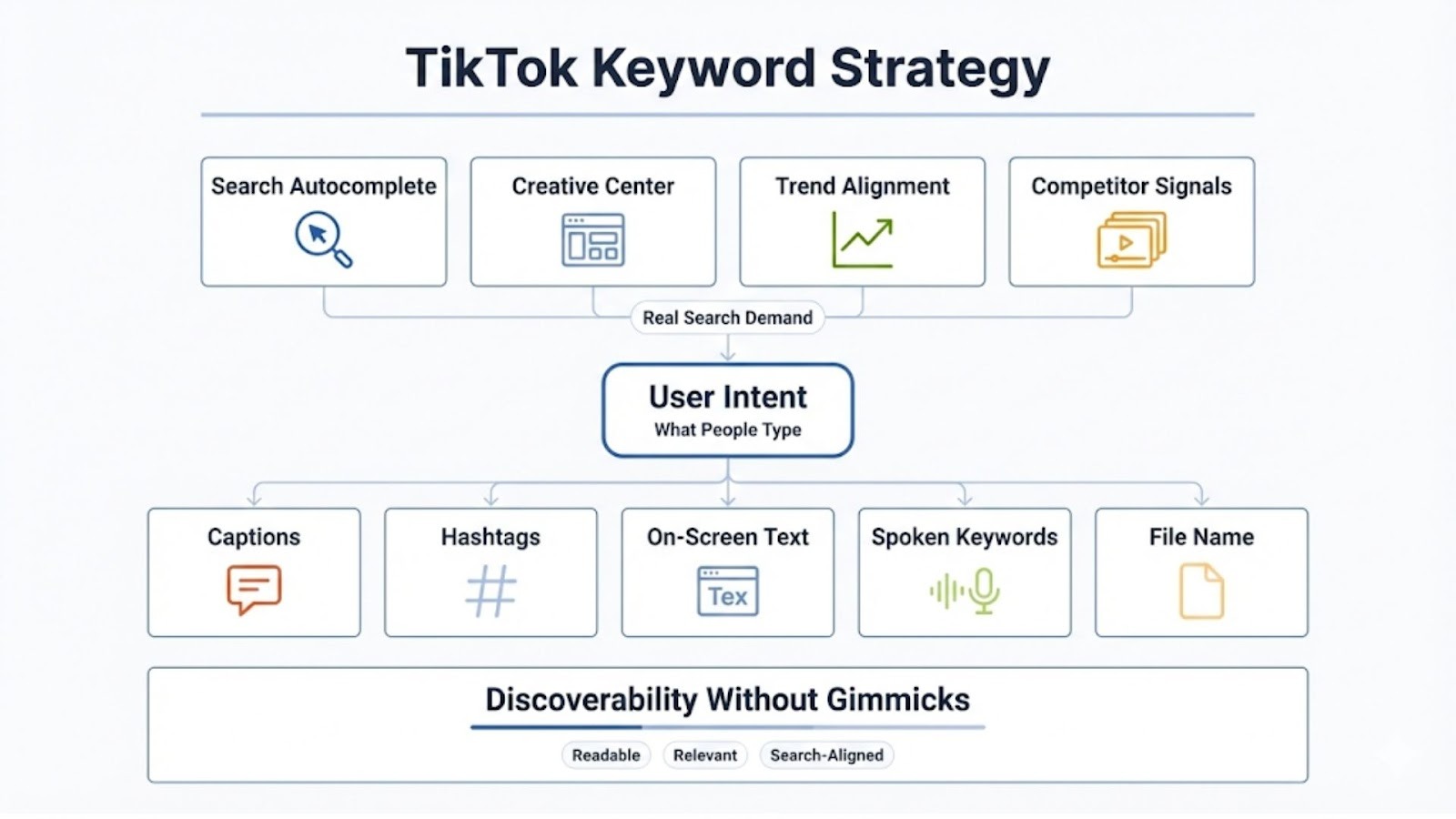
TikTok SEO Keyword Research and Placement (A Strategic, Non-Gimmicky Approach)
Let’s talk about keywords, not as hashtags, but as the actual words your audience types when they want to find something.
How I Find TikTok Keywords That Actually Matter
I use a hybrid stack of:
- TikTok search bar (autocomplete shows top live queries)
- TikTok Creative Center → Keyword Insights
- Google Trends for temporal alignment
- Competitor content: reverse-engineer what terms top-ranking videos clearly target
If you’re guessing what keywords people search, you’re doing it wrong. Effective discoverability has always been about aligning content with real user intent, not assumptions.TikTok gives you the clues; you just have to be patient enough to read them.
Pro tip: TikTok’s search suggestions are driven by actual search volume. If you type “how to” and it autocompletes “how to clean white sneakers,” that’s a real trend you should consider targeting.
Where Keywords Should Go (and What Actually Gets Indexed)
Here’s what I’ve confirmed through testing and client-side experiments:
- Captions: still heavily weighted. Include your primary keyword in the first sentence if possible. Don’t keyword-stuff; write for readability. But know that TikTok parses it for meaning.
- Hashtags: still helpful, especially niche-specific ones. Don’t overdo it. I use 3–6, max. Go for:
- 1–2 broad discoverability tags (#foryou, #tiktokseo)
- 2–3 niche semantic tags (#personalbranding, #b2bmarketingtips)
- 1 trending or community tag (#CareerTok, #MomsOfTikTok)
- On-screen text: TikTok’s OCR is sophisticated. Text overlays (especially in the first 3–5 seconds) are indexed and can help you rank.
- Voiceover or spoken keywords: TikTok transcribes and parses audio. Saying your keyword clearly, “Let me show you how I organize my Notion dashboard”, helps TikTok classify your content.
- Video file name (if uploading via desktop): minor factor, but I still name my files like personal_brand_tips_2026.mp4.
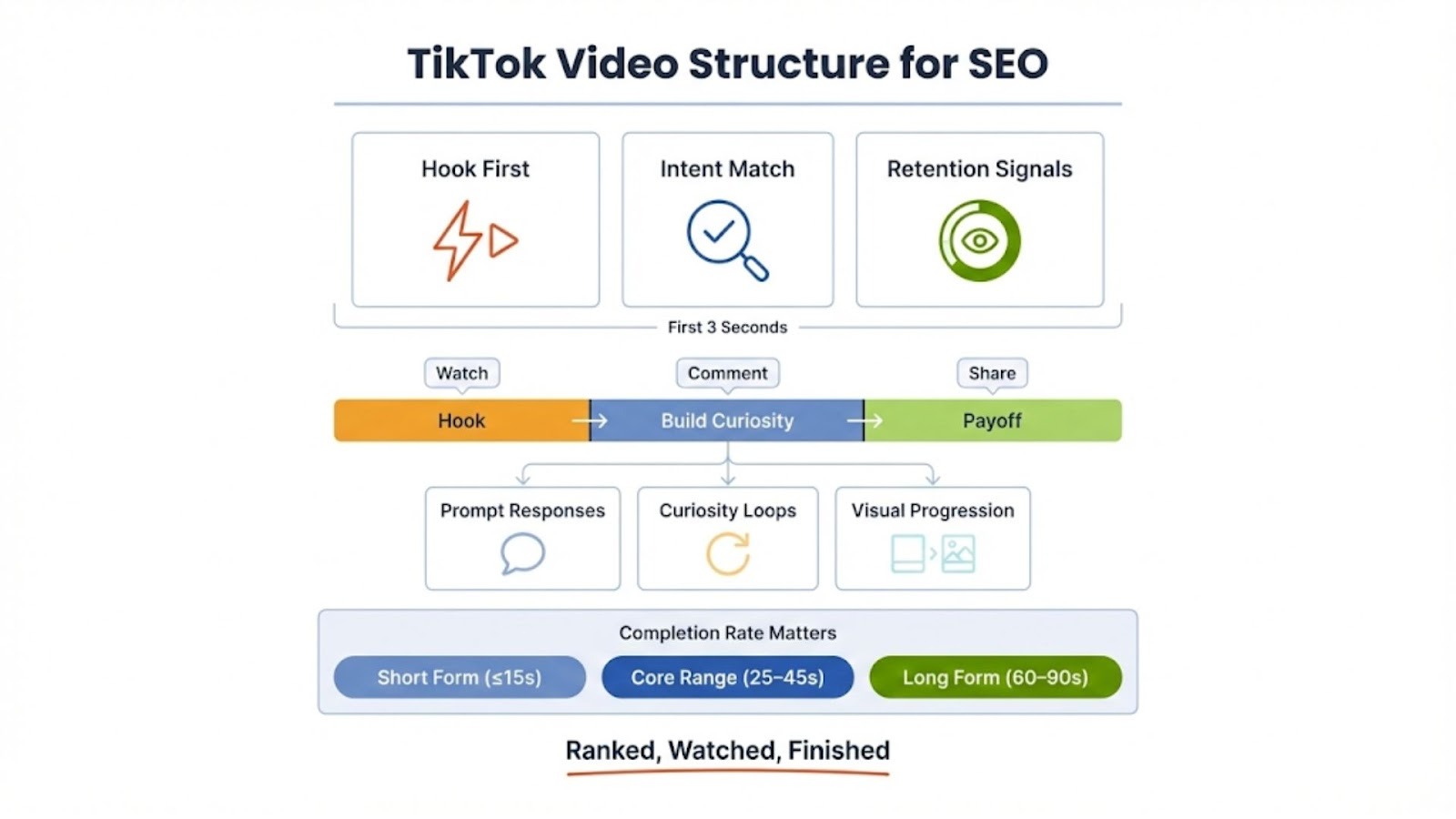
How to Structure Videos for TikTok SEO, Search Ranking, and Retention
Here’s the truth: even perfectly optimized videos won’t rank if they suck.
The TikTok search system doesn’t just check for relevance. It checks for retention and interaction quality. Here’s how I build videos that do both.
Hook First. Always.
If you don’t grab attention in the first 3 seconds, you’re toast.
Examples:
- “Most people fail at this part of their resume. Here’s why.”
- “The way I batch create TikToks for the entire week in 45 minutes.”
Start with a statement or question that aligns with your target query. That’s how you keep viewers from swiping, and signal to TikTok this content is worth distributing.
Drive Engagement Intentionally
Comments and shares are weighted heavily. Likes help. Saves matter even more.
Don’t just ask for engagement. Earn it. Try:
- Prompting responses (“Which of these would you use?”)
- Creating curiosity loops (“Watch till the end for the twist”)
- Using visual progressions (before/after reveals)
Length Optimization
Contrary to belief, longer isn’t always better. I aim for:
- 25–45 seconds for tactical content
- <15 seconds for trends or list-style content
- 60–90 seconds only when retention rates are historically solid
What matters most is completion rate, not total duration.
How Long Does TikTok SEO Take to Work?
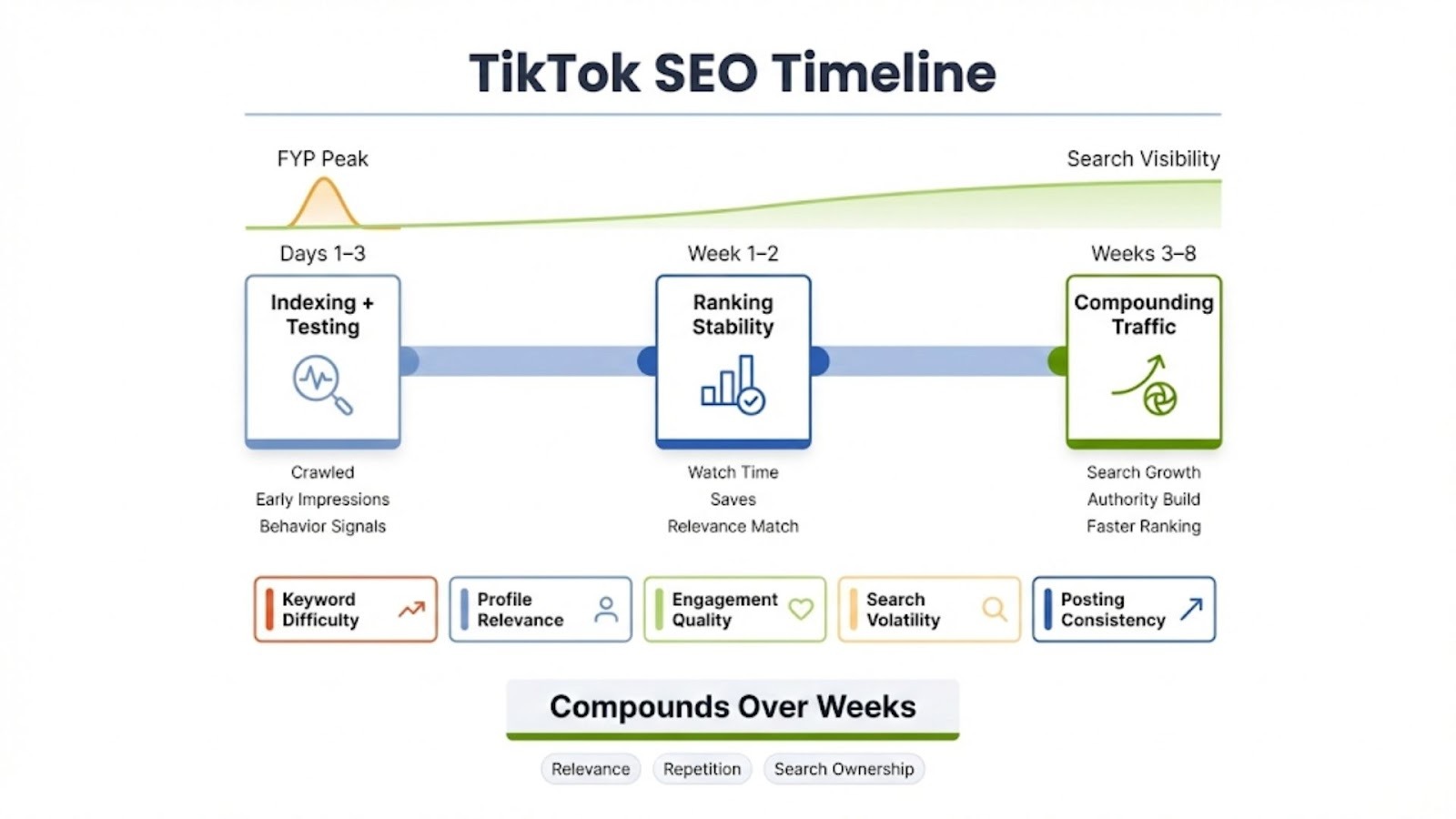
TikTok SEO moves faster than traditional search engine optimization, but it still operates along a staged timeline of visibility, trust-building, and compounding returns. In most cases, you’ll see early signals quickly, but meaningful, sustained results emerge over weeks, not days.
Let’s break down the process.
The Core Timeline of TikTok SEO Performance
Unlike Google, which may take months to index and rank a page meaningfully, TikTok operates with a much shorter feedback loop. Based on observed performance patterns across multiple optimized accounts, here’s a common trajectory:
Days 1–3: Indexing + Search Impression Testing
- TikTok crawls your video content almost immediately.
- It analyzes the caption, spoken words (via speech-to-text), on-screen text, hashtags, and viewer behavior within the first 24–72 hours.
- Your video may begin surfacing in search results for low-competition or long-tail keywords early on.
- This phase is often overlooked, but TikTok uses early view data to test relevance: who watches, how long, and what search led them there.
Week 1–2: Ranking Stabilization
- If the video maintains strong watch time, save rates, and replay signals, TikTok will reinforce your position in the search results.
- Search visibility tends to stabilize between Day 5 and Day 12, especially for videos targeting medium-difficulty keywords (e.g., “how to budget with Notion”).
- TikTok continues testing the video across different audience segments.
- The algorithm begins associating your profile with the keyword or content cluster you’re targeting.
Weeks 3–8: Compounding Search Traffic
- TikTok Search behaves like a soft index; content doesn’t get locked into a position but gains cumulative authority if it continues to satisfy queries.
- Users start saving, sharing, or commenting, which sends positive semantic signals back to the system.
- As your profile-level topical relevance strengthens, newer videos can begin to rank faster, leveraging prior SEO gains.
Why TikTok SEO Doesn’t “Expire” Like FYP Content
One of the most important distinctions is this:
TikTok search visibility doesn’t decay in the same way that For You Page exposure does, which aligns with a broader shift toward search-first discovery across platforms.
While your FYP impressions peak within 48 hours and often drop off fast, a search-optimized video can:
- Rank for a long-tail keyword months later
- Regain momentum if the query trend reactivates
- Appear alongside newly published content targeting the same term
In some cases, creators have seen search-driven videos resurface six months later due to seasonal interest or renewed demand.
Factors That Influence TikTok SEO Speed
Not all videos follow the exact same curve. Here’s what can accelerate or delay your SEO performance:
| Factor | Impact on Speed |
| Keyword Difficulty | Easier to rank quickly for specific or underutilized phrases |
| Profile Relevance | Established accounts in a niche rank faster and higher |
| Engagement Metrics | High retention and saves accelerate visibility |
| Search Volume Volatility | Trending queries can shift results faster |
| Consistency of Publishing | Regularly posting around one theme increases topical authority |
| Quality of Optimization | Misaligned captions or weak hooks slow indexing and rank gain |
If you’re targeting a new niche or competitive space, expect a longer warm-up period, especially if your account hasn’t posted on that topic before.
What This Means for Strategy
TikTok SEO isn’t about flash-virality. It’s about compounding results through relevance and repetition, the same strategic mindset required when building sustainable SEO systems across channels.
If your goal is to:
- Rank for niche terms
- Own intent-driven discovery
- Build a searchable content archive
Then you’ll need to commit to weeks of focused publishing, with each video improving your footprint and content library for TikTok’s search system.
Strategic Content Types for SEO-Driven Growth
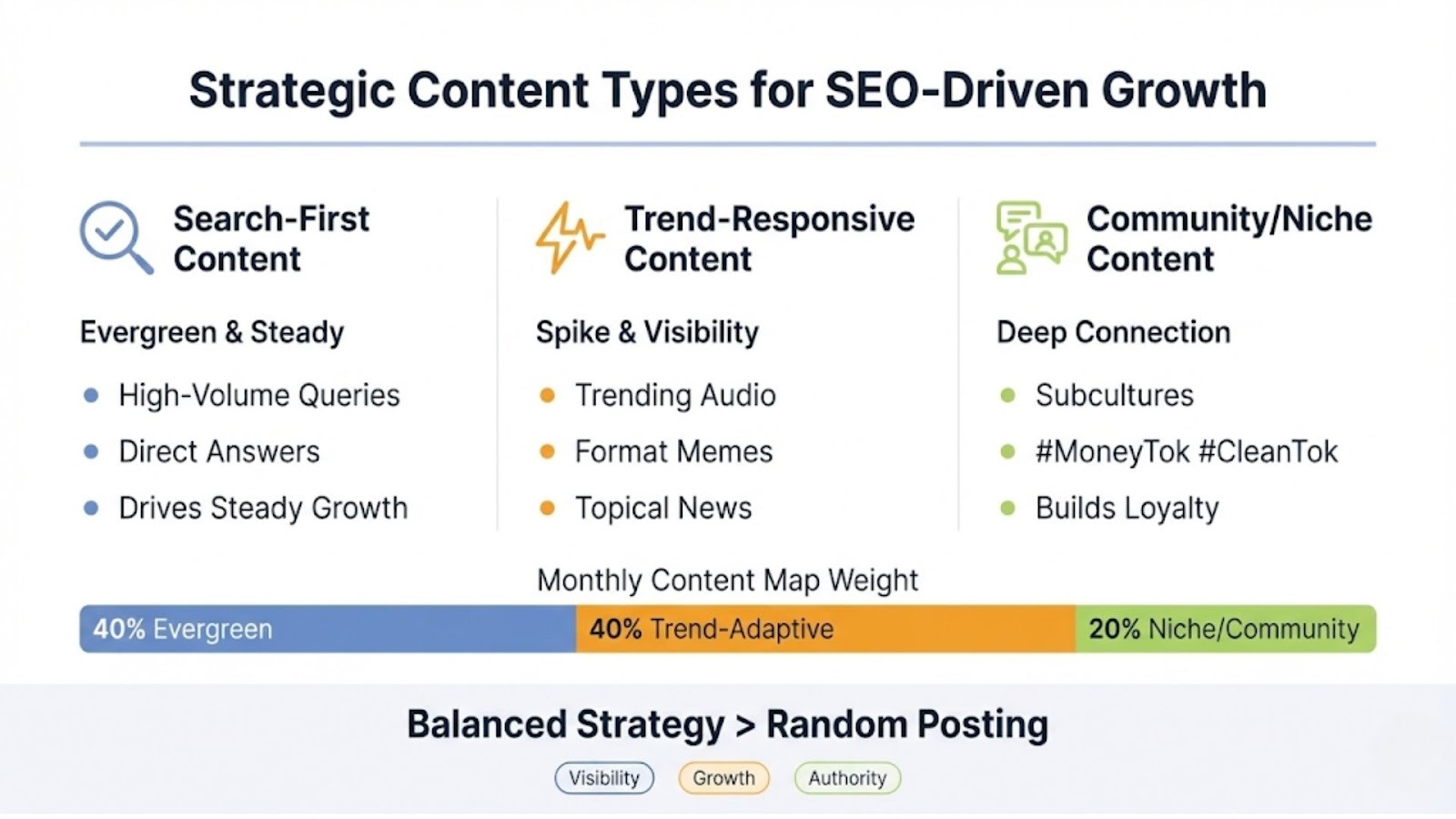
I don’t believe in random posting. Every piece of content should map to a strategic intent. Here’s how I think about formats:
1. Search-First Content
Directly addresses high-volume queries:
- “How to use Notion for content calendars.”
- “TikTok SEO tips for small businesses”
This content is evergreen, finds its audience through search, and drives steady growth.
2. Trend-Responsive Content
Takes advantage of:
- Trending audio
- Format memes
- Topical news
These can spike your reach, but they don’t always compound. Use them to drive visibility that leads to profile growth.
3. Community/Niche Content
Designed for subcultures like:
- #MoneyTok
- #CleanTok
- #TherapyTok
These build deeper connections and signal algorithmic relevance within a niche.
I mix all three into a monthly content map, weighted 40% evergreen, 40% trend-adaptive, 20% niche/community-building.
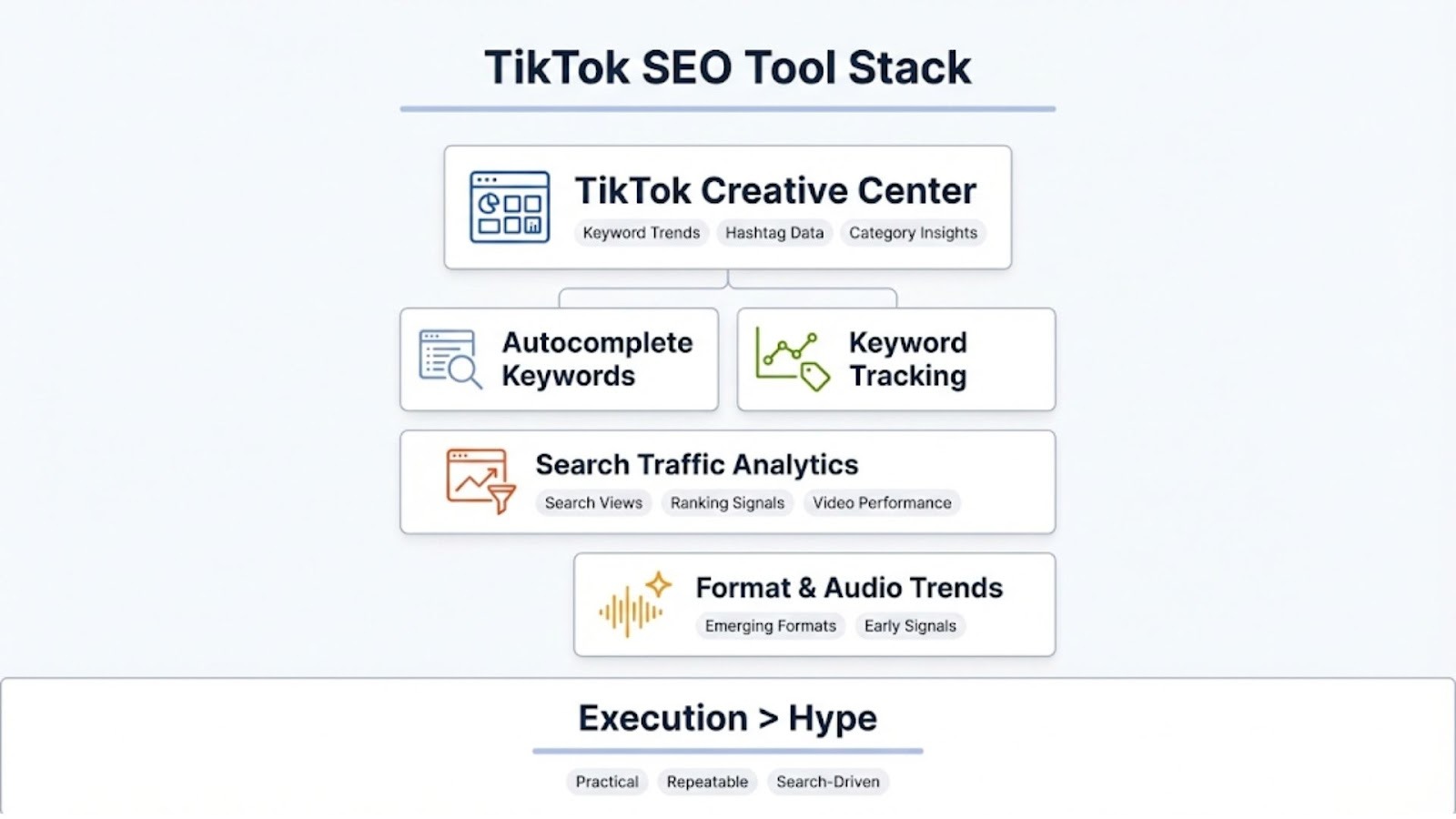
Tools I Actually Use to Execute TikTok SEO
Let’s separate useful from hype. These are the tools I consistently lean on:
- TikTok Creative Center: Real-time keyword trends, best-performing hashtags, industry-specific ideas.
- KeywordTool.io for TikTok: Great for surfacing autocomplete data at scale.
- Exolyt: Keyword tracking across your own and competitor content. Expensive but worth it for agency-level analysis.
- TikTok Analytics (native): Use this obsessively. Monitor which videos are getting “Search” traffic.
- TrendTok Analytics: For staying ahead of audio and format trends. Especially helpful in fashion, beauty, fitness, and entertainment verticals.
Case Studies: Proven TikTok SEO in the Real World
Most TikTok SEO conversations float around vague anecdotes or unverified “growth hacks.” What actually matters is performance-backed outcomes. Below are verified, data-supported case studies from real campaigns and brands that applied search-focused strategies to measurable effect.
1. Travel Brand SEO Case Study, Ranking #1 on TikTok Search
Agency: Rise at Seven
Client: UK-based travel brand
Campaign Focus: Organic TikTok discoverability via travel-related search terms
This campaign demonstrates that TikTok’s native search now rivals, and in some cases surpasses, Google for certain intent-driven queries.
Strategy and Execution:
- The agency created videos targeting real user search terms like “Things to do in Newquay.”
- They structured each video to speak the keyword, include it on-screen, and feature it in the caption.
- The videos were optimized not just for engagement, but specifically for ranking in TikTok Search.
Key Results:
- The video achieved the top organic position for the target keyword.
- Estimated search demand on TikTok (based on platform suggestion data) was 57,900 monthly searches, surpassing the Google equivalent for the same query.
- Videos that ranked for these terms delivered higher CTR than comparable Google rankings, in some cases up to 66% click-through rate from TikTok Search.
- All performance was achieved organically, with no paid boost.
What this proves: TikTok SEO is more than theoretical. With keyword-driven planning and structured metadata, brands can earn high-intent visibility, at scale, within TikTok’s internal search engine.
2. TikTok For Business, Official Brand Case Results
Source: TikTok For Business – Case Studies Portal
TikTok has published dozens of performance-based brand case studies that, while not all SEO-specific, reflect discoverability optimization in action.
Example, L’Oréal Paris (Makeup Tutorials)
- Created short, search-optimized makeup tutorials using real-world user queries (“how to get perfect eyeliner”).
- Used voiceover and on-screen text with keyword-rich phrases.
- Structured captions using TikTok’s expanded character limit (2,200 chars) to build context.
- Leveraged niche hashtags and the TikTok Creator Marketplace for reach.
Results:
- L’Oréal reported a double-digit engagement rate uplift over the campaign average.
- The content maintained visibility for weeks beyond the FYP spike, driven by consistent TikTok search traffic.
Why this matters: When brands design content to match what users are actively searching for, it drives real engagement and extends shelf life. TikTok’s search ranking system now allows for continuous traffic long after the trend cycle ends.
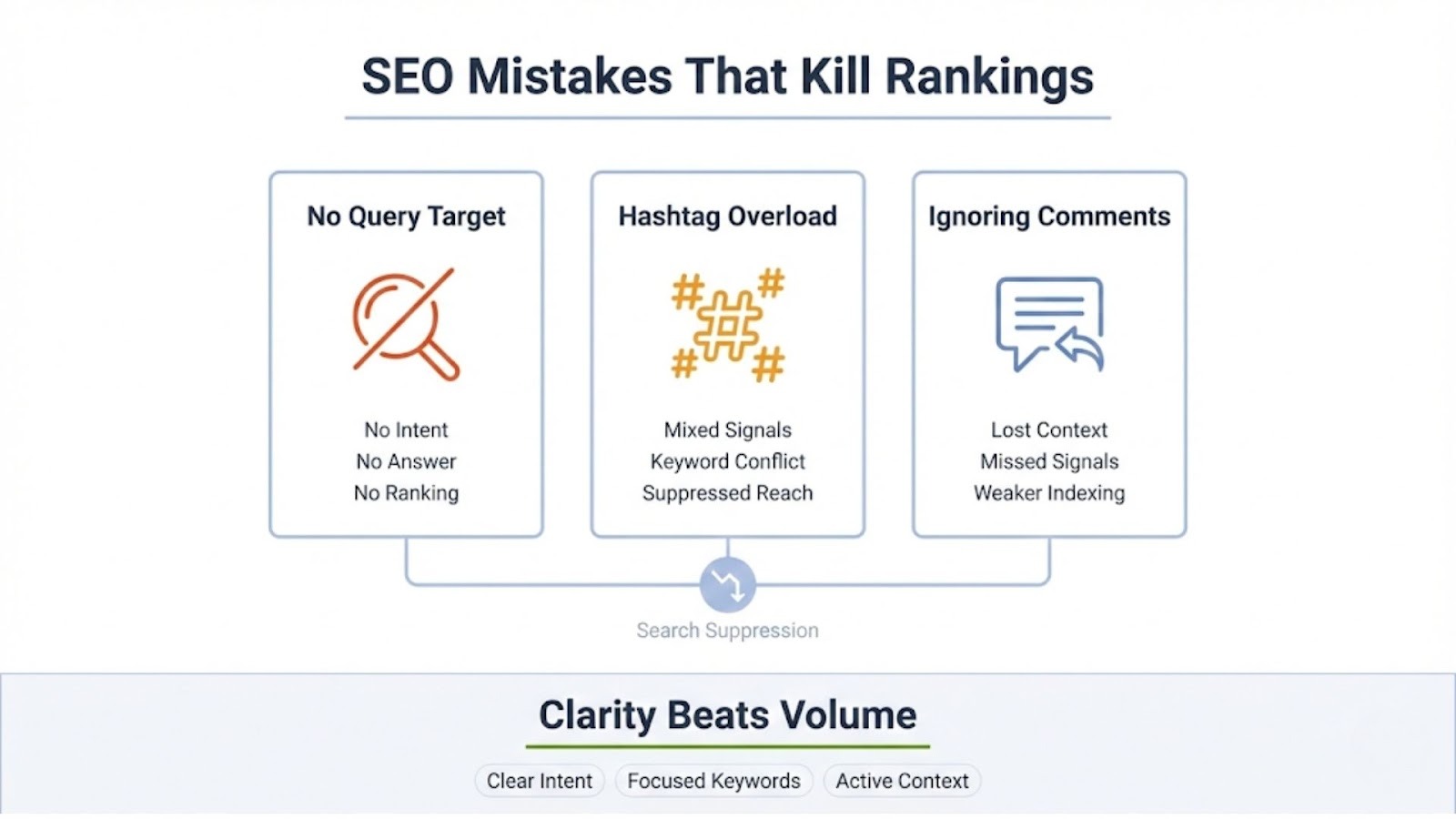
Mistakes That Kill Your SEO (Even If You Have Great Content)
Not every problem is fixed with effort. Some mistakes will bury even the most valuable content. These are the ones I see most often.
Mistake 1: Posting Without Targeting a Query
“Just post consistently, and you’ll grow” is the advice everyone gives. But if your video doesn’t answer something people are looking for, it’s unlikely to rank or compound.
Every evergreen video should answer:
- What problem am I solving?
- What question am I answering?
- What keyword am I targeting?
If your caption is “✨✨✨💥” and your on-screen text is “watch this,” you’re not going to rank for “meal prep for busy professionals.” That traffic is going to someone who made it obvious.
Mistake 2: Hashtag Overload and Keyword Cannibalization
Throwing 12 hashtags at a video doesn’t improve discoverability; it clouds it. I’ve seen videos try to rank for unrelated terms in one go:
#Makeup #BusinessTips #FYP #Dance #WorkFromHome
TikTok’s algorithm is fast, but not omniscient. If it doesn’t know which audience to show your video to, it’s going to suppress it instead of gambling.
Pick a lane. Build clusters of related keywords over time instead of trying to shotgun every post.
Mistake 3: Ignoring Comments as SEO Surface Area
Comments aren’t just a place to say thanks; they’re keyword context.
Responding to comments with natural language that reintroduces your keywords is a signal TikTok can use. This is especially powerful in early traction. If someone comments, “What app is that?” and you reply, “It’s Notion, I use it to organize my project dashboards,” you’ve just added more context to help rank for “Notion dashboard” or “project organization.”
Also, TikTok’s search often indexes comment text, not just the video and caption.
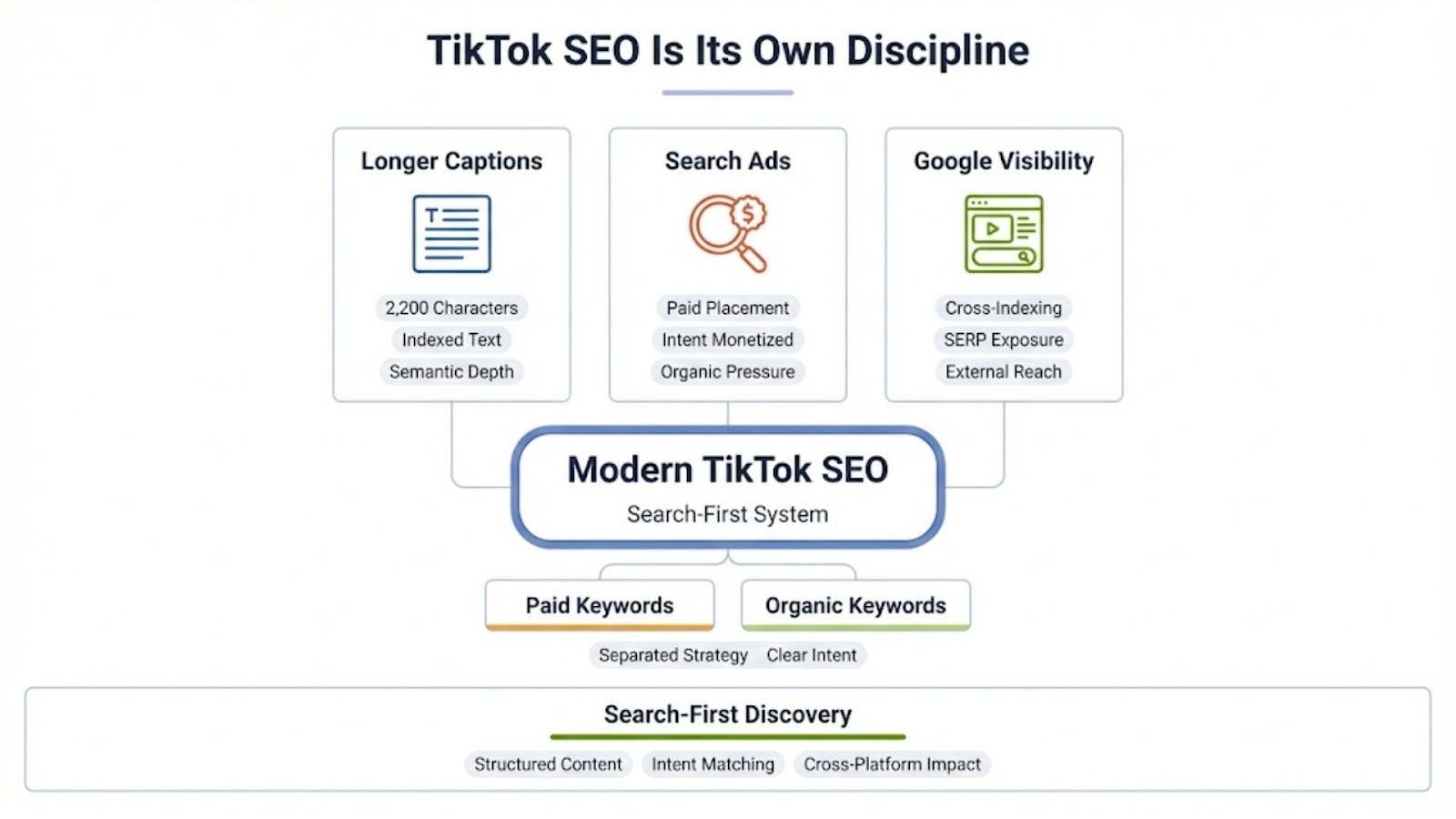
What Changed in 2024–2026: TikTok SEO Is Now Its Own Discipline
TikTok has gone through a few major updates in the last two years. If you’re still playing by 2022 rules, you’re likely invisible. Here’s what changed, and how it affects us.
Longer Captions: From 300 to 2,200 Characters
TikTok now allows full-length captions, and yes, they’re indexed. The first two lines still matter most (that’s what users see), but now we can build structured, keyword-rich descriptions.
I use this space to:
- Rephrase the main keyword 2–3 times
- Add synonyms and semantic variations
- Include a short CTA or link-related incentive
- Provide full value if the video is short (e.g., ingredient lists, step-by-steps)
Captions now function like YouTube descriptions, don’t waste them.
Search Ads Went Live
TikTok rolled out search ads, which appear at the top of certain queries with a “Sponsored” tag. This tells us two things:
- TikTok takes search intent seriously (enough to monetize it).
- Organic results are going to be pushed further down, especially on commercial keywords.
In my campaigns, I now separate content into:
- Paid keywords: competitive, high-CPC, we’ll run ads
- Organic keywords: long-tail or mid-tier, we’ll build optimized content to rank
Google Indexing of TikToks Increased
This wasn’t obvious at first, but as of 2025, Google started surfacing TikToks more prominently for mobile queries. If your TikTok is well-optimized and embedded or linked to elsewhere (e.g. on your site or blog), it can get picked up and shown in Google’s video carousel.
We’ve tracked multiple TikToks appearing on Google for terms like:
- “how to organize your notion dashboard”
- “fall candle recommendations”
- “best productivity setup 2025”
TikTok SEO now supports your broader digital presence, not just inside the app.
My Checklist for Search-Optimized TikTok Content
Here’s the process I follow or assign to clients when publishing SEO-driven content:
Before Posting
- Keyword chosen based on TikTok search suggestion or Keyword Insights
- Hook written to include the keyword or its variant
- Caption includes keyword within the first 100 characters
- Hashtags limited to 3–6, all contextually relevant
- On-screen text includes main keyword
- Spoken word (voiceover or dialog) includes keyword in the first 10 seconds
- Video file named descriptively (if uploading from desktop)
After Posting
- Early commenters receive replies within 12 hours
- Comments include natural use of keywords when appropriate
- Monitor TikTok Analytics for “Search Traffic” % after 24–48 hours
- Iterate next content piece based on top comment questions or engagement
This isn’t a “hack.” It’s a repeatable SEO strategy tuned for TikTok’s real behavior patterns.
TikTok SEO FAQ: Expert-Level Clarifications and Strategy
How long does it take for a TikTok video to rank in search?
Ranking can happen within hours or take days, depending on several factors:
- Keyword competition
- Content engagement (especially watch time and saves)
- How quickly the video gains interaction post-publish
- Whether TikTok already recognizes your profile as topically relevant
Generally, if the video is structured well and the keyword is long-tail or mid-tier competitive, you can expect to see search impressions within 24–72 hours. For more competitive terms, it may take repeated content or multiple videos on the same topic to build relevance over time.
Does deleting low-performing TikToks improve overall SEO performance?
No, deleting older or underperforming videos doesn’t directly improve SEO performance. TikTok doesn’t penalize past video performance unless the content violates guidelines. However, if you’re trying to train the algorithm to understand your niche more clearly, making your profile leaner and focused can help over time.
Rather than delete, consider private content or leaving it and simply publishing more keyword-relevant posts that cluster around the niche you want to rank in.
Is there such a thing as “keyword cannibalization” on TikTok?
Yes, and no.
If you post multiple videos targeting the exact same keyword in a short time span without differentiation, TikTok may show only one or two of them in search results. It tends to pick the highest-performing one, suppressing others from the same account.
But if you’re covering the same keyword from different angles or with different formats, TikTok often rewards that, especially if the videos don’t feel redundant. For example:
- “How to negotiate salary, entry-level jobs.”
- “How to negotiate salary, mid-career.”
- “Salary negotiation tips that actually work in 2026”
That’s semantic diversity, not cannibalization.
Can TikTok SEO impact visibility on Google or YouTube?
Yes, indirectly. Here’s how:
- TikToks that are embedded in blog posts or linked externally can appear in Google’s video carousel (especially on mobile).
- Some TikTok videos are now indexed by Google directly, especially those with strong metadata and external links.
- Repurposing TikTok content to YouTube Shorts, while not affecting TikTok SEO, helps create multi-platform discoverability using the same core keyword strategy.
The more optimized and well-linked your TikToks are, the more likely they’ll perform outside the app.
What’s the ideal video structure for SEO, in terms of visual layout?
Based on best practices and what the TikTok algorithm currently rewards, here’s a recommended structure:
First 0–3 seconds:
- Keyword in spoken voice + on-screen text
- Strong hook framed around a problem or outcome
3–15 seconds:
- Step-by-step value delivery or explanation
- Include supporting text or visuals (but not over-cluttered)
15–45 seconds (optional):
- Show transformation, final takeaway, or clear CTA
- Prompt engagement (“Which one would you try?” “Save this for later”)
Final screen (1–2 sec):
- Leave room for shares or saves, don’t cut off too fast
TikTok indexes voice, on-screen text, and caption, so aligning all three matters. Layout should support readability and pacing, especially for mobile viewers.
Should I use TikTok’s new 2,200-character caption limit?
Yes, but strategically. Longer captions give you space to:
- Reiterate keywords and include semantic variations
- Add value for viewers who want text-based summaries
- Train TikTok’s NLP model to classify your content accurately
However, the first 2 lines (about 100–120 characters) are still what viewers see without tapping. So:
- Front-load your most important message
- Avoid keyword stuffing, write naturally
- Treat the caption like a mini blog post, not a hashtag dump
Does TikTok differentiate between niche and broad search content?
It does. TikTok’s search engine rewards niche-specific authority, especially when content comes from a profile that consistently posts within a focused topic cluster.
For example, someone posting only about “Notion productivity hacks” will usually rank higher on related queries than a lifestyle creator who posts about 10 unrelated things.
You can use this to your advantage by:
- Building content clusters around a topic
- Using consistent naming formats
- Repeating but varying your keyword themes
TikTok begins to associate your profile with a subject area, improving your chances of ranking across related searches.
Is there a way to see what people are searching for in my niche?
Yes. Here are three tools:
- TikTok Search Bar: Start typing a query and watch autocomplete suggestions.
- TikTok Creative Center – Keyword Insights: Filter by region, category, and time to find trending search terms.
- Exolyt or TrendTok Analytics: Third-party platforms that track search demand, trending sounds, and keyword positioning over time.
You can also check which keywords are driving views to your content via TikTok Analytics > Video Details > Traffic Source. If “Search” is present, you’ll know your SEO is working.
Final Thoughts: TikTok SEO as Long-Game Leverage
TikTok SEO is not a viral lottery ticket. It’s an intent-driven discoverability engine that you can design for, just like you would with Google or YouTube.
But unlike traditional SEO, the platform rewards:
- Immediacy
- Format fluency
- Personality and creativity
If you’re in this space professionally, here’s what I’d recommend you do next:
- Start tagging and tracking every video by keyword focus.
- Revisit your top-performers and analyze where their traffic came from.
- Train your team or clients to see TikTok not as a trend factory, but as a searchable library.
The future of search is not just indexed web pages. It’s short-form media that answers questions visually, conversationally, and fast. And TikTok is already there.
About RiseOpp: Bringing Structure and Strategy to Modern SEO
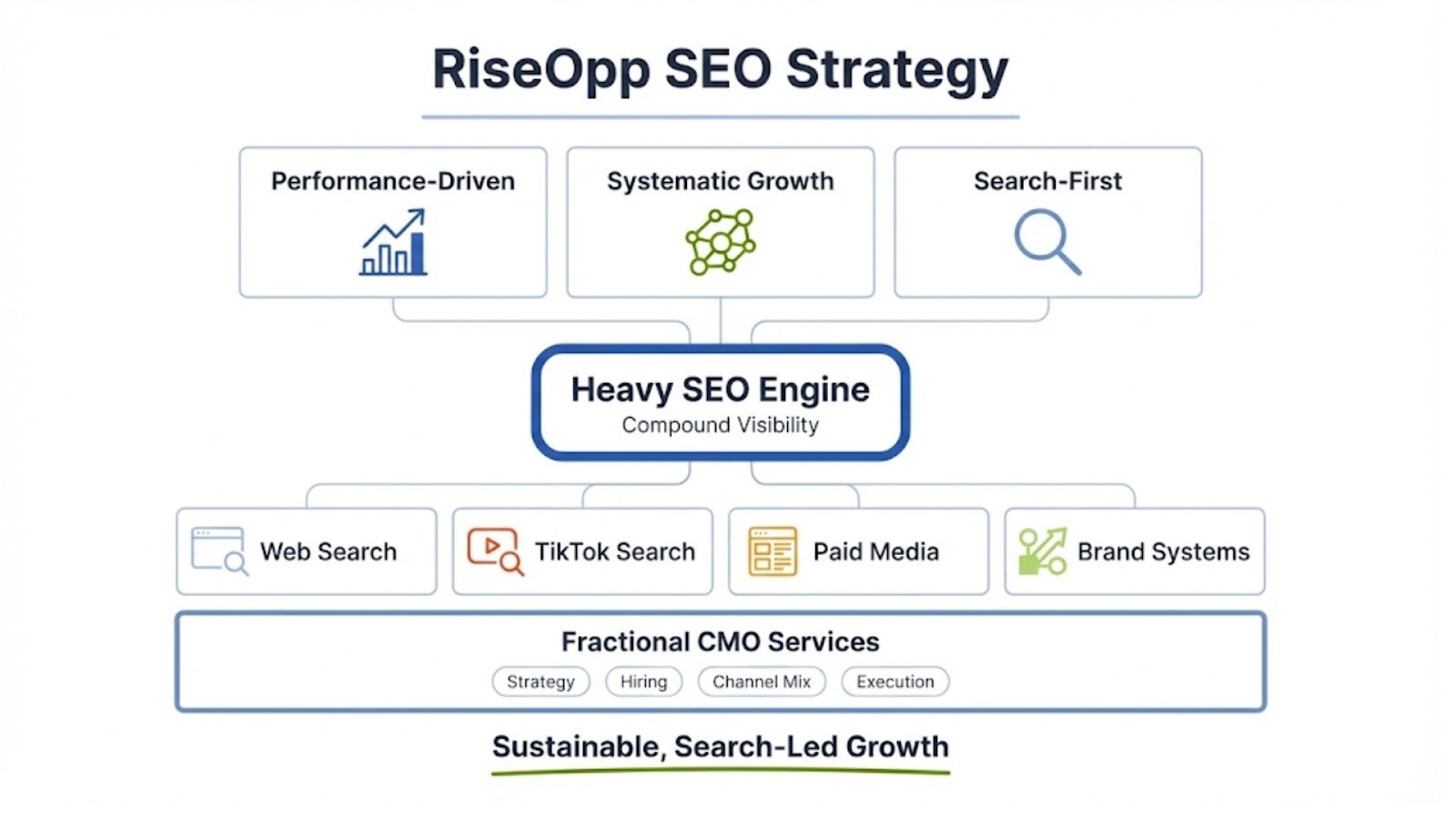
At RiseOpp, we’ve seen firsthand how rapidly the digital marketing landscape is evolving, and platforms like TikTok are redefining what it means to be discoverable online. As a company deeply rooted in performance-driven strategy and innovation, we don’t just observe these shifts, we build systems to capitalize on them.
Our Heavy SEO methodology is built to rank websites for tens of thousands of keywords over time, using a scalable, compound approach that mirrors what platforms like TikTok are beginning to reward through their own search engines. And while TikTok SEO operates differently than traditional web search, the underlying principles of intent-matching, content structure, and authority-building remain consistent, and we apply them across every platform and every campaign we touch.
For clients engaging with us through Fractional CMO Services, we don’t silo TikTok into a one-off channel. We treat it as part of a unified strategy that spans brand development, channel selection, hiring, and performance execution, including TikTok Ads, Meta Ads, LinkedIn Ads, Google Ads, and beyond. Whether you’re a B2B company seeking deeper search discoverability or a B2C brand building relevance with the next generation, our approach is built to support sustainable growth.
If you’re serious about leveraging SEO across both traditional and emerging platforms, let’s talk. TikTok SEO may be new territory, but at RiseOpp, we’re already building roadmaps for it.
Comments are closed