- Lifecycle marketing maximizes customer lifetime value (LTV) by fostering long-term engagement, retention, and loyalty at every stage of the journey.
- Frameworks like AARRR, RACE, and the 5-Stage Funnel help structure and optimize customer acquisition, activation, and retention efforts.
- Personalization and automation enhance lifecycle marketing, boosting customer engagement, conversion rates, and sustained brand loyalty over time.
Lifecycle marketing is far from a one-time, short-term campaign; it is a strategy built on ongoing, personalized engagement with customers at each step of their journey. It’s not just about attracting customers but ensuring they stay loyal, find consistent value, and eventually become advocates of your brand. In essence, it is the art of nurturing a customer from their first awareness of your brand to becoming a loyal advocate who refers others.
Lifecycle marketing aims to maximize lifetime value (LTV) and retention by delivering the right message, through the right channel, at the right time. It involves a deep understanding of customer behavior, aligning your teams and data, and crafting a personalized experience for each individual across every touchpoint.
According to the State of Lifecycle Marketing Report 2025 by Customer.io, 68% of brands believe they are likely or very likely to achieve their lifecycle marketing goals in 2025, indicating strong confidence in the effectiveness of lifecycle strategies among marketers.
While many businesses still focus heavily on acquisition, the true growth lies in engaging customers long after the sale. Lifecycle marketing is an ongoing process that involves continual refinement and alignment between marketing, product, sales, and customer success teams. This article will explore the frameworks, tactics, and tools used in lifecycle marketing, offering you a comprehensive guide for mastering this powerful approach.
Top Lifecycle Marketing Frameworks You Need to Know for Successful Campaigns
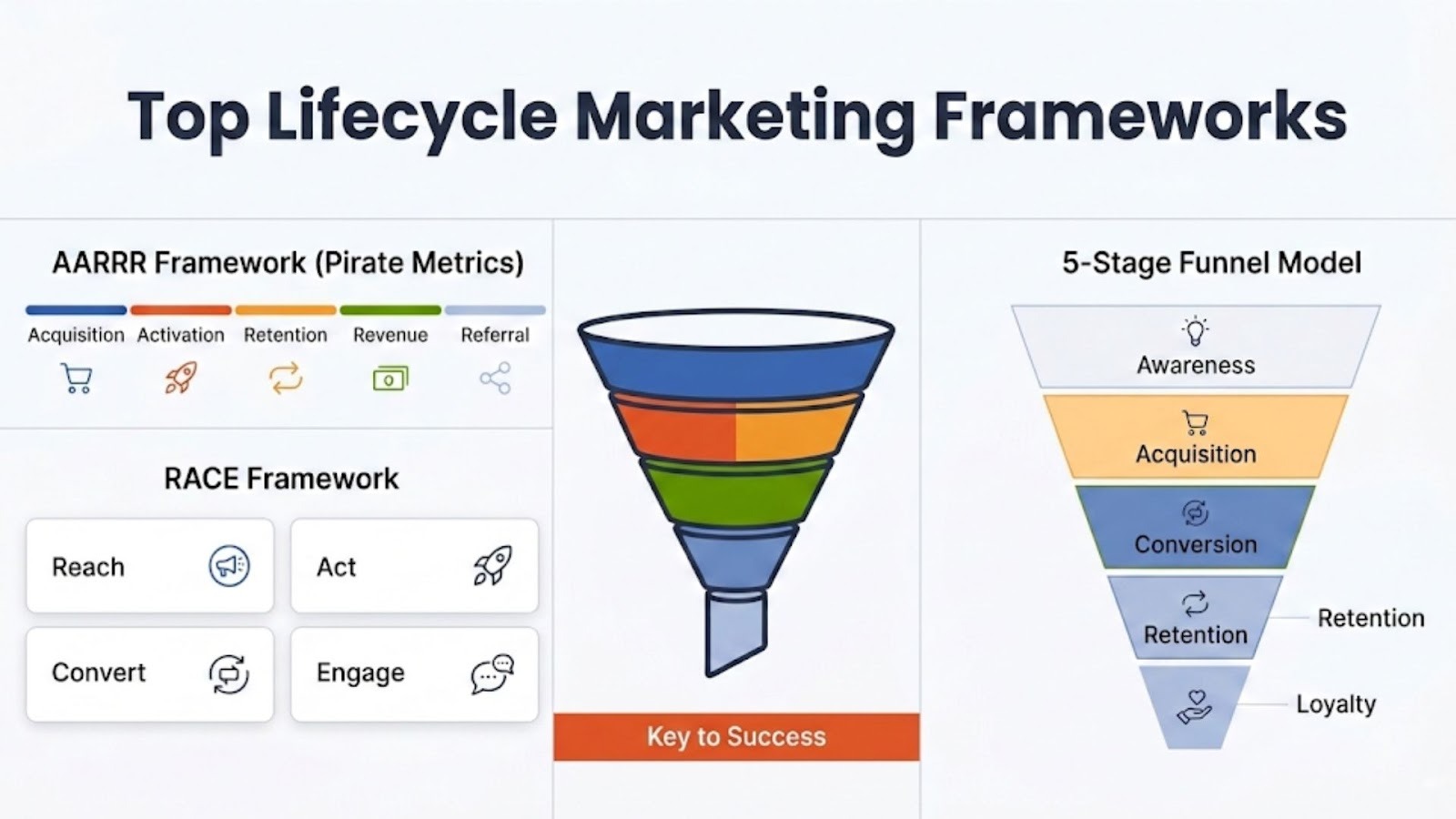
In the world of lifecycle marketing, frameworks provide the structure and foundation for your strategy. These models help visualize the customer’s journey, define goals at each stage, and ensure consistency across various teams. Let’s go through the most widely adopted frameworks in lifecycle marketing.
How the AARRR Framework (Pirate Metrics) Drives Lifecycle Marketing Success
One of the most widely recognized frameworks for lifecycle marketing is the AARRR model, also known as Pirate Metrics. It’s designed for businesses that focus on product growth and customer retention. The framework breaks down the customer journey into five key stages:
- Acquisition: Getting potential customers to discover your product or service.
- Activation: Turning those customers into engaged users, offering them their first “wow moment.”
- Retention: Ensuring that customers return to use the product or service again.
- Revenue: Converting retained users into paying customers.
- Referral: Encouraging satisfied customers to refer others to your product.
This model is especially useful for businesses that aim to optimize their product for customer growth. The simplicity and actionable insights provided by AARRR make it an excellent starting point for lifecycle marketers, particularly those interested in the principles outlined for B2B SEO.
RACE Framework
Another popular framework is RACE (Reach, Act, Convert, Engage), developed by Smart Insights. This model is especially focused on digital marketing and outlines a comprehensive strategy for engaging customers across online channels:
- Reach: Creating awareness and attracting traffic to your digital platforms (website, social media, etc.).
- Act: Encouraging visitors to take action, like signing up for an email list, downloading an ebook, or engaging with content.
- Convert: Turning those engaged visitors into paying customers or subscribers.
- Engage: Fostering long-term engagement with customers to ensure retention and encourage repeat purchases.
RACE is a flexible model that works well for digital marketers focusing on omnichannel engagement. Its focus on reach and engagement makes it ideal for companies investing in digital marketing strategies.
The 5-Stage Funnel Model
The 5-Stage Funnel is one of the most traditional models and aligns well with the sales process many businesses are familiar with. It breaks the customer journey down into five stages:
- Awareness/Reach: Customers first discover your brand.
- Acquisition/Consideration: Leads are generated as customers show interest.
- Conversion/Purchase: Prospects turn into paying customers.
- Retention/Engagement: Keeping customers engaged, reducing churn.
- Loyalty/Advocacy: Transforming customers into loyal advocates who refer others.
The 5-Stage Funnel emphasizes a smooth and uninterrupted journey for the customer, with the goal of getting them from initial awareness to repeat purchases and, eventually, loyalty. It’s an intuitive framework that fits well into many traditional sales processes.
Understanding the Stages of the Customer Journey
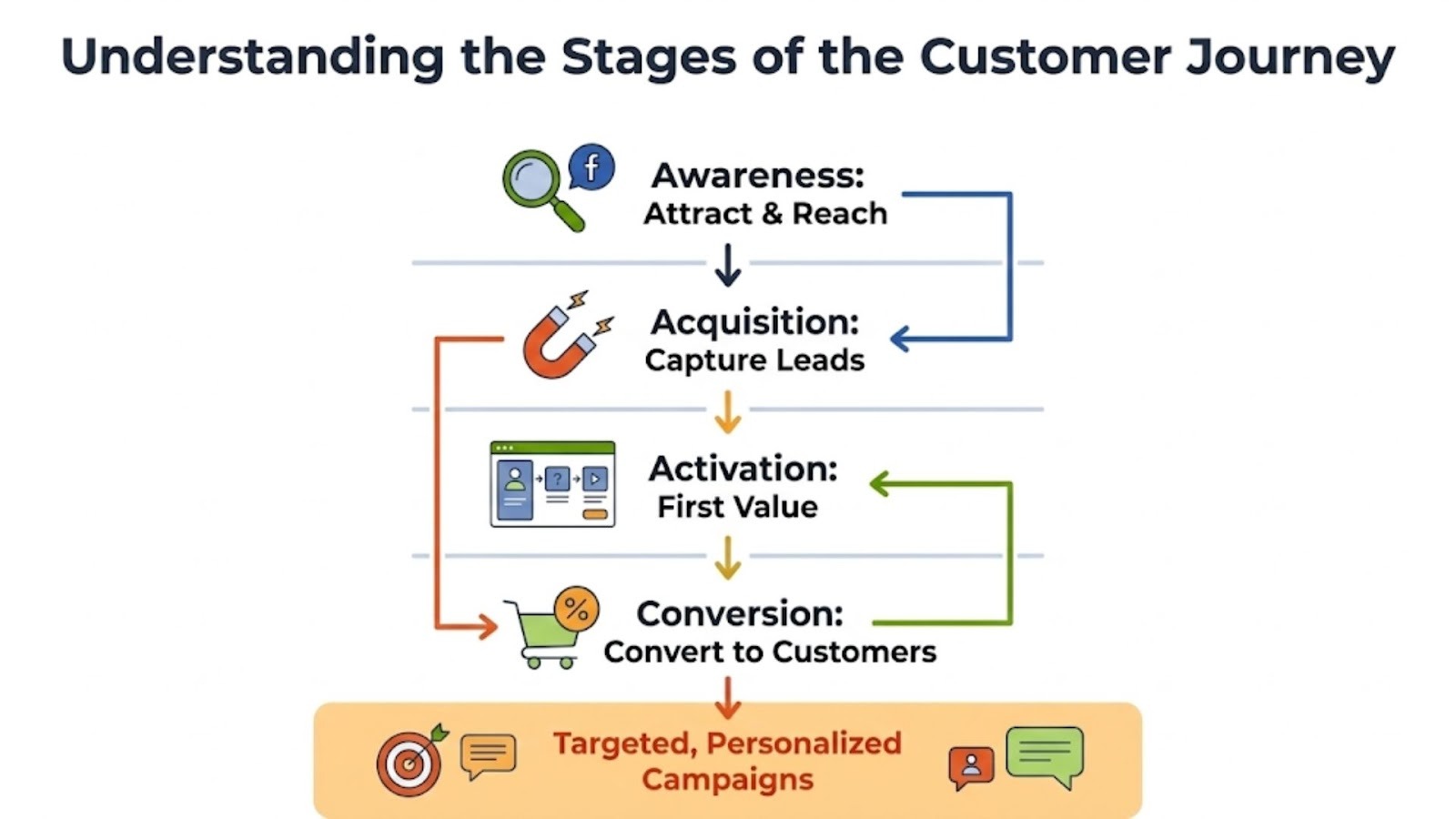
Now that we’ve discussed the key frameworks, let’s explore the practical implementation of lifecycle marketing. The customer journey is not linear, but each stage of the journey provides an opportunity for targeted marketing and personalized communication.
Awareness (Reach/Attract)
The journey begins with awareness , this is where potential customers first hear about your brand. They may come across your brand through organic search, social media, content marketing, or advertising. The primary objective in this stage is to cast a wide net and get your brand in front of as many eyes as possible.
Some of the key metrics to track at this stage include:
- Website traffic
- Brand mentions
- Social media impressions
It’s essential to focus on attracting potential leads here, using SEO, content marketing, and ads to create visibility. Once you’ve attracted them, you can start the process of engagement.
Acquisition (Consideration)
At this stage, customers are beginning to show interest in your product or service. They’ve moved beyond awareness and are actively considering your brand as a potential solution. The goal here is to capture their contact information, so you can continue engaging with them.
The tactics for acquisition include:
- Offering lead magnets like free eBooks, case studies, or whitepapers
- Gated content that requires an email sign-up
- Free trials or demos to show the value of your product
Acquisition metrics often include:
- Number of leads generated
- Sign-up rates
- Engagement with content
It’s crucial to segment these leads based on their behavior and interest level, ensuring you continue to nurture them appropriately.
Activation (First Value)
Activation is the stage where you take a new user and guide them to their first positive experience with your product or service. This is especially critical for SaaS businesses, where users often need to experience the core value of a product before they commit long-term.
During this phase, you need to ensure that the user gets to their first “wow moment.” This can be achieved by:
- Onboarding emails that provide product walkthroughs
- Tutorials and in-app guides
- Personalized messages or calls to help users get started
Metrics for activation include:
- Activation rate (the percentage of users who reach the desired milestone, e.g., completing onboarding)
- Time-to-first-value (the time it takes for a user to experience the core benefit of your product)
A smooth activation phase significantly impacts customer retention. If users don’t experience value quickly, they may churn before becoming fully engaged.
Conversion (Purchase)
In the conversion stage, the goal is to turn leads or trial users into paying customers. This phase is all about converting interested users into customers through targeted offers and personalized messaging.
Conversion tactics include:
- Cart abandonment emails
- Retargeting ads
- Personalized discount codes or time-limited offers
Key metrics here include:
- Conversion rate (the percentage of leads that make a purchase)
- Revenue per visitor
- Average order value (AOV)
The more personalized and timely your offers are, the higher your conversion rates will be. Don’t be afraid to use urgency tactics (e.g., limited-time promotions) to nudge users into taking action.
Retention, Loyalty, and Advanced Strategies
Retention (Engagement)
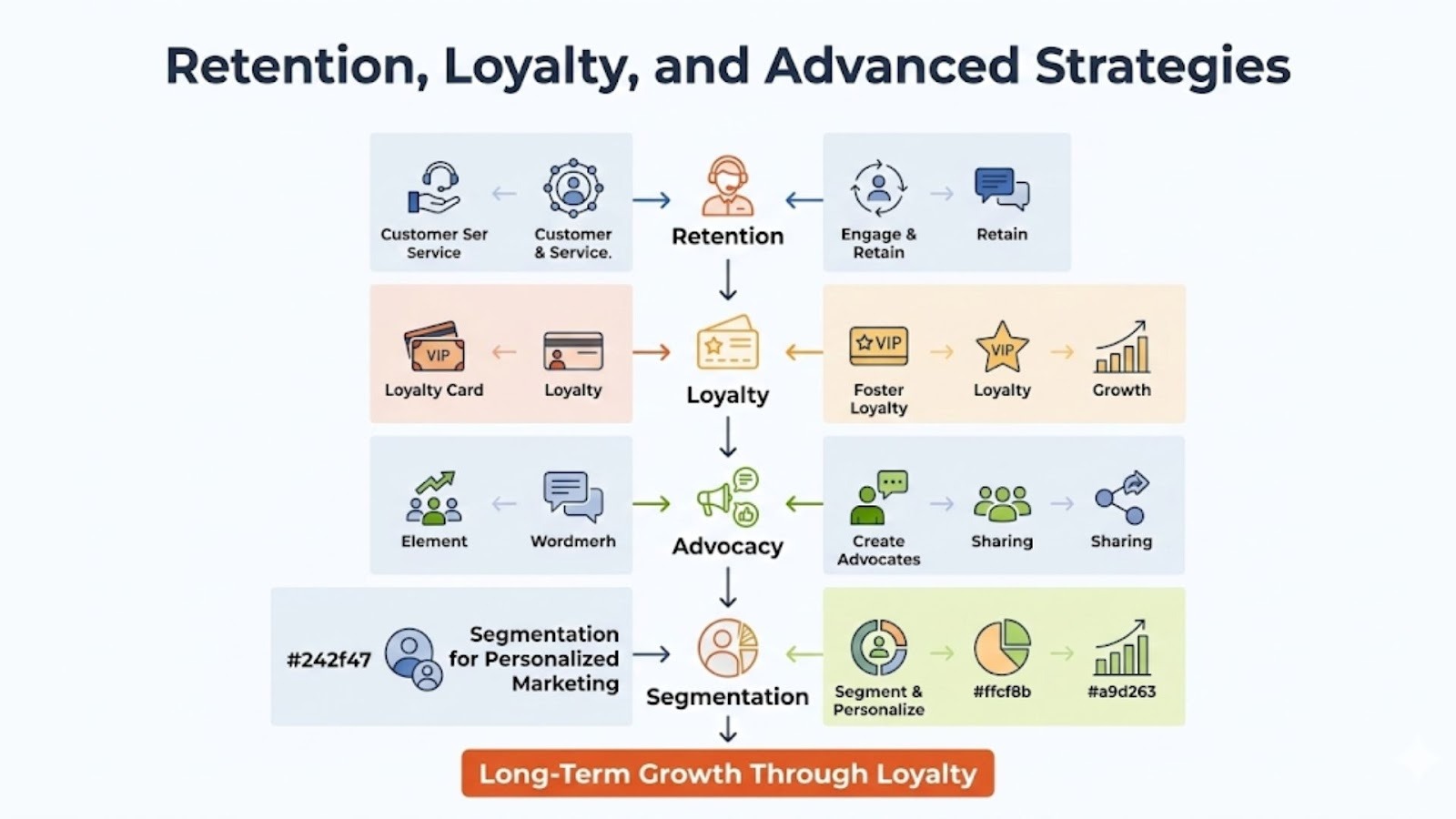
Once a customer makes a purchase, the focus shifts to retention. Retaining a customer is often much more cost-effective than acquiring a new one, which is why this phase is critical to a successful lifecycle marketing strategy. Retention is about keeping customers engaged, satisfied, and coming back for more, a strategy that works effectively when combined with tools like marketing automation. It’s where the real magic happens in terms of long-term revenue growth.
In this phase, the goal is to make customers feel valued and ensure they continue using your product or service. A successful retention strategy will decrease churn, increase repeat purchases, and create loyal customers.
Key tactics for retention include:
- Loyalty Programs: Rewarding customers for repeat purchases, referrals, or engagement with exclusive perks and discounts.
- Behavioral Email Triggers: Setting up automated emails that target specific behaviors, such as replenishment reminders or usage reminders for products that need to be restocked.
- In-App Messages or Push Notifications: Delivering relevant product updates or personalized content directly within your app or website.
Metrics to track in retention include:
- Repeat Purchase Rate: The percentage of customers who make another purchase after their initial transaction.
- Customer Engagement: Monitoring how often customers interact with your product or service, which can include logins, usage frequency, and time spent in your product.
- Churn Rate: The percentage of customers who stop using your product or service over a specific period.
As you build and refine your lifecycle marketing strategy, email marketing plays a crucial role. As reported by HubSpot (2026), 75% of marketers plan to maintain or increase investment in email marketing in 2026, while 78% say subscriber segmentation is the most effective strategy for email campaigns. This highlights the central role of email marketing and segmentation in lifecycle strategies.
Successful retention efforts often involve continuous nurturing of the relationship. Customers who engage frequently with your brand are more likely to stay and continue purchasing, so it’s essential to personalize the experience and keep customers interested.
Loyalty and Advocacy
After retention, the ultimate goal is to create a group of loyal customers who are advocates for your brand. These customers not only continue to purchase but also promote your brand to their friends, family, and followers. Loyalty and advocacy are the final stages of the lifecycle marketing process and can lead to exponential growth through referrals and word-of-mouth marketing.
To foster loyalty, consider implementing:
- Referral Programs: Offer incentives for customers to refer friends or colleagues to your brand, such as discounts, free products, or exclusive content.
- VIP Programs: Give your most loyal customers special privileges like early access to new products, members-only events, or personalized offers.
- User-Generated Content (UGC): Encourage satisfied customers to share their experiences on social media, leave reviews, or participate in branded campaigns.
Metrics to measure loyalty and advocacy include:
- Net Promoter Score (NPS): A measurement of how likely customers are to recommend your brand to others. A high NPS is indicative of strong customer loyalty.
- Referral Rate: The percentage of new customers who came through referrals, which is a clear sign of advocacy.
- Customer Lifetime Value (CLV): The total amount of revenue a customer is expected to bring to your business over the course of their relationship with your brand. Loyal customers tend to have higher CLV.
By cultivating a base of advocates, you can generate organic growth, as satisfied customers are your best marketers. It’s important to continue nurturing these relationships by providing value and rewarding loyalty.
Segmentation for Personalized Marketing
A key component of lifecycle marketing is the ability to segment your audience effectively. Customers are not a homogenous group, and a one-size-fits-all approach will not yield the best results. Proper segmentation enables you to deliver personalized experiences that resonate with each individual, increasing the likelihood of conversions and long-term loyalty.
Effective segmentation strategies include:
- Behavioral/RFM Segmentation: Segmenting customers based on their recent interactions (recency), the frequency of their interactions, and the monetary value of their purchases (recency, frequency, monetary value , RFM). This allows you to tailor offers and messaging based on customer behavior.
Example: Send a special offer to customers who have purchased frequently but haven’t made a purchase in a while. - Engagement Level: Group users by their activity level within your product or service. Highly engaged users may appreciate advanced tips or loyalty rewards, while dormant users might need a re-engagement campaign.
Example: Send targeted re-engagement emails with a special discount to dormant users or provide advanced features to highly engaged users. - Lifecycle Stage: Tag customers based on where they are in their journey (e.g., new customer, repeat customer, lapsed customer). Tailor your messaging to their needs at each stage.
Example: New customers might benefit from onboarding content, while repeat customers could be offered personalized deals based on their purchase history.
Segmentation helps you deliver the right message to the right person, at the right time, which is the backbone of lifecycle marketing and can be enhanced with AI tools for marketing
Tools, Automation, and Technology
To execute a successful lifecycle marketing strategy, you’ll need the right tools and technology to support your efforts. Automation and personalization platforms are the key enablers of lifecycle marketing, helping you scale your campaigns and deliver the right message to customers at the right moment.
Lifecycle marketing thrives when it incorporates automation and personalization. According to DesignRush (2025), lifecycle marketing campaigns that incorporate automation and personalization lead to impressive improvements: 83.4% improvement in email open rates, 341.1% increase in click-through rates, and a staggering 2,270% lift in conversion rates. These statistics demonstrate how automating lifecycle campaigns and personalizing content can significantly boost engagement and conversions
Some of the essential tools include:
- Customer Relationship Management (CRM): Platforms like Salesforce or HubSpot CRM centralize customer data, allowing you to track interactions and ensure that all customer-facing teams have access to the same information.
- Marketing Automation Platforms: Tools like Marketo, HubSpot, or Eloqua help you automate email workflows, nurture leads, and manage campaigns across multiple channels.
- Customer Data Platforms (CDPs): Segment or Tealium unify your first-party customer data across various touchpoints (website, app, CRM), creating single customer profiles for more accurate segmentation and personalization.
- Analytics and Product Analytics Tools: Tools like Mixpanel, Amplitude, or Google Analytics allow you to track customer behaviors, measure funnels, and understand which touchpoints are driving engagement and conversions.
- Email and SMS Marketing Tools: Platforms like Klaviyo, Braze, and Iterable specialize in automated email and SMS campaigns, helping you trigger messages based on specific actions or behaviors. which are pivotal in creating effective marketing automation workflows.
These tools allow you to centralize data, segment customers, automate workflows, and personalize messaging at scale. Integration is essential: customer data should flow seamlessly between platforms, enabling you to run coordinated campaigns across channels.
Privacy, Compliance, and Data Governance
In lifecycle marketing, adhering to privacy laws and regulations is not just a legal necessity; it’s also a key aspect of maintaining customer trust. Customers are more aware than ever of how their data is used, and businesses that fail to protect that data can face legal repercussions and damage to their brand reputation.
Key privacy regulations to consider include:
- GDPR (General Data Protection Regulation): In the EU and UK, GDPR mandates explicit consent for all marketing communications. Consent must be given freely and be separate from other terms (i.e., no pre-checked boxes). Businesses must also store consent records and provide customers with the option to easily opt-out of communications.
- CCPA (California Consumer Privacy Act): Similar to GDPR, the CCPA grants California residents the right to know what data is collected about them and the ability to opt out of data sales. Marketing teams must honor requests for data deletion and ensure customers can easily manage their communication preferences.
- Other Privacy Laws: Depending on your location or target market, you may need to comply with additional regulations like CASL (Canada), LGPD (Brazil), or other local data protection laws.
Best practices include:
- Obtain explicit consent before sending any marketing communications.
- Respect customer preferences for frequency and type of messaging.
- Ensure transparency about data collection and usage through clear privacy policies.
- Audit your data regularly to ensure compliance and prevent breaches.
By prioritizing data protection and complying with privacy regulations, you’ll foster trust with your customers and maintain a strong relationship with them, ensuring your campaigns are aligned with the best practices in SEO compliance.
FAQ: Lifecycle Marketing
1. What are the key benefits of lifecycle marketing?
Lifecycle marketing helps build long-term customer relationships by engaging customers at every stage of their journey. Key benefits include increased customer retention, higher customer lifetime value (LTV), stronger brand loyalty, and more personalized marketing communication. It also allows businesses to target specific audience segments with tailored strategies, which can ultimately improve overall marketing ROI.
2. How do I measure the success of lifecycle marketing?
The success of lifecycle marketing is typically measured through several key performance indicators (KPIs), including:
- Customer Lifetime Value (CLV): The total revenue a customer generates during their relationship with a brand.
- Churn Rate: The percentage of customers who stop purchasing or disengage.
- Repeat Purchase Rate: The percentage of customers who make multiple purchases over time.
- Retention Rate: The percentage of customers who continue engaging with the brand.
- Net Promoter Score (NPS): A measure of customer satisfaction and their likelihood to recommend the brand.
Tracking these metrics helps evaluate strategy effectiveness and identify opportunities for improvement.
3. How can lifecycle marketing be adapted for B2B businesses?
Lifecycle marketing in B2B environments must account for longer sales cycles, multiple decision-makers, and more complex buying processes. Strategies often focus on personalized content, customer education, and account-based marketing (ABM). Engaging decision-makers through targeted resources, such as webinars, case studies, and consultations, helps move prospects through the buying journey more effectively.
4. What tools are essential for implementing lifecycle marketing?
Several tools support effective lifecycle marketing execution, including:
- CRM systems (e.g., Salesforce, HubSpot): Track customer interactions and manage relationship data.
- Marketing automation platforms (e.g., Marketo, Pardot): Automate campaigns and multi-channel workflows.
- Email and SMS marketing tools (e.g., Klaviyo, Braze): Deliver personalized and automated messages.
- Customer Data Platforms (CDPs) (e.g., Segment, Tealium): Centralize customer data for improved segmentation.
- Analytics tools (e.g., Google Analytics, Mixpanel): Measure customer behavior and campaign performance.
These tools enable businesses to create seamless, data-driven customer journeys across multiple touchpoints.
5. What’s the difference between lifecycle marketing and traditional marketing?
Traditional marketing often focuses on short-term campaigns designed primarily to generate immediate sales. Lifecycle marketing, by contrast, is an ongoing strategy that nurtures relationships with customers throughout their journey, from awareness and acquisition to retention and loyalty. This continuous engagement creates stronger relationships and drives higher long-term customer value.
6. How often should a lifecycle marketing strategy be reviewed?
A lifecycle marketing strategy should ideally be reviewed on a quarterly basis. However, key performance indicators should be monitored continuously to identify trends, measure performance, and make necessary adjustments. Regular optimization ensures the strategy remains aligned with customer behavior and evolving market conditions.
7. Can lifecycle marketing help businesses during economic downturns?
Yes. Lifecycle marketing can be particularly valuable during economic downturns because it focuses on customer retention and increasing the lifetime value of existing customers. Retaining current customers is typically more cost-effective than acquiring new ones, making lifecycle marketing a practical strategy for maintaining revenue and strengthening customer relationships during challenging periods.
8. Is lifecycle marketing suitable for all industries?
Lifecycle marketing can be applied across nearly all industries, though the execution will vary depending on the business model and customer journey. For example, B2B companies often emphasize lead nurturing and educational content due to longer sales cycles. In contrast, retail or FMCG brands may focus more on rapid engagement and repeat purchases. While the approach may differ, the core principles of lifecycle marketing remain widely applicable.
Final Thoughts: Continuous Optimization for Success
Lifecycle marketing is a powerful strategy for turning one-time buyers into long-term, loyal customers. It’s about understanding each stage of the customer journey, delivering personalized and timely experiences, and optimizing every touchpoint for maximum impact. By focusing on retention, loyalty, and advocacy, you can transform your customers into brand ambassadors who help fuel sustainable growth.
To execute a successful lifecycle marketing strategy, you must use the right frameworks, tools, and segmentation strategies, all while adhering to privacy regulations. And remember, lifecycle marketing is not a one-time effort; it’s an ongoing process of testing, learning, and optimizing.
As you build and refine your lifecycle marketing program, keep the customer at the center of everything you do. A customer-centric approach will not only increase your LTV and retention rates but will also ensure that you’re creating a truly seamless and meaningful experience for every individual who interacts with your brand.
Maximize Your Lifecycle Marketing with RiseOpp
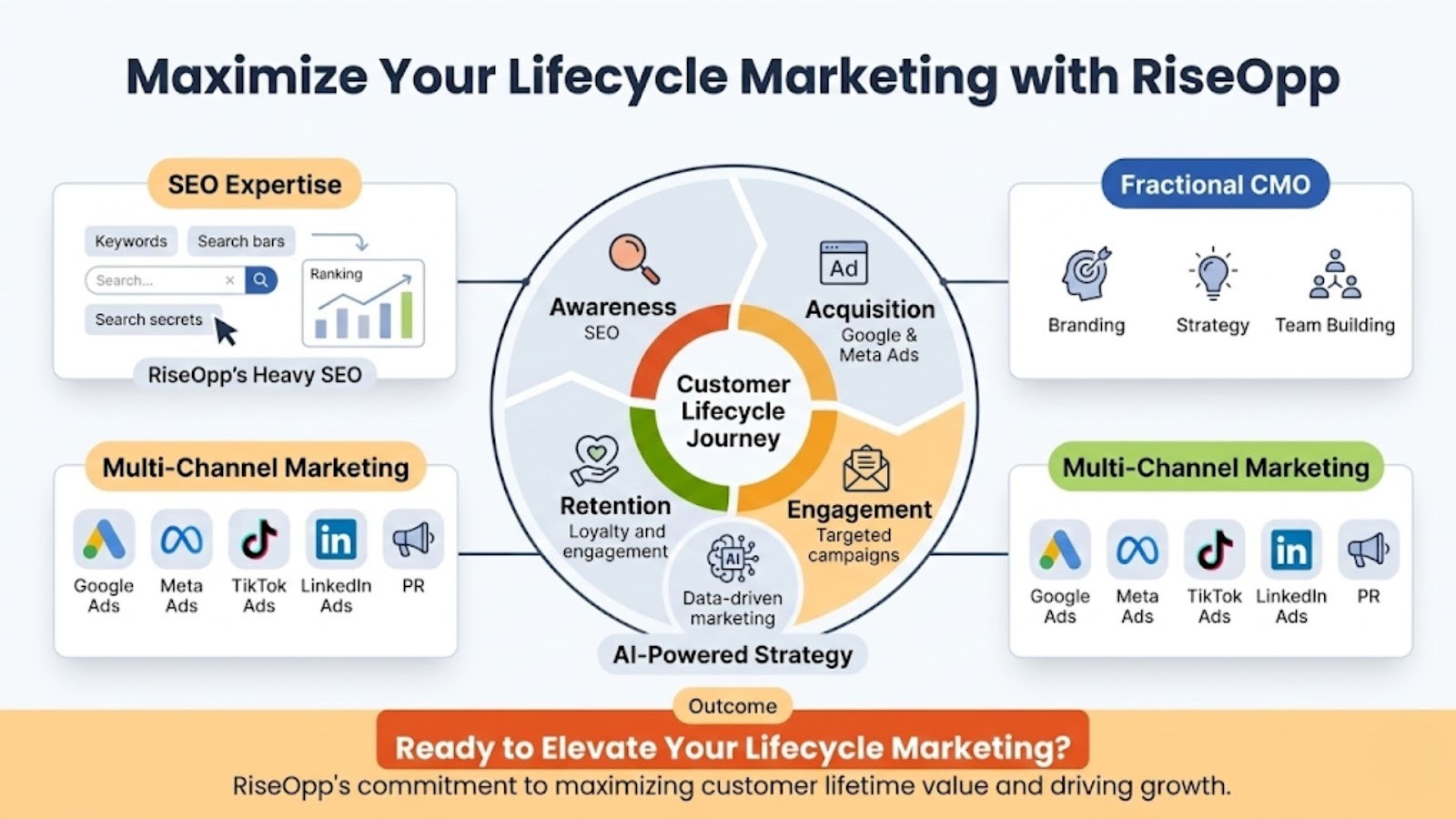
At RiseOpp, we believe lifecycle marketing is key to driving long-term growth and increasing customer lifetime value. As a top Fractional CMO and SEO services provider, we specialize in helping businesses implement AI-powered marketing strategies backed by years of expertise.
Our Heavy SEO methodology has helped clients rank for thousands of keywords, ensuring visibility at every customer journey stage. Whether driving awareness with SEO, acquiring high-quality leads through Google Ads or Meta Ads, or engaging customers with targeted email campaigns, RiseOpp has the tools to guide your business.
In addition to SEO, our Fractional CMO services cover branding, marketing strategy, and team building. We take a holistic approach, combining digital and traditional marketing channels like PR, TikTok Ads, LinkedIn Ads, and affiliate marketing to support every stage of the customer journey.
By partnering with a team that turns insights into action, you can optimize your customer lifecycle. RiseOpp is committed to crafting personalized, data-driven experiences that lead to lasting relationships and improved ROI.
Ready to elevate your lifecycle marketing strategy? Contact us today to learn how we can help maximize your customer lifetime value and achieve sustainable growth.
Comments are closed