- Local SEO services optimize Google Business Profile, service pages, reviews, links, and technical foundations to drive map and organic visibility.
- Local SEO services improve rankings by strengthening relevance, proximity, and coverage strategy, and by enhancing prominence through review velocity, authority, and entity signals.
- Local SEO services align strategy to business type: foundational, growth, multi-location, or recovery, with staged execution and revenue-based measurement.
Local SEO services for small businesses are no longer optional. If your company depends on local customers, whether you run a service-area business, storefront, professional practice, or multi-location brand, your visibility in Google’s local search results directly determines your revenue.
According to Google’s Think with Google research on consumer “I-want-to-go” micro-moments, 76% of people who search for something nearby on their smartphones visit a related business within 24 hours.
This guide breaks down exactly how professional local SEO services for small businesses work, what they include, how pricing is structured, how long results take, and what separates high-performing local SEO campaigns from low-cost packages that plateau.
If you’re evaluating a local SEO agency, hiring a local SEO consultant, or building a long-term local search marketing strategy for your company, this is the framework. It also complements a practical breakdown of how small businesses should evaluate SEO providers in the U.S. market.
WHAT YOU’LL LEARN:
- What local SEO services actually include (and what they shouldn’t)
- How Google’s local ranking systems work
- How to structure service pages and location pages properly
- How reviews, links, and authority impact map pack rankings
- What local SEO pricing really reflects
- How to evaluate or hire a local SEO company the right way
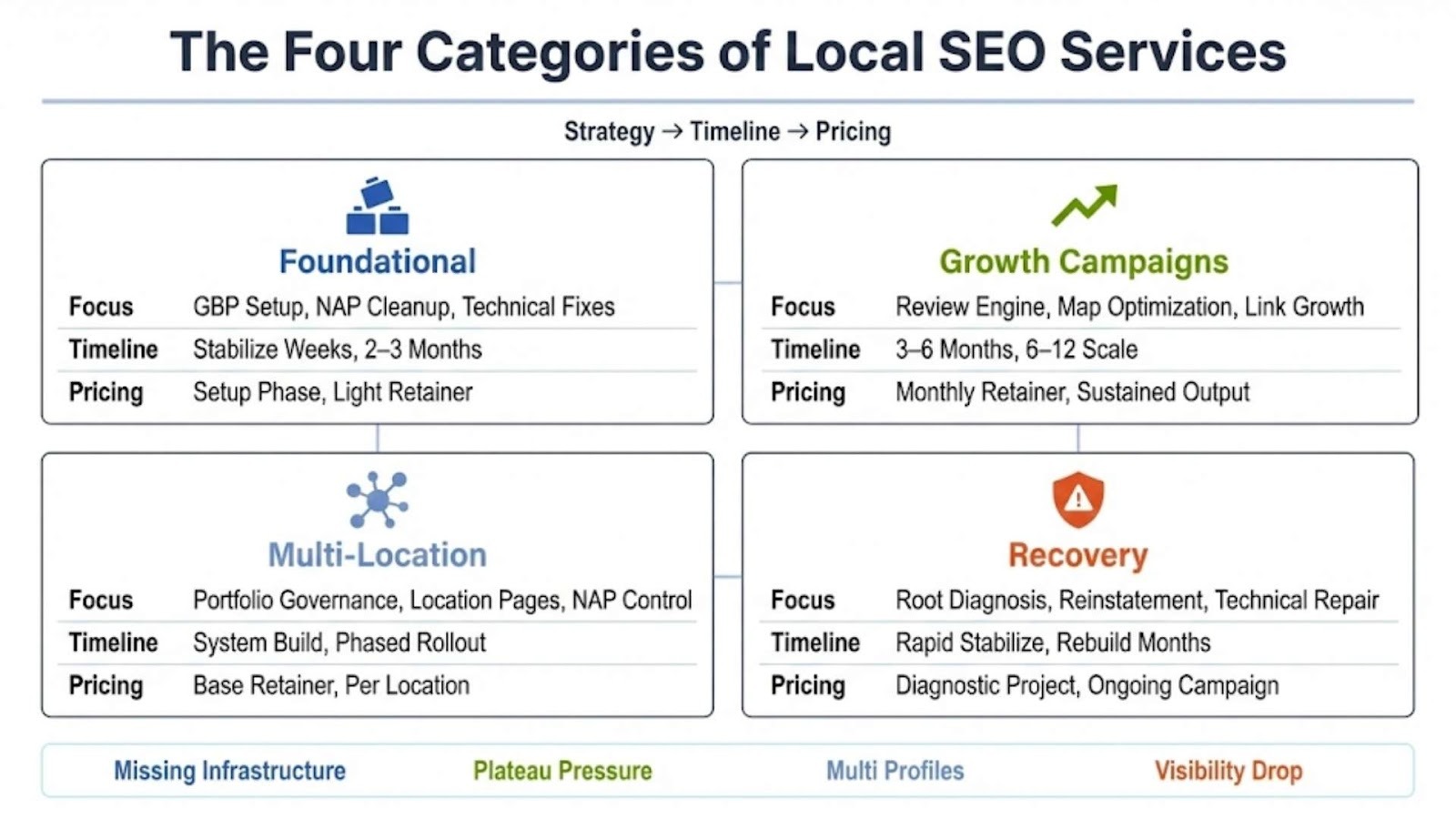
The Four Categories of Local SEO Services and How They Determine Strategy, Timeline, and Pricing
When someone asks me for “local SEO,” I first classify the business into one of four categories. That decision dictates execution order, cadence, expected timeline, and budget. If you misclassify, you buy the wrong work and judge results on the wrong clock. This is why conducting a structured local SEO audit before committing to a strategy is critical.
Foundational Local SEO
This fits new or under-optimized businesses that need the basics done correctly before growth work can compound.
Typical needs
- Google Business Profile setup or overhaul (categories, services, governance)
- Citation and NAP cleanup (duplicates, incorrect listings, consistency)
- On-page fixes (core service pages, titles, internal linking, conversion paths)
- Technical fixes (indexing, canonicals, speed, sitemap)
Timeline logic
Weeks for stabilization and correction effects, then 2 to 3 months for meaningful traction in easier segments.
Pricing behavior
Often best as a one-time setup plus a short retainer, or a heavier first 30 to 60 days followed by lighter ongoing support.
Growth-Focused Local SEO Campaigns
This fits businesses with a functional baseline that want more share of voice, more leads, and broader territory coverage.
Typical needs
- Review generation system and response SOPs
- Ongoing map pack optimization (GBP content cadence, photos, posts, Q&A)
- Service page expansion and upgrades
- Link acquisition and local mentions
- Conversion optimization and lead-quality feedback loop
Timeline logic
3 to 6 months for consistent lift in core services, 6 to 12 months for compounding dominance in competitive markets.
Pricing behavior
Usually a monthly retainer because outcomes depend on sustained outputs (reviews, links, content, monitoring).
Multi-Location Local SEO
This fits franchises and regional brands. The core challenge is governance and scalability, not “more SEO.”
Typical needs
- GBP portfolio governance (standards, workflows, verification readiness)
- Scalable location page strategy (unique blocks, hubs, anti-cannibalization rules)
- Network-wide NAP and citation control
- Location-level reporting and attribution
Timeline logic
Slower start (system build), then faster rollout once standards and templates are in place.
Pricing behavior
Commonly a base retainer plus per-location components, depending on location count and market difficulty.
Recovery and Cleanup
This fits businesses dealing with visibility loss, suspensions, spam competition, or indexing problems. I run it like an incident response.
Typical needs
- Root-cause diagnosis (GBP changes, indexing, site migrations, citations, competitors)
- GBP reinstatement or verification workflows where relevant
- Technical remediation (noindex, canonicals, redirects, duplication)
- Spam defense for high-impact offenders
- Rebuild plan (reviews, links, content) after stabilization
Timeline logic
Days to weeks to stabilize, then months to rebuild prominence if competitors filled the gap.
Pricing behavior
Typically a diagnostic/remediation project followed by an ongoing campaign once stability returns.
How to Classify Yourself Quickly
Identify your primary constraint:
- Missing infrastructure and consistency → Foundational
- Plateau and competitive pressure → Growth
- Multiple profiles and locations to manage → Multi-location
- Drops, suspensions, or indexing failure → Recovery
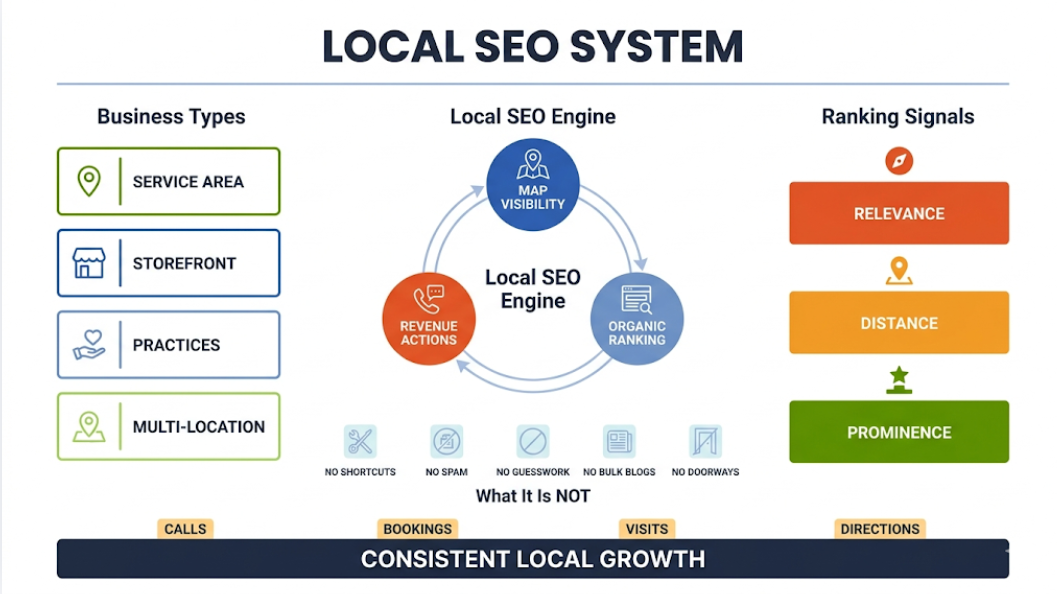
What I Mean by Local SEO Services for Small Businesses
When I talk about local SEO services, I’m not talking about “SEO, but with a city name sprinkled in.” I’m talking about a system that reliably produces three outcomes:
- Map visibility (Google Business Profile and Google Maps discovery)
- Local organic visibility (service pages and location pages that rank)
- Revenue outcomes (calls, booked appointments, form fills, store visits, direction requests)
Professional local SEO services for small businesses exist to create those outcomes in a repeatable, scalable way, whether you operate one location, multiple offices, or a service-area model that covers an entire metro. The work looks different depending on the business model:
- Service-area businesses (SABs) like HVAC, plumbing, roofers, cleaning services, mobile locksmiths.
- Brick-and-mortar storefronts like dental clinics, restaurants, salons, retail.
- Practices like law firms, medical offices, therapy clinics.
- Multi-location brands like franchises, chains, and regional providers.
The shared truth is simple: Google’s local systems reward businesses that prove three things at scale:
- Relevance: you match the query intent (service + location + constraints).
- Distance: you sit close enough to the searcher or the centroid they associate with the query.
- Prominence: you look like a real, trusted, popular entity offline and online.
Local SEO services align your business with those signals and remove the friction that blocks ranking.
What Local SEO Is Not
I want to be blunt, because professionals waste months here.
- It is not “set up a profile and wait.”
- It is not “buy citations and pray.”
- It is not “write 30 generic blog posts.”
- It is not “spam your service area in the business name.”
- It is not “rank for every city within 100 miles with doorway pages.”
Those tactics either plateau fast or create long-term risk. Effective local SEO looks like operational excellence translated into search signals, with technical precision and content discipline.
What Counts as “Local” in 2026 Search Behavior
“Local” means any query where the user expects:
- a provider near them,
- a provider who serves a defined area,
- a provider in a specific neighborhood or city,
- or a provider who can arrive quickly.
That includes explicit modifiers (“Austin TX,” “near me,” “downtown”) and implicit local intent (“dentist,” “locksmith,” “urgent care”). 8 in 10 (80 %) U.S. consumers search online for local businesses at least once per week, as reported by the SOCi Consumer Behavior Index and cited by several SEO industry sources. Local SEO services have to win both.
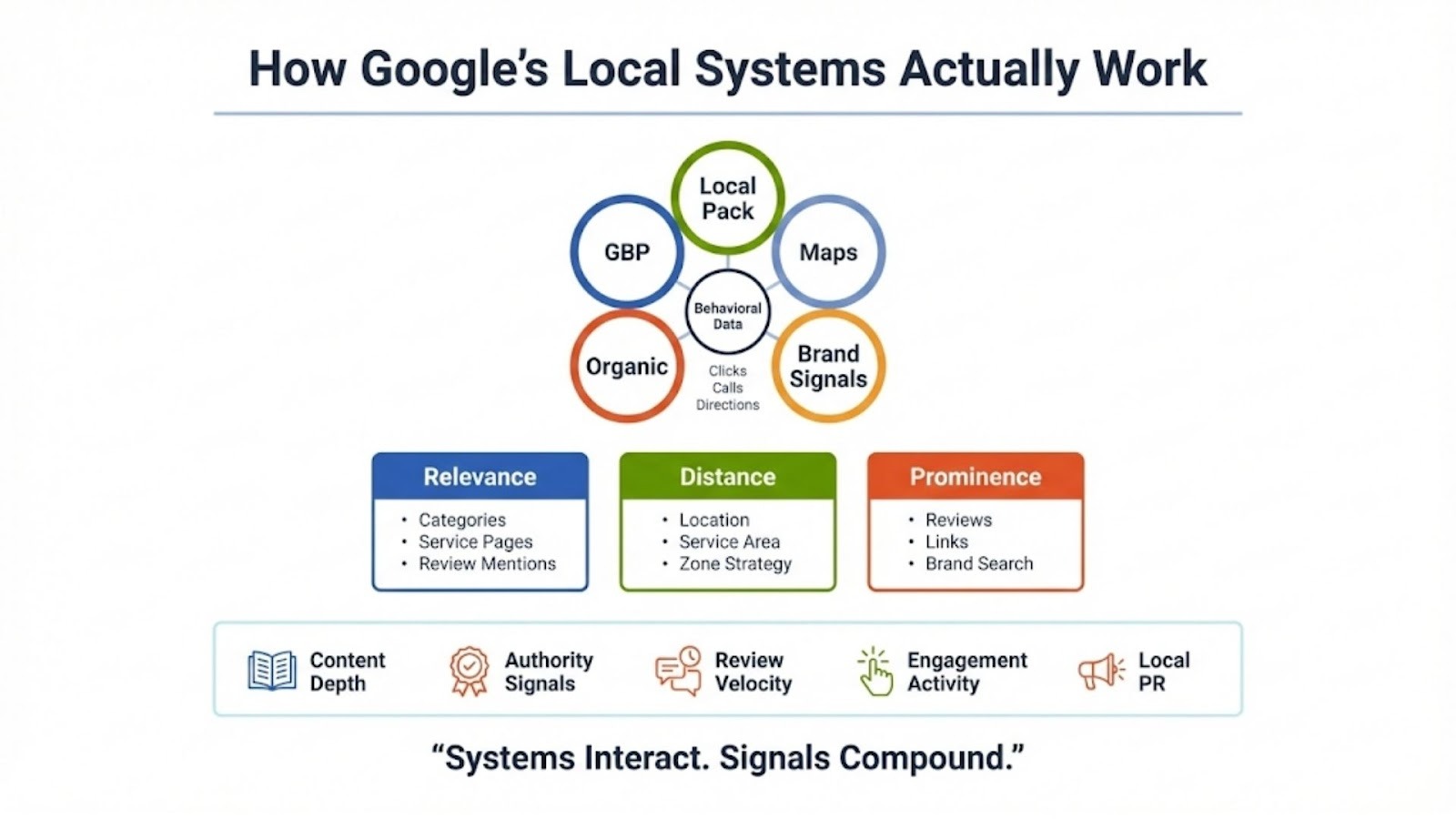
How Google’s Local Systems Actually Work (What I Optimize For)
If you want a professional-level view, stop thinking in terms of one algorithm. Local performance is the intersection of:
- Google Business Profile (GBP)
- Local pack rankings
- Maps rankings
- Local organic rankings
- Brand/entity signals
- Behavioral data (clicks, calls, engagement, driving directions)
I structure local SEO services around how these layers influence each other.
Relevance: Matching Intent With Real Business Evidence
You don’t “tell” Google you offer a service. You prove it through:
- primary and secondary categories,
- services and products in GBP (where appropriate),
- on-site service pages with clear scope,
- supporting content that answers local questions,
- photos and posts that show real operations,
- reviews that naturally mention specific services and outcomes.
If your service pages look generic, or your reviews never mention your core services, you’ll struggle to hold local pack positions in competitive markets.
Distance: The Constraint You Can’t Hack, Only Strategize Around
Distance is a hard constraint. You can’t change where the searcher stands. You can choose:
- where you locate your business (for storefronts),
- how you define your service area (for SABs),
- how you build location strategy (for multi-location brands),
- how you build relevance in pockets you can realistically win.
Professionals plan “coverage” like a media buyer: choose the neighborhoods that matter, map the competitive intensity, then build pages and authority to win those zones.
Prominence: The Compounding Advantage
Prominence is where local SEO becomes unfair, in a good way. Once you build real prominence, it compounds.
Prominence comes from:
- review volume and quality,
- link authority,
- brand searches and brand mentions,
- local PR and community involvement,
- consistent NAP presence,
- operational signals (photos, posts, engagement, responses),
- strong on-site experience and conversions.
When I run local SEO services properly, prominence becomes the moat that protects rankings from every new competitor “doing SEO.”
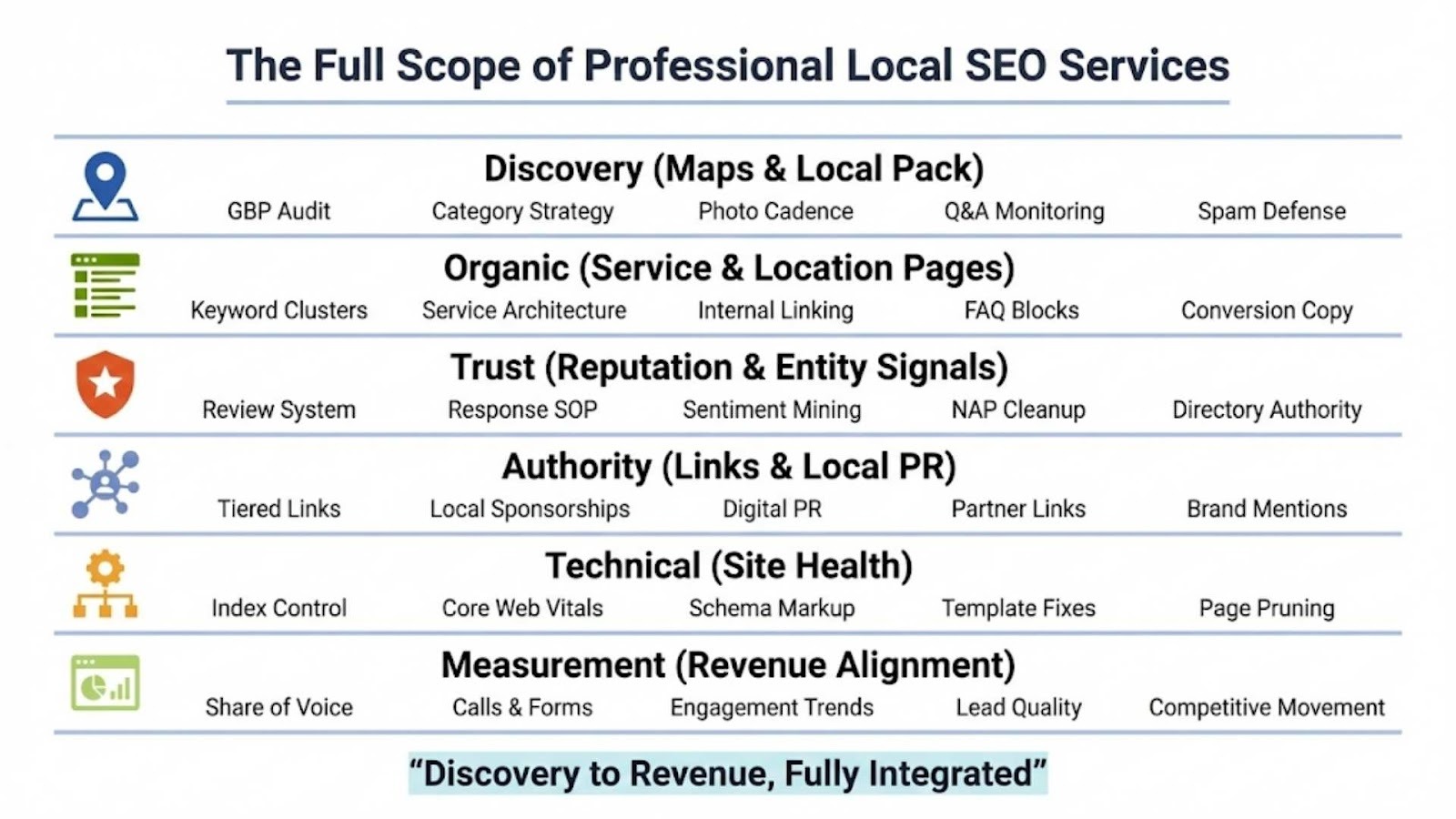
The Full Scope of Local SEO Services (What a Professional Package Includes)
If I sell local SEO services to a serious small business, I include a stack of services that cover the entire funnel: discovery, trust, conversion, and retention.
Discovery Layer (Maps and Local Pack)
This layer focuses on what directly influences GBP and local pack visibility:
- GBP audit and remediation
- category strategy
- service and product configuration
- attributes, hours, description, appointment URLs, messaging
- photo strategy and ongoing photo cadence
- GBP posts strategy (what to post, how often, and why)
- Q&A strategy (seeding and monitoring)
- spam defense and competitor monitoring
Organic Layer (Local Service Pages and Supporting Content)
I build and optimize the pages that rank outside the map pack, and that support pack rankings indirectly:
- local keyword research by intent cluster
- service page architecture
- city and neighborhood page architecture (when justified)
- internal linking systems
- content briefs that reflect real service delivery
- FAQ blocks that capture long-tail and reduce bounce
- conversion-focused copy and UI alignment
Trust Layer (Reputation, Reviews, and Entity Consistency)
Trust is not a soft metric. It’s measurable and rank-correlated:
- review acquisition system design
- review response SOPs and templates
- sentiment and keyword mining from reviews
- NAP consistency and citation cleanup
- authoritative directory placements (not just volume)
- suppression of duplicates and wrong listings
Authority Layer (Links, Mentions, and Local PR)
This is where most low-cost local SEO packages for small businesses fall apart. Real authority building requires editorial standards, real outreach, and local relationships not automated link blasts or bulk directory submissions.
- local link building plan by tier (foundational, local, industry, editorial)
- sponsorships and community listings (done strategically)
- digital PR hooks tied to local relevance
- partner and supplier link opportunities
- unlinked brand mention reclamation
- content assets that deserve links (data, guides, tools)
Technical Layer (Site Health That Impacts Local Performance)
Local SEO fails when technical issues sabotage crawlability and speed:
- crawl and indexation control
- Core Web Vitals improvements that matter for conversions
- template fixes (title tags, H1s, schema patterns)
- structured data: LocalBusiness, Service, FAQ, Review (when compliant)
- location page scalability for multi-location
- log-based or Search Console-based indexing diagnostics
- spammy or thin page pruning when needed
Measurement Layer (Reporting That Connects to Revenue)
Professional clients do not want “rankings only.” I report:
- local pack share of voice (tracked by geo grid where possible)
- calls, forms, direction requests, and booking events
- GBP engagement trends
- organic landing page performance by service line
- lead quality feedback loops
- competitive movement and why it happened
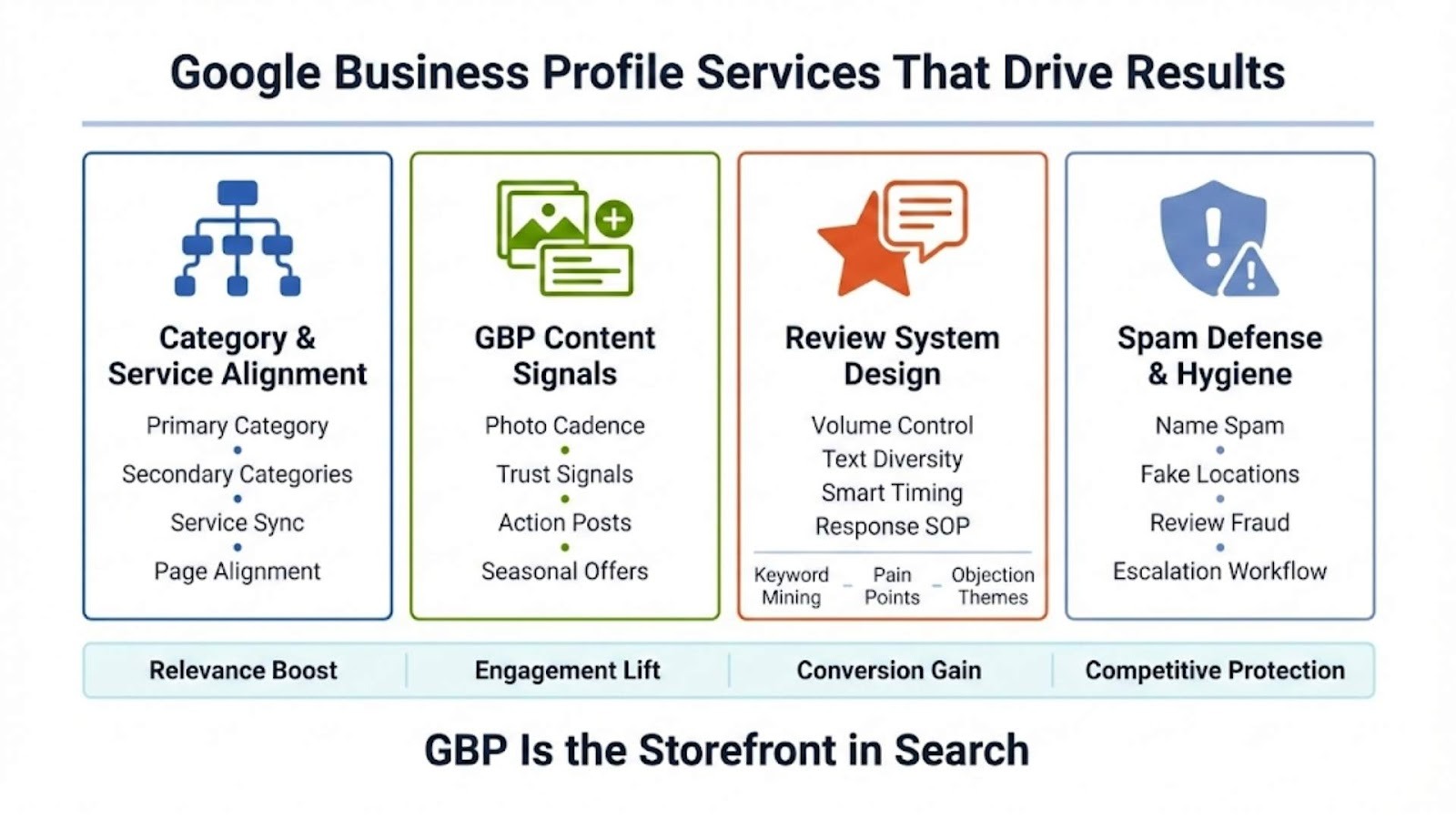
Google Business Profile Services (The Work That Actually Moves the Needle)
Most small businesses under-invest in GBP and over-invest in “website SEO.” GBP is the storefront in search.
Category Strategy and Service Alignment
I treat categories like taxonomy decisions, not guesses.
- Choose the best primary category for pack reach.
- Add secondary categories that reflect actual service lines.
- Align services and on-site pages to those categories.
If categories and service pages disagree, you create ambiguity. Ambiguity kills rankings.
GBP Content: Photos, Posts, and Real Signals
I don’t post for fun. I post to influence:
- relevance,
- engagement,
- and conversion.
For photos, I build a cadence:
- exterior and interior (storefront trust),
- team and process (service trust),
- before/after (outcome proof),
- product and equipment (expertise),
- geo-tagged context if appropriate (without gimmicks).
For posts, I run formats that produce actions:
- offers that match seasonal demand,
- service highlights tied to real local pain points,
- proof posts (case wins, outcomes, testimonials),
- event and community posts.
Reviews as a Ranking and Conversion System
Professionals know this, but many still treat reviews like luck.
I design a review system that delivers:
- steady volume,
- high star average,
- and textual diversity that reflects service mix.
Key elements:
- timing: ask when satisfaction peaks,
- channel: SMS/email sequencing,
- staff training: how to ask without pressure,
- routing: remove friction without filtering in a policy-violating way,
- response: respond like an operator, not a robot.
I also mine reviews for:
- service keywords,
- pain points,
- objections,
- and phrasing that I can mirror in service-page copy.
GBP Spam Defense and Competitive Hygiene
In competitive verticals, you will face:
- keyword-stuffed business names,
- fake locations,
- lead gen listings,
- review spam.
Local SEO services should include monitoring and escalation workflows. Otherwise, you’re playing fair while others cheat.
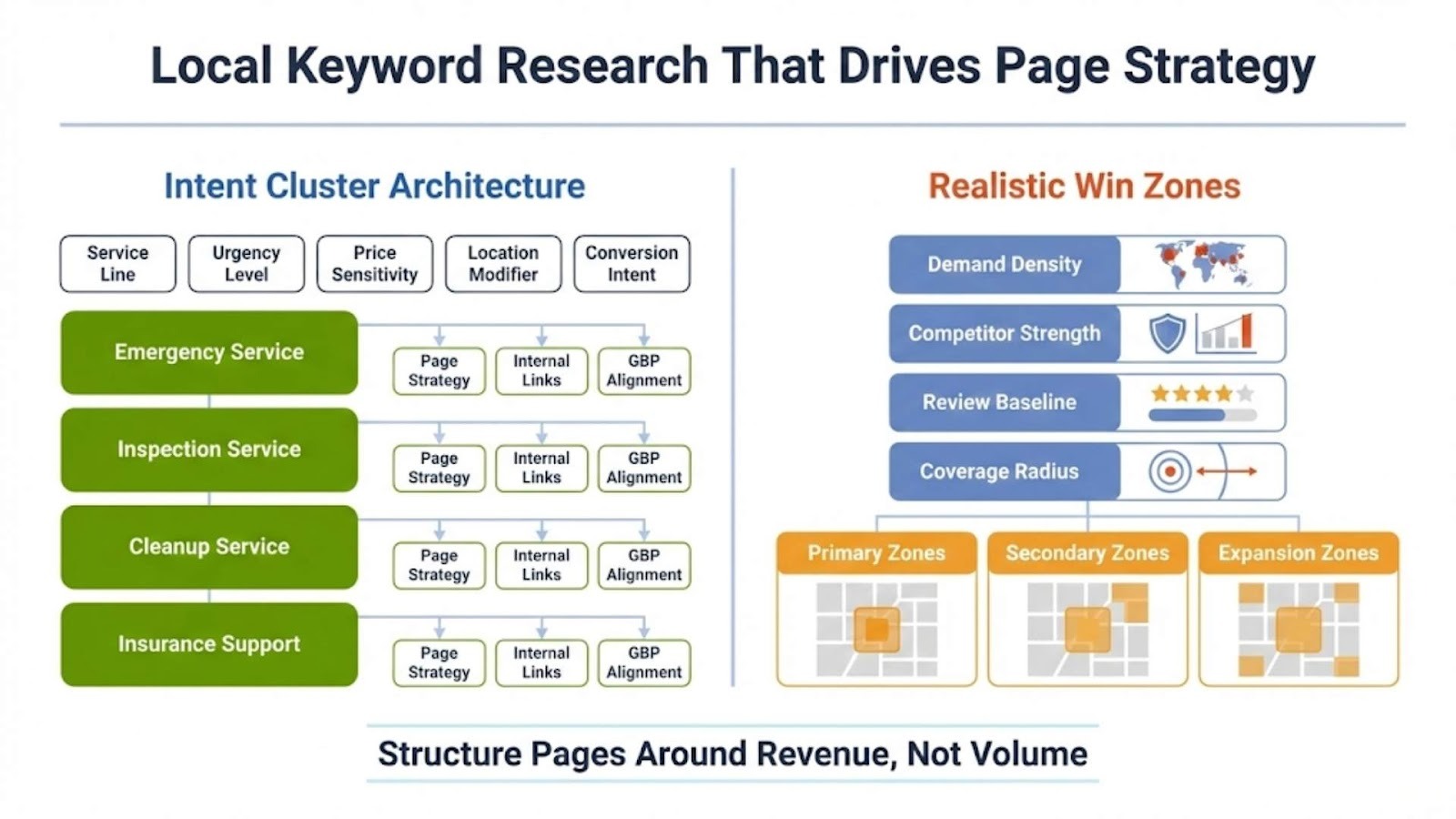
Local Keyword Research That Drives Page Strategy
Local keyword research is not a spreadsheet exercise. It requires properly aligning SEO strategy with content execution priorities. I use it to shape site structure and revenue priorities.
Intent Clusters, Not Single Keywords
I group keywords by:
- service line,
- urgency (emergency vs planned),
- price sensitivity,
- location modifiers,
- and conversion propensity.
Example clusters for a contractor:
- “emergency water damage restoration”
- “mold inspection”
- “basement flood cleanup”
- “insurance claim help”
Each cluster gets a page strategy, internal links, and GBP alignment.
Geo Targeting With Realistic Win Zones
I map where the business can actually win, based on:
- proximity to dense demand,
- competitor strength,
- existing review and authority baseline,
- operational coverage.
Then I prioritize neighborhoods and cities that deliver ROI, not vanity “we serve everywhere” lists.
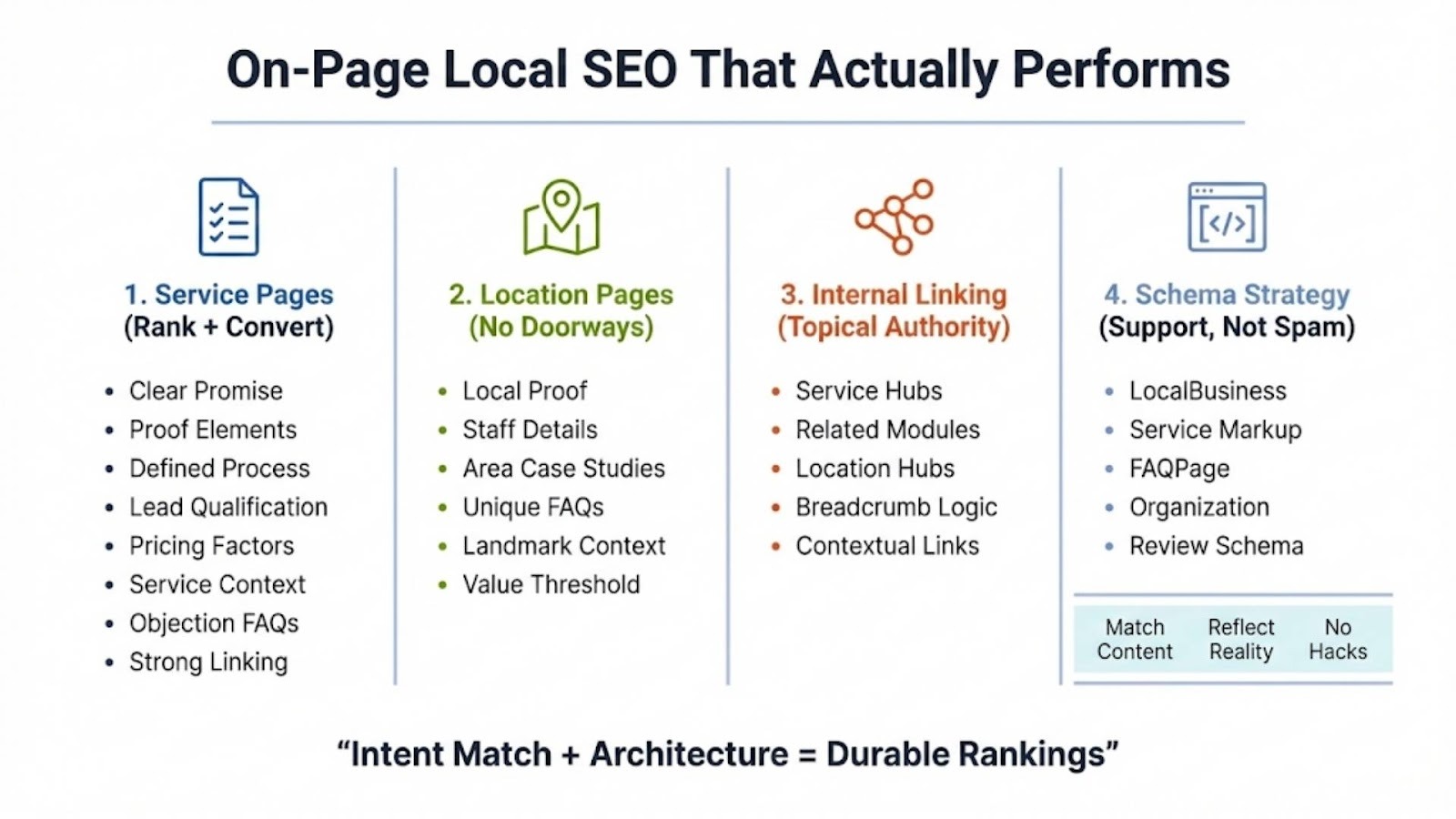
On-Page Local SEO Services (The Page Work Most Agencies Rush)
On-page local SEO is where professional execution shows up. The difference between mediocre and elite usually comes down to page intent matching and information architecture.
Service Pages That Rank and Convert
A serious local service page includes:
- a clear promise and scope,
- proof elements near the top (reviews, badges, case outcomes),
- service process explained with specificity,
- “who it’s for” and “who it’s not for” (qualifies leads),
- pricing approach or factors (reduces junk leads),
- service area context (without stuffing),
- FAQs based on real calls and objections,
- strong internal links to related services.
I avoid filler. I write pages like I’d sell the service on a call.
Location Pages That Avoid Doorway Risks
Location pages work when each page delivers unique value:
- location-specific proof,
- staff, office info, or dispatch approach,
- local case studies,
- unique FAQs for that area,
- neighborhood landmarks and logistics.
If the only difference is the city name swapped in a template, you build a liability. Local SEO services should include a threshold test: if you cannot make a page truly useful, do not publish it.
Internal Linking That Builds Topical Authority
Local sites often suffer from orphan pages and weak topical clustering. I build:
- service hub pages,
- related service modules,
- location hubs (where appropriate),
- breadcrumb logic,
- contextual links inside FAQ blocks.
This work increases crawl efficiency and clarifies hierarchy for search engines and humans.
Schema That Supports, Not Spams
Structured data helps when it reflects reality and matches page content.
Common schema patterns I deploy:
- LocalBusiness (and relevant subtypes)
- Service
- FAQPage (only when questions and answers appear on page)
- Organization
- AggregateRating or Review only when compliant and supported
I treat schema like “labeling,” not “ranking hacks.”
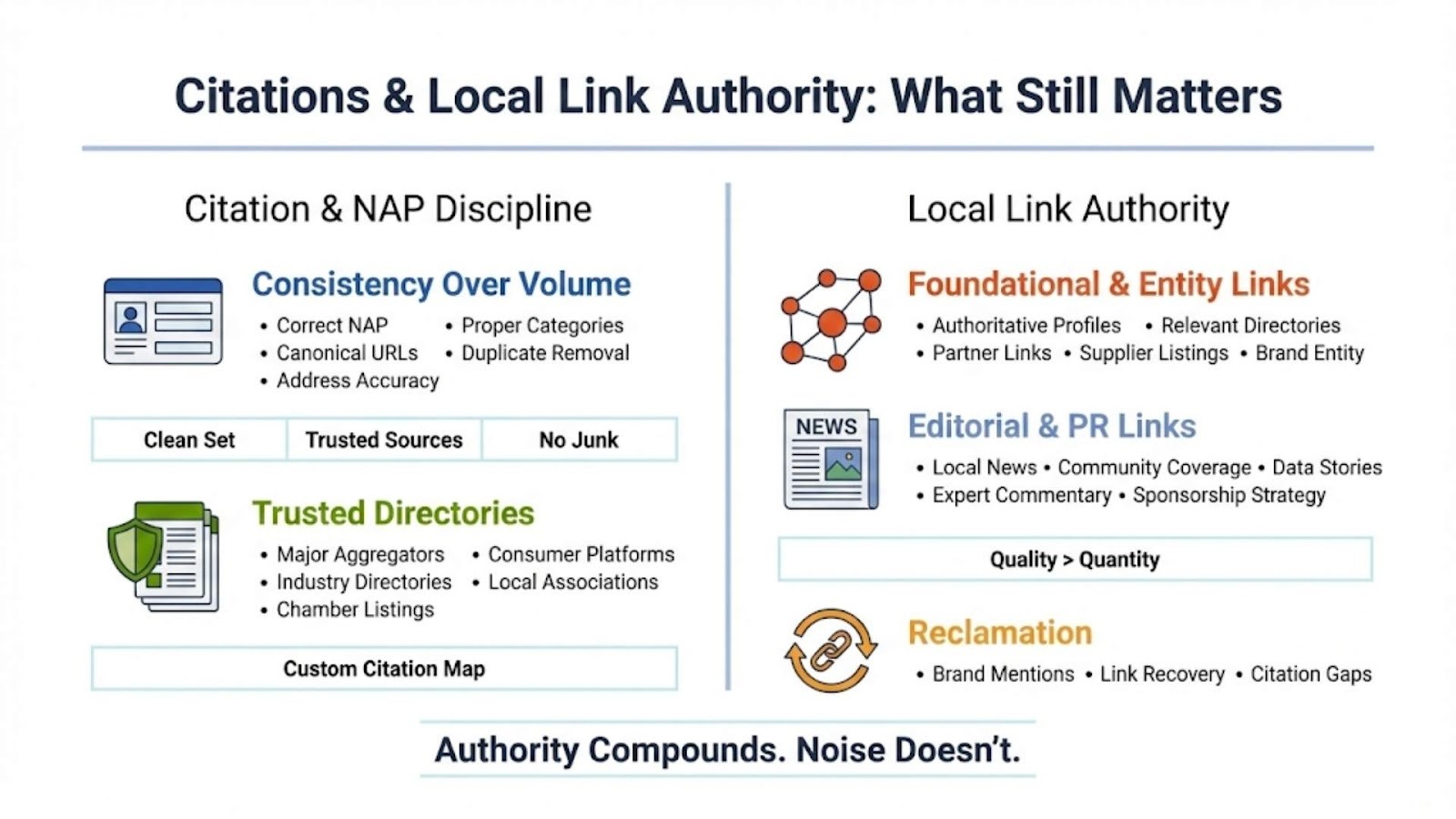
Citations and NAP Management (What Still Matters and What Doesn’t)
Citations still matter, but not the way many vendors sell them.
Consistency Beats Volume
I care about:
- correct NAP,
- correct categories,
- correct URLs,
- no duplicates,
- no wrong addresses.
A small set of clean, authoritative citations beats 200 junk listings.
Industry and Local Authority Directories
I prioritize directories that Google and users trust:
- major aggregators (market-dependent),
- top consumer platforms (maps, review sites),
- niche industry directories,
- local business associations,
- chambers, sponsor pages, community resources.
Professional local SEO services include a citation map that matches the business type, not a one-size list.
Local Link Building That Professionals Respect
Links remain one of the strongest levers for competitive local markets, especially outside the map pack and for organic service pages.
Foundational Links and Brand Entity Links
Foundational links include:
- authoritative profiles (not spam),
- relevant directories,
- partner profiles,
- supplier or manufacturer “find a pro” listings.
Entity links strengthen trust and prominence.
Local Editorial Links and PR
This is where I push beyond “SEO.”
- local news mentions,
- community event coverage,
- data-driven stories (local statistics, surveys),
- expert commentary pitched to local reporters,
- scholarship and sponsorship strategies that don’t look manipulative.
A single strong editorial link can do more than dozens of weak placements.
Reclamation and Unlinked Mentions
Businesses frequently get mentioned without links. I run:
- brand mention searches,
- citation audits for missing links,
- outreach for link reclamation.
This often delivers quick authority gains with low effort.
Content Marketing for Local SEO (The Part Most People Misuse)
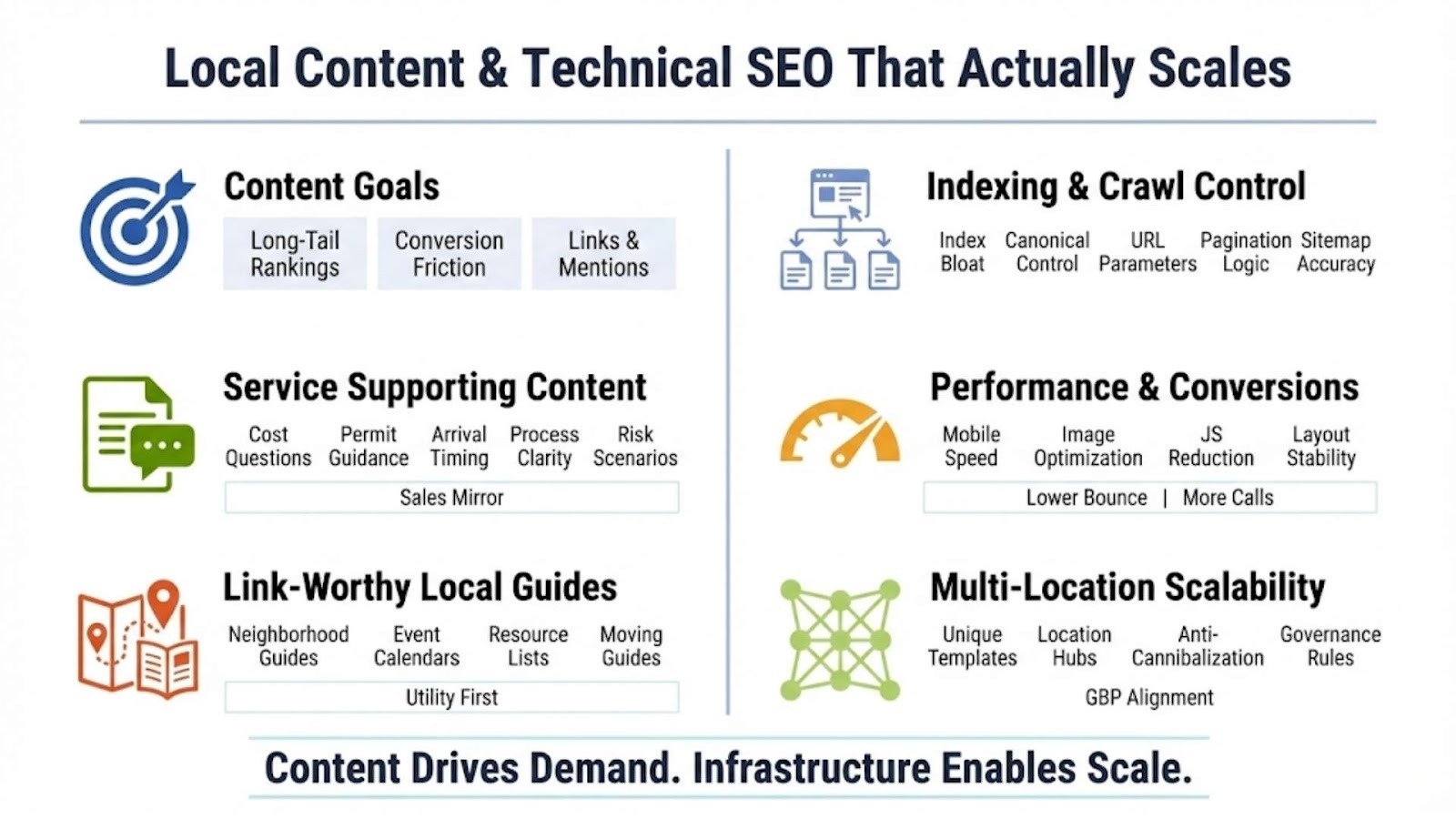
Local content should support one of three goals:
- rank for long-tail local intent,
- reduce friction for conversions,
- earn links and mentions.
Service Supporting Content
I publish content that answers the questions people ask right before they call:
- “How much does X cost in [city]?”
- “Do I need a permit?”
- “How fast can you arrive?”
- “What does the process look like?”
- “What can go wrong?”
This content works because it mirrors sales conversations.
Local Guides That Earn Links
The easiest local links come from useful community assets:
- neighborhood guides,
- event calendars,
- local resource lists,
- “moving to” guides for real estate adjacent businesses.
These only work when you build them with genuine utility, not as thin SEO bait.
Technical Local SEO (Indexing, Speed, and Architecture)
Technical work often determines whether the rest of the strategy can scale.
Indexing Control and Crawl Efficiency
I audit:
- index bloat (thin pages, tag pages, duplicates),
- canonical issues,
- parameter URLs,
- pagination problems,
- sitemap accuracy.
Then I fix what blocks Google from understanding the important pages.
Performance That Improves Conversions
Speed matters most when it changes lead volume and lead quality. I focus on:
- mobile performance on service pages,
- image compression and delivery,
- JavaScript bloat,
- layout stability.
A faster site reduces bounce and increases booked calls. That alone can justify the entire local SEO retainer.
Multi-Location Scalability
For multi-location, I design:
- location page templates with unique blocks,
- store locator or location hub strategy,
- internal linking that prevents cannibalization,
- GBP alignment across locations,
- governance rules so new locations don’t break the system.
Tracking, Reporting, and Proving ROI
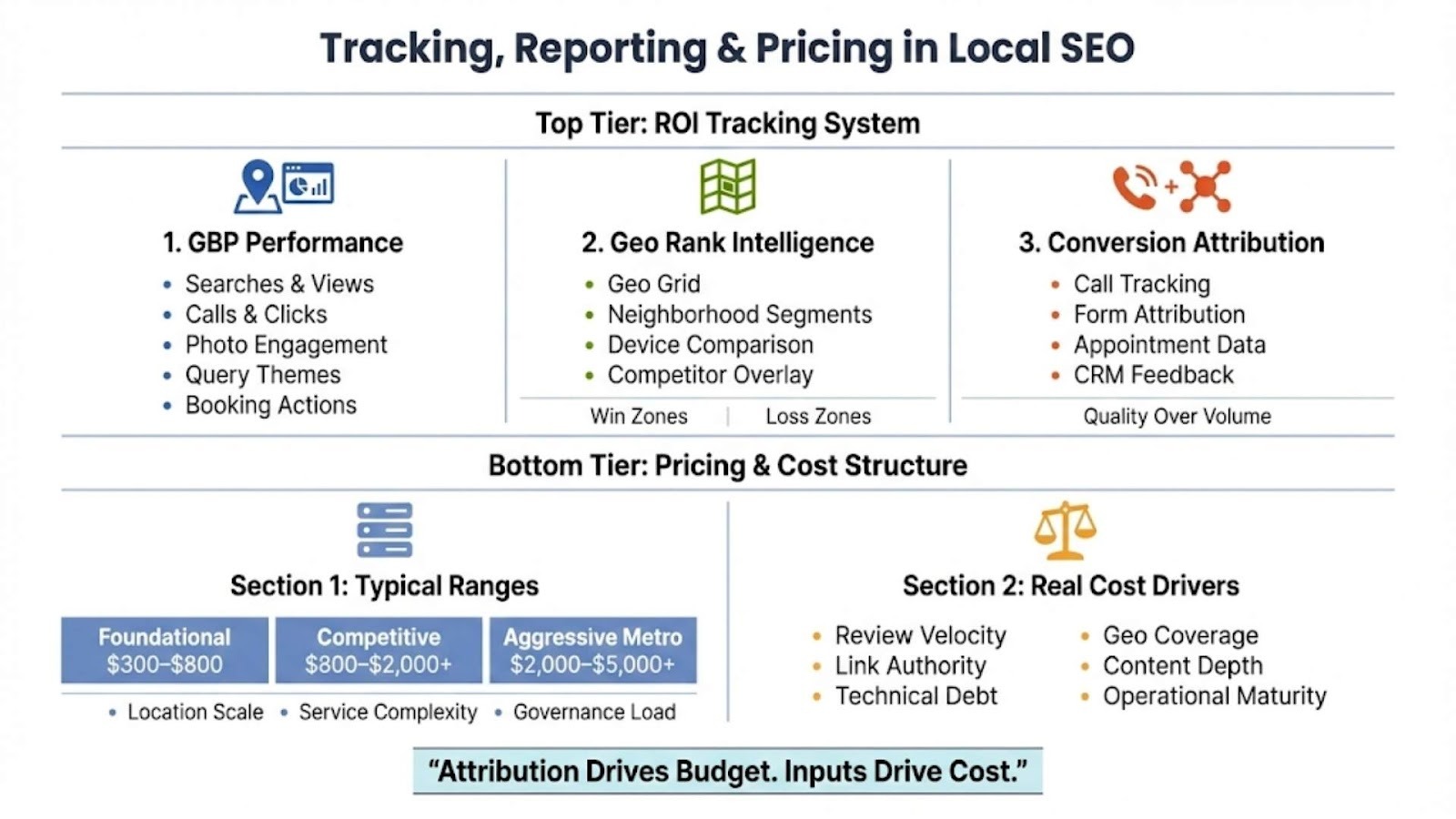
Professionals want attribution, not noise.
GBP Reporting That Matters
I track:
- searches and views trends,
- actions (calls, directions, website clicks),
- photo views and engagement,
- query themes,
- booking and messaging performance.
Local Rank Tracking With Geo Context
Standard rank trackers lie for local. I use:
- geo-grid tracking for map visibility,
- segmented tracking by neighborhood,
- device-based comparisons,
- competitor overlays.
This answers the real question: “Where do we win, where do we lose, and why?”
Conversion and Call Quality Feedback Loops
If you cannot tie local SEO to leads, you will lose budget.
I implement:
- call tracking with source attribution,
- form tracking tied to landing pages,
- booked appointment tracking,
- CRM feedback on lead quality by channel.
Then I adjust targeting based on what sells.
Pricing Models and What Drives Cost
Local SEO services for small businesses vary in cost because the competitive inputs vary, review velocity, link authority, technical debt, geographic coverage, and service-line complexity all influence pricing and campaign intensity.
Typical Ranges (How I See the Market)
For a single-location small business:
- foundational local SEO: $300 to $800 per month
- competitive service verticals: $800 to $2,000+ per month
- aggressive growth in tough metros: $2,000 to $5,000+ per month
For multi-location, cost usually scales by:
- number of locations,
- number of service lines,
- and the complexity of governance and reporting.
The Real Cost Drivers
- competitor review velocity and authority
- site condition and technical debt
- number of target neighborhoods and cities
- link acquisition difficulty
- content depth required to differentiate
- operational maturity (how easy it is to generate reviews, photos, proof)
Cheap local SEO fails because it ignores those drivers.
Timelines and What “Success” Looks Like in Practice
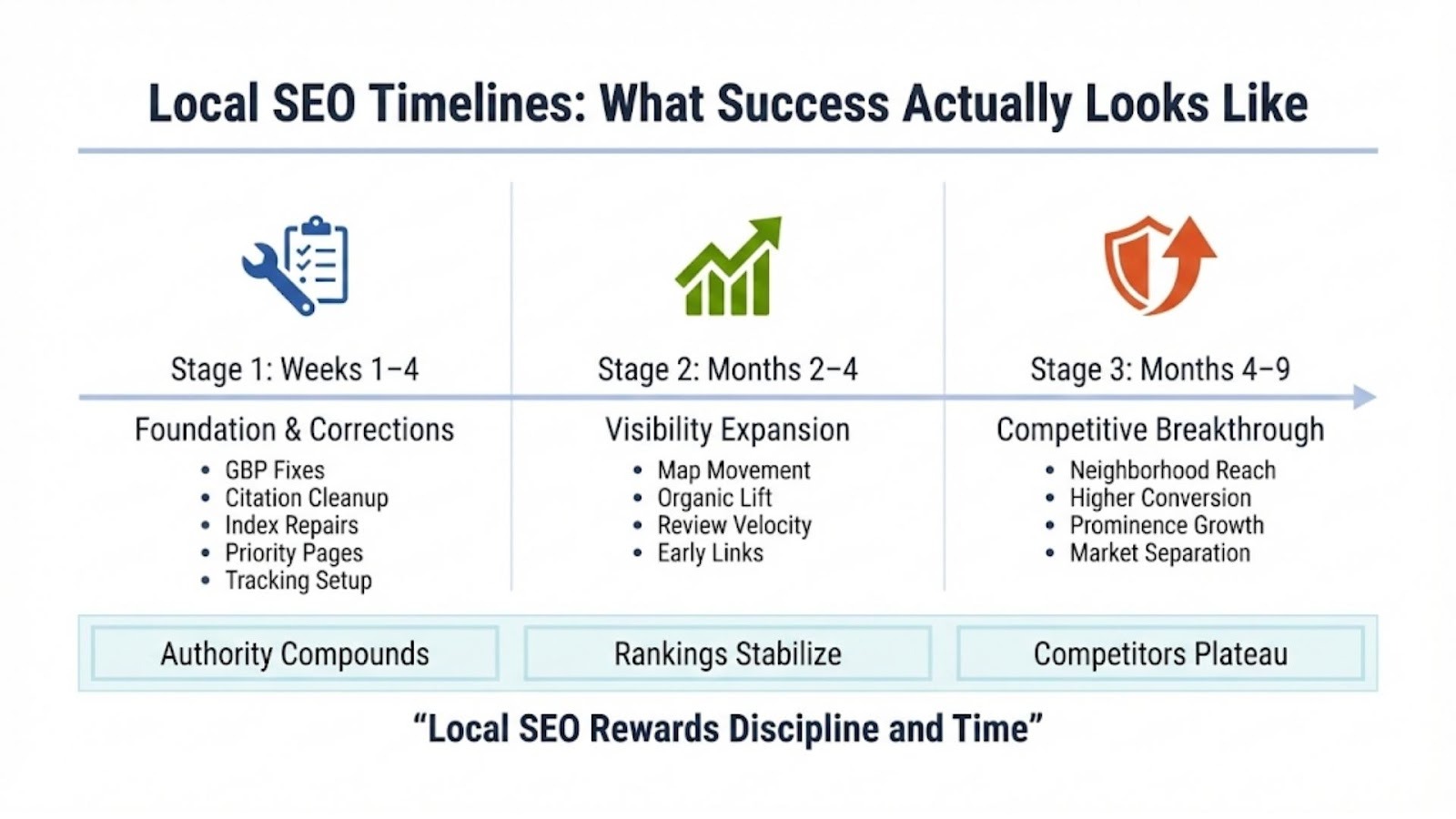
Professionals should expect staged progress:
Weeks 1 to 4: Foundation and Corrections
- fix GBP issues and inconsistencies
- clean citations and duplicates
- repair indexing and technical blockers
- ship high-priority service pages
- implement tracking
Months 2 to 4: Visibility Expansion
- map pack movement for primary services
- organic improvements for service clusters
- review velocity stabilizes
- links and mentions start landing
Months 4 to 9: Competitive Breakthroughs
- broader neighborhood coverage
- stronger conversion rates due to better pages and proof
- prominence begins compounding
- competitors feel “stuck” while you keep climbing
In competitive markets, the compounding phase is where local SEO turns into an unfair advantage.
Common Failure Modes I See (And How I Avoid Them)
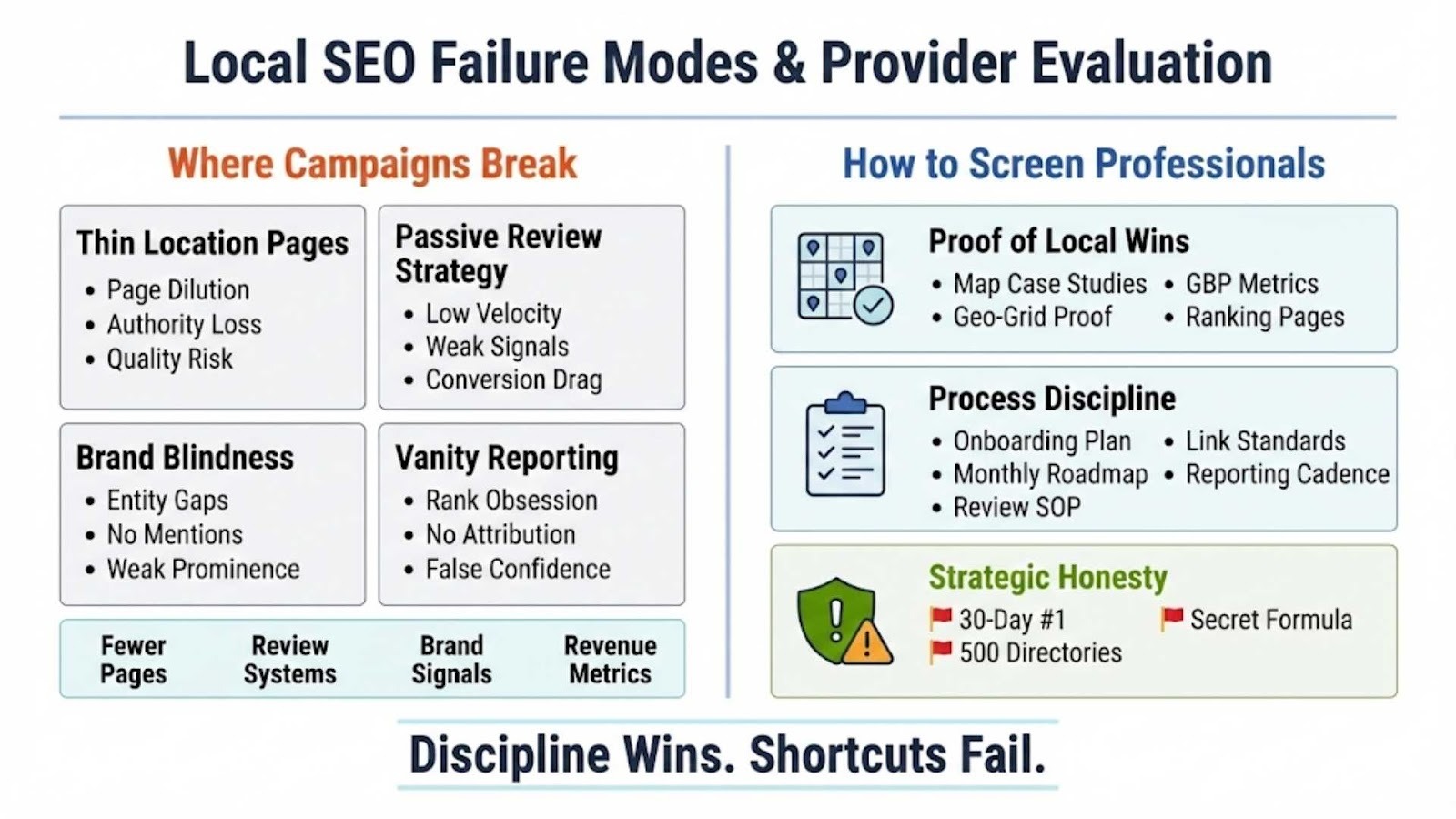
Overbuilding Location Pages
If you publish 100 thin pages, you dilute your authority and invite quality issues. I publish fewer pages with higher depth.
Treating Reviews Like a Side Task
Review velocity is a core ranking input and a core conversion input. I operationalize it with systems, not reminders.
Ignoring Brand and Entity Signals
Local SEO is not separate from brand. Brand searches, mentions, and real-world presence influence prominence.
Reporting Vanity Metrics
Rankings without revenue outcomes create false confidence. I report on calls, bookings, and qualified leads.
How I Evaluate and Select a Local SEO Provider (If You’re Hiring)
If you’re a professional hiring another professional, I recommend you screen for:
Evidence of Real Local Wins
Ask for:
- map pack case studies,
- geo-grid screenshots,
- before/after GBP metrics,
- examples of location pages that rank and convert.
Process Documentation
A serious provider has:
- onboarding checklist,
- monthly execution plan,
- review generation SOP,
- link standards,
- reporting cadence.
Strategic Honesty
If a provider promises:
- “#1 in 30 days,”
- “we submit to 500 directories,”
- “we use proprietary local SEO secrets,”
Walk away.
FAQ: Advanced Questions Professionals Ask About Local SEO Services for Small Businesses
How should I think about radius targeting and service areas when distance acts as a hard constraint?
I treat “radius targeting” as an operational constraint, not a ranking lever. Google does not give you a dial that expands rankings outward just because you select a larger service area. Instead, I model service coverage by: (1) where we can realistically win in the map pack given proximity and competitor density, and (2) where we can win in organic results with location-specific pages and authority. For service-area businesses, I prioritize a small set of high-value zones first, then expand outward once prominence and review velocity support it.
How do you prevent local cannibalization when multiple pages target overlapping cities or services?
I use a page governance system: one primary service page per service line, a controlled set of city or neighborhood pages only where differentiation exists, and strict internal linking rules that preserve hierarchy. I also separate intent: the service page targets “service + near me / city-wide,” while a location page targets “service + specific city/neighborhood” plus logistics and proof for that area. If Search Console shows query overlap that causes instability, I consolidate pages and strengthen a single authoritative URL rather than forcing two weak URLs to compete.
What is the professional way to structure local SEO for businesses with multiple service lines and multiple locations?
I build a matrix: locations on one axis, service lines on the other, then I assign a “primary landing page” per service line per location only where demand and capacity justify it. In practice, that means you do not publish every combination. You publish the combinations that you can operationally deliver, support with reviews and proof, and defend with authority. Then you connect everything with hubs: service hubs, location hubs, and internal links that prevent index bloat.
How do you decide when a location page becomes a doorway page risk?
I apply a usefulness threshold. If the page cannot include unique proof, unique local logistics, and unique local FAQs that reflect real differences, I will not publish it. The safest location pages resemble genuine local landing pages built for users, not SEO templates. If I can’t make the page materially different, I consolidate into a single service-area page and lean on internal sections or modules for smaller neighborhoods rather than separate URLs.
How do you approach local SEO for businesses in regulated industries (legal, medical, financial) where claims and reviews require caution?
I build compliance into the content and review process. On-page, I avoid unsubstantiated outcome claims and I document scope, disclaimers, and appropriate language. For reviews, I encourage authentic experience-based reviews without prompting prohibited content. I also focus more heavily on entity trust and authority: professional associations, accreditations, and citations from legitimate industry sources tend to matter more in these verticals.
How do you use offline signals without relying on “black box” assumptions?
I translate offline reality into online evidence. If a business sponsors events, wins awards, hires locally, or has community partnerships, I make sure those activities create digital artifacts: mentions, links, photos, press coverage, and authoritative citations. I do not need to claim Google “reads” every offline signal directly. I need the offline signal to produce online corroboration that Google can evaluate.
How do you handle Google Business Profile suspensions and verification failures as part of local SEO services?
I treat this as a risk-management workflow: document requirements, naming conventions, signage and proof standards, and a change-log protocol for GBP edits. Most suspension issues come from aggressive edits, mismatched business info, or business models that violate representation guidelines. A professional provider should maintain a verification-ready asset pack (photos, signage, documentation) and implement controlled changes rather than frequent high-risk edits.
What is your process for diagnosing sudden local ranking drops when nothing “changed” on the client side?
I start with a differential diagnosis:
- GBP changes, category edits, attribute changes, or hidden suspensions
- Competitor spam or new listings
- Review velocity changes or review removals
- Website indexing issues, canonical shifts, or accidental noindex
- Local algorithm updates or volatility in the vertical
- Behavioral shifts: lower CTR, fewer calls, weaker engagement
Then I validate with Search Console, GBP metrics, local rank grids, and crawl data. I treat it like incident response: identify the layer that moved first, then restore stability.
How do you determine whether a business should invest in local SEO versus local services ads or paid search first?
I map the decision to unit economics and urgency. If the business needs leads immediately and the LTV supports it, paid channels can bridge short-term demand. Local SEO becomes the compounding asset that reduces long-term CAC and stabilizes lead flow. In many cases, the best answer is hybrid: use paid for immediate volume while building local SEO to own the market over 6 to 12 months.
How do you evaluate whether reviews are helping rankings or only helping conversions?
I separate correlation from impact by tracking:
- map visibility changes versus review velocity shifts
- keyword mentions in reviews (service and locality) over time
- competitive review deltas (your pace versus top pack competitors)
- conversion rates from GBP traffic and landing page traffic
Even when reviews do not visibly shift rankings in the short term, they almost always improve conversion rates and lead quality, which changes ROI.
What is the correct way to handle practitioner listings (doctors, lawyers, agents) alongside a firm listing?
I align the structure with how the business actually operates. In some models, practitioner listings help capture branded searches and specialist-intent queries. In others, they fragment reviews and confuse Google. I typically keep one primary firm listing as the revenue engine, then add practitioner listings only if: (1) the practitioners maintain real client-facing presence, (2) the brand benefits from individual authority, and (3) we can manage duplication risk and review strategy without splitting prominence.
How should a professional local SEO program handle competitive spam without triggering retaliation or wasting effort?
I document violations, prioritize high-impact offenders, and submit evidence methodically. I do not chase every spam listing. I target the listings that actively block top pack access, especially keyword-stuffed names and fake locations. At the same time, I keep building my own prominence so we win even in imperfect environments. Spam fighting works best as a strategic layer, not the whole strategy.
When should a small business expand beyond one GBP listing, and when is that a mistake?
Expanding to additional listings makes sense only when you have:
- legitimate separate locations or departments that qualify under guidelines
- operational capacity to serve those areas
- signage, staffing, and documentation to support verification
Creating extra listings to manipulate proximity is a mistake and often leads to suspension. If the goal is coverage expansion, organic location strategy and prominence building usually outperform risky listing proliferation.
How do you treat “near me” queries differently from “city name” queries in your strategy?
I don’t treat “near me” as a separate keyword target. I treat it as a proximity-driven intent signal. To win it, we need strong GBP relevance, prominence, and engagement near the searcher. “City name” queries often allow more organic capture through location-aware service pages, especially when the user searches from outside the city center or uses desktop. The strategy difference is about layer emphasis: maps for “near me,” organic plus maps for “city.”
What does mature local SEO look like after you’ve “won” the rankings?
Mature local SEO becomes a maintenance and moat-building program:
- protect GBP with disciplined governance
- sustain review velocity
- continue authoritative link and mention acquisition
- expand content only where it increases revenue or defends territory
- improve conversion rates and lead quality
- monitor competitors and spam
At that stage, the program shifts from “get visible” to “stay dominant while improving profitability.”
The Professional Standard for Local SEO Services (My Bottom Line)
If you sell local SEO services or you buy them, hold the work to a professional standard:
- treat GBP like a conversion asset,
- build service pages with real specificity and proof,
- win prominence with reviews, links, and community signals,
- measure outcomes that map to revenue,
- build a system that compounds month after month.
That’s what local SEO services should mean for small businesses that want predictable growth and a defensible local presence.
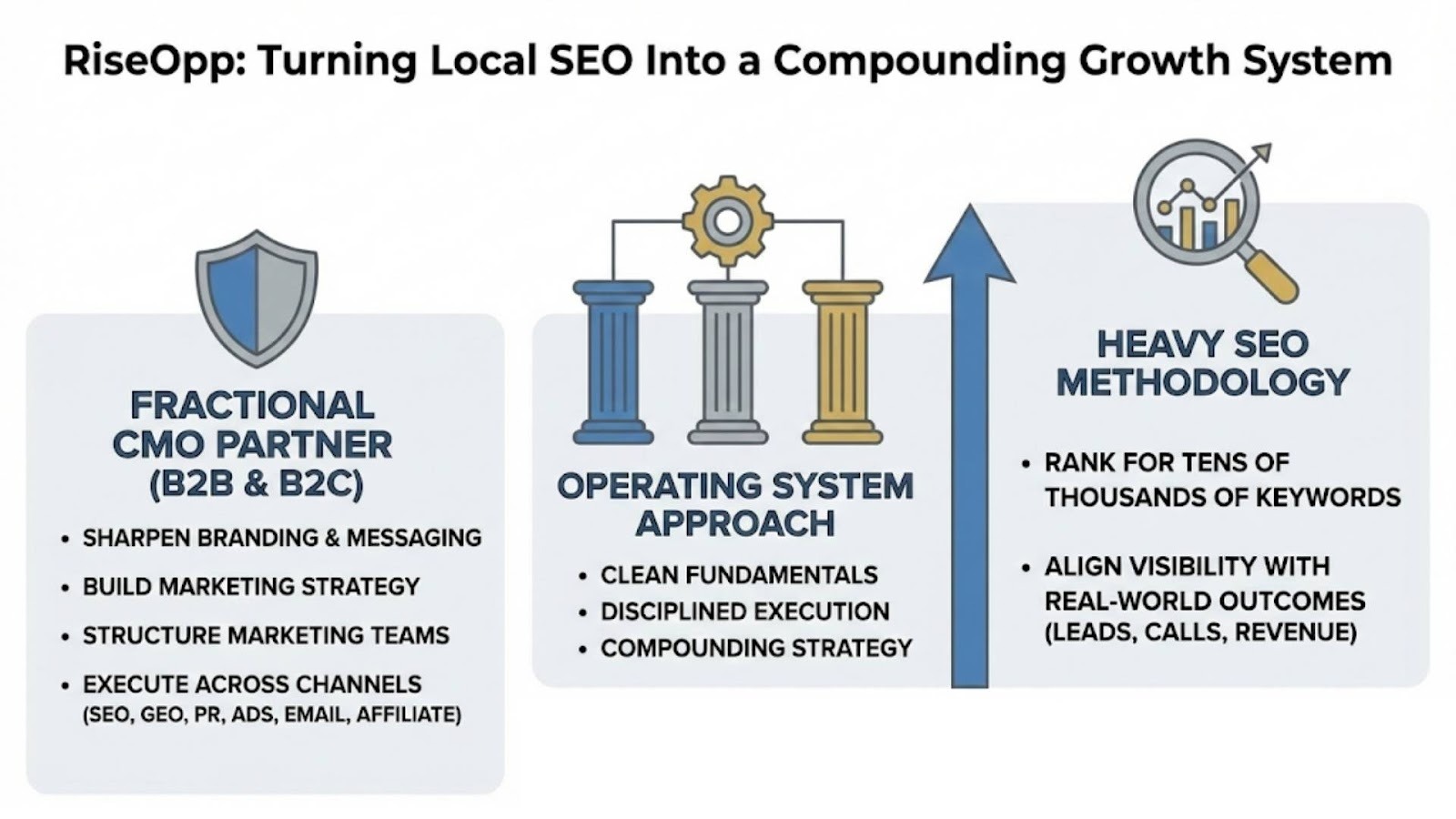
About RiseOpp: Turning Local SEO Into a Compounding Growth System
At RiseOpp, we built our Fractional CMO and SEO services for teams that want more than incremental gains. Local SEO works best when you treat it like an operating system: clean fundamentals, disciplined execution, and a strategy that compounds month after month. That’s why we apply our proprietary Heavy SEO methodology to help businesses rank for tens of thousands of keywords over time, while we align that visibility with real-world outcomes like qualified leads, booked calls, and revenue.
When clients need more than SEO alone, we step in as a Fractional CMO partner across both B2B and B2C, sharpening branding and messaging, building the marketing strategy, helping hire and structure marketing teams, and executing across channels that support local growth, including SEO, GEO, PR, Google Ads, Meta Ads, LinkedIn Ads, TikTok Ads, email marketing, and affiliate marketing.
If you want a local SEO strategy built around the right category (foundational, growth, multi-location, or recovery) and executed with the kind of rigor professionals expect, contact us to discuss how we can help.
Comments are closed