- Claude AI, developed by Anthropic, uses Constitutional AI to deliver reliable reasoning, structured analysis, and consistent long-form marketing output.
- Claude AI processes large context inputs like brand guidelines, CRM data, and research reports to generate nuanced insights and strategy recommendations.
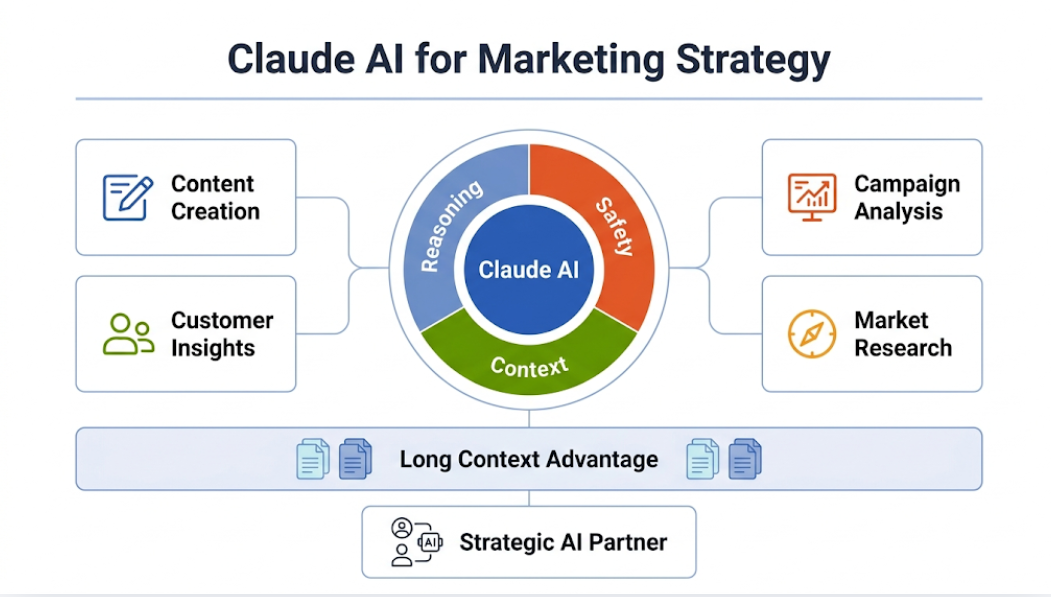
- Marketing teams use Claude AI for content creation, customer insight analysis, campaign optimization, and market research across complex workflows.
I have spent years working with marketing technology, automation platforms, analytics systems, and AI tools. Every few years a new tool appears that promises to change marketing. Most of them do not. A few of them do.
Claude AI belongs in the second category.
In my work with marketing teams, agencies, and growth departments, I see the same pressures everywhere. Teams need to produce more content. Campaigns must become more personalized. Data volumes grow faster than teams can analyze them. Strategy cycles shrink. Marketing leaders want both speed and precision.
AI has started to close that gap, and its role is becoming more central across the broader field of AI in marketing.
According to Backlinko Claude AI user data (2026), Claude has approximately 18.9 million monthly active users worldwide, which reinforces how quickly AI tools are becoming part of everyday marketing workflows.
Among the current generation of AI systems, Claude AI has developed a reputation for depth, reasoning ability, and consistency in long-form work. While many marketers initially experiment with AI for quick copywriting, Claude proves far more valuable when you use it for research, analysis, strategy support, and complex content production.
In this article I will walk through exactly how Claude AI fits into the modern marketing stack. I will explain what Claude is, how it compares with other tools like ChatGPT, Jasper, and Copy.ai, and how experienced marketing teams are integrating it into real workflows.
I will also discuss practical use cases across industries, including SaaS, e-commerce, healthcare, travel, and education. Along the way, I will share implementation strategies, best practices, and the limitations marketers need to understand before adopting AI at scale.
This guide assumes the reader already works in marketing and understands strategy, campaigns, content operations, and analytics. I will treat this topic as a professional conversation between experts rather than a beginner tutorial.
Let’s begin with the fundamentals.
What Claude AI Is and Why Marketers Should Care
Understanding Claude AI
Claude AI is a large language model developed by the company Anthropic. The model belongs to the same general category as OpenAI’s GPT systems. Both rely on transformer-based architectures trained on massive datasets to understand and generate language.
What differentiates Claude is not the core architecture but the design philosophy.
Anthropic built Claude around a framework called Constitutional AI. Instead of relying only on reinforcement learning with human feedback, the model uses an internal set of principles to guide its reasoning and responses. This design focuses heavily on reliability, safety, and interpretability.
From a marketing perspective, that approach produces a few practical advantages.
Claude tends to produce structured reasoning. When asked analytical questions, it often explains how it reached a conclusion rather than simply producing an answer. This behavior makes it far more useful in strategy discussions and campaign analysis.
Claude also handles large context windows exceptionally well. Modern versions can process extremely long documents or datasets within a single conversation. For marketers who work with research reports, CRM exports, brand guidelines, and multi-page campaign briefs, that capability becomes extremely valuable.
In simple terms, Claude behaves less like a copy generator and more like a research analyst and strategist.
Why Claude Matters for Marketing Workflows
Marketing has always combined creativity with analysis. In recent years the analytical side has grown dramatically.
Campaign performance data arrives from multiple channels. Customer feedback spreads across review platforms, social networks, and support systems. Content production requires coordination across blogs, social media, video, newsletters, and landing pages, making marketing automation workflows increasingly important for execution.
Teams struggle to keep up.
Claude can assist across multiple layers of that workload.
I often divide marketing applications of Claude into four categories:
- Content creation and editing
- Customer insight and segmentation
- Campaign analysis and optimization
- Market research and strategic planning
Many AI tools address only the first category. Claude performs strongly across all four.
For example, I regularly use Claude to review campaign reports containing thousands of data points. The system can identify patterns and produce structured summaries within minutes.
I also use it to analyze customer feedback datasets, which can reveal recurring objections or motivations that should influence messaging.
When applied correctly, Claude becomes a thinking partner rather than just a writing assistant.
The Importance of Context Length
One feature that experienced marketers immediately appreciate is Claude’s ability to handle long context inputs.
Most AI models historically struggled when conversations exceeded a few thousand tokens. That limitation meant marketers had to simplify or fragment information.
Claude dramatically expands that limit.
You can upload full strategy documents, product documentation, research reports, and campaign datasets in one conversation. Claude can then reference that information while generating recommendations or content.
This changes how marketing teams interact with AI.
Instead of prompting the model with isolated questions, teams can create a working environment where Claude has visibility into the same materials the marketing team uses.
That approach allows the AI to operate with far more nuance.
Claude AI vs Other Marketing AI Tools
The Current Landscape of Marketing AI
When I speak with marketing teams about AI adoption, they usually mention three tools first:
- ChatGPT
- Jasper
- Copy.ai
Each of these tools serves a different purpose. Even though the broader landscape of AI assistants for marketing continues to expand.
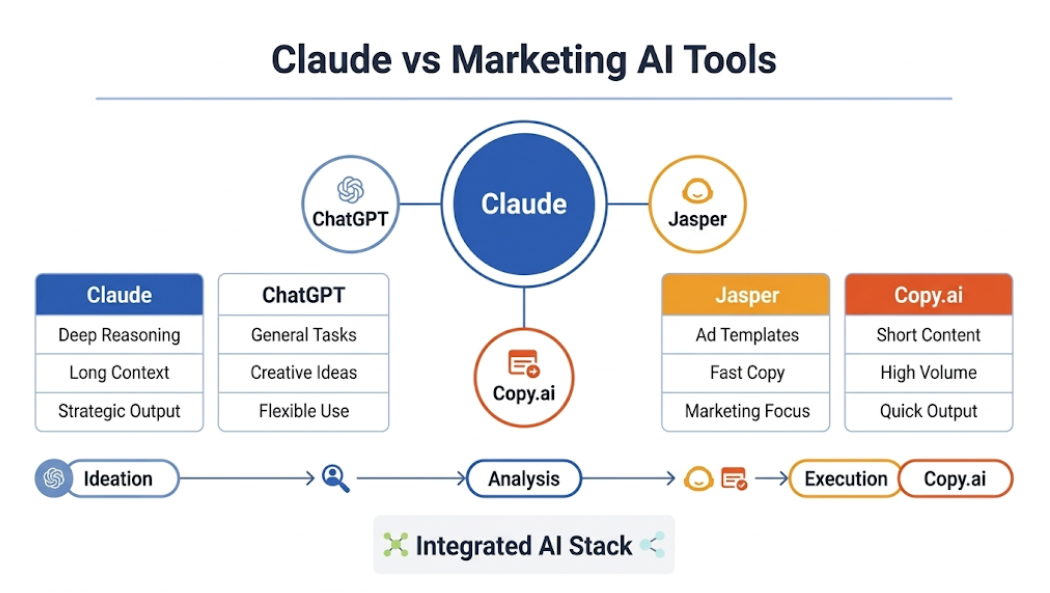
ChatGPT functions as a general-purpose AI assistant capable of writing, coding, and reasoning across many tasks.
Jasper focuses specifically on marketing copy and content production. It offers numerous templates designed for ads, product descriptions, and email campaigns.
Copy.ai emphasizes speed and scalability for short-form marketing content.
Claude occupies a slightly different position.
It excels in situations where marketers need depth, reasoning, and consistency across large bodies of information.
Let me walk through the practical differences.
Claude vs ChatGPT
ChatGPT remains the most widely recognized AI assistant in the market. It performs well across a wide range of tasks and supports a robust plugin ecosystem, which is why many teams still rely on it as part of their broader AI marketing toolkit.
However, in marketing workflows I often see a few differences.
Claude tends to maintain context across longer discussions without losing track of earlier information. This characteristic helps when analyzing long documents or multi-layered strategy discussions.
Claude also produces structured reasoning more consistently. When evaluating campaign performance or explaining market trends, it frequently breaks down its analysis in logical steps.
ChatGPT still performs extremely well in creative brainstorming and conversational interactions. Many teams use both systems depending on the task.
Claude vs Jasper
Jasper built its reputation on marketing templates. The platform includes dozens of structured workflows for ads, landing pages, product descriptions, and email campaigns.
For marketers who want immediate outputs with minimal prompt engineering, Jasper offers convenience.
Claude requires more intentional prompting. It does not rely on predefined marketing templates. Instead it expects the user to define the task clearly.
This difference produces different outcomes.
Jasper often produces fast copy variations. Claude produces deeper analysis and more nuanced long-form writing when given the right context.
Teams focused primarily on high-volume ad copy may prefer Jasper. Teams working on research, positioning, and long-form content often gravitate toward Claude.
Claude vs Copy.ai
Copy.ai targets rapid generation of short-form content. Social media posts, ad headlines, and product descriptions appear quickly using simple prompts.
For teams running high-frequency advertising campaigns, that speed helps.
Claude takes a more analytical approach.
When I ask Claude to generate social content, I usually include information about audience segments, brand voice guidelines, and campaign objectives. The output reflects that broader context.
The difference resembles the distinction between a copy assistant and a strategic collaborator.
Choosing the Right Tool
Most advanced marketing teams do not rely on a single AI system.
Instead they build tool stacks that combine multiple capabilities.
A typical workflow might look like this:
- ChatGPT for brainstorming and rapid ideation
- Claude for research analysis and long-form content
- Jasper or Copy.ai for generating ad variations at scale
Each system contributes different strengths.
Claude plays its most valuable role when marketers need to synthesize complex information and translate insights into structured messaging.
Key Features That Make Claude Particularly Valuable for Marketers
Before we go deeper into marketing workflows, we need to understand the specific capabilities that make Claude useful in professional marketing environments.
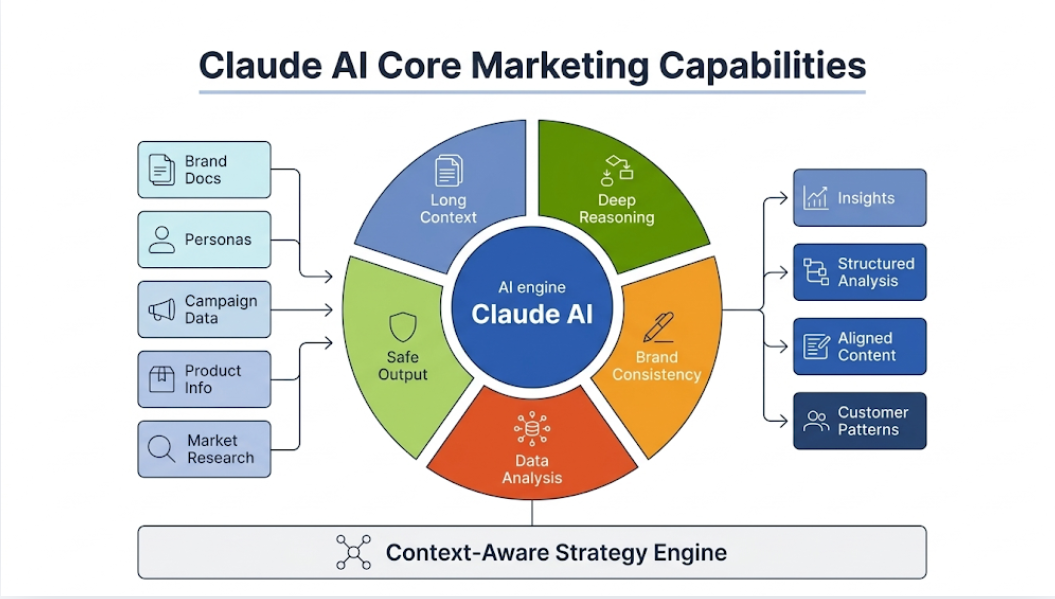
Many marketers initially treat AI as a copy generator. That approach misses most of the value. Claude becomes powerful when you use it as a context-aware thinking tool rather than a simple writing machine.
Over time I have identified several capabilities that make Claude particularly effective for marketing work.
Massive Context Window
Why Context Matters in Marketing
Marketing work rarely happens in isolation. Every campaign depends on layers of context.
That context includes:
- Brand voice guidelines
- Customer personas
- Competitive positioning
- Previous campaign results
- Product documentation
- Market research
- Sales insights
When an AI system cannot access that information, it produces generic output.
Claude solves this problem with an unusually large context window. In practical terms, this means I can provide the model with extremely long documents or datasets in a single conversation.
For example, I frequently upload the following into Claude before asking it to produce content or analysis:
- 30 to 50 pages of brand guidelines
- full customer persona documentation
- CRM export summaries
- product messaging frameworks
- past campaign reports
- competitor messaging examples
Claude can reference all of that information when generating responses.
This capability fundamentally changes how AI fits into marketing work.
Instead of giving Claude small prompts, I give it the same information a senior strategist would receive before working on a campaign.
The output improves dramatically.
Strong Reasoning and Analytical Structure
Many language models can generate text. Fewer can explain reasoning.
Claude tends to break complex problems into logical steps. When I ask questions about campaign performance or market trends, the model often responds with structured reasoning.
For example, if I ask:
Why might our conversion rate have dropped in Q3 despite higher traffic?
Claude may produce an analysis that includes:
- traffic source changes
- landing page performance
- audience quality shifts
- messaging mismatch
- competitive pressure
It explains how each factor might contribute to the problem.
This behavior makes Claude particularly useful for marketing strategy discussions.
Instead of receiving vague advice, I receive a structured diagnostic analysis.
Consistent Brand Voice
Brand voice consistency remains one of the hardest challenges in AI-generated content.
Many models drift toward generic language after several responses. They forget tone guidelines or gradually simplify phrasing.
Claude tends to maintain tone more reliably when given clear instructions and examples.
In practice, I usually begin a content workflow by providing:
- brand tone guidelines
- examples of approved content
- messaging principles
- audience description
Claude then adapts its writing style accordingly.
When the conversation continues across multiple messages, the model typically maintains that tone without frequent reminders.
For content teams managing large editorial calendars, this reliability saves substantial editing time.
Ability to Process Unstructured Data
Marketing data rarely arrives in clean spreadsheets.
Instead, teams deal with:
- customer reviews
- social media comments
- support tickets
- survey responses
- interview transcripts
- sales call notes
Traditional analytics tools struggle with this kind of qualitative information.
Claude handles it surprisingly well.
I regularly use the model to analyze large collections of customer feedback. By feeding Claude hundreds or thousands of comments, I can ask it to identify patterns such as:
- recurring complaints
- emotional language customers use
- desired product improvements
- motivations behind purchases
This analysis often produces insights that structured dashboards cannot capture.
For marketers focused on positioning and messaging, that insight is extremely valuable.
Safety and Reliability Considerations
Anthropic built Claude with a strong emphasis on safety and responsible output.
From a marketing standpoint this means the model often avoids:
- offensive language
- manipulative messaging
- misleading claims
This behavior may occasionally frustrate users who want aggressive advertising copy. However, it significantly reduces reputational risk.
When producing public-facing marketing content, I prefer a system that leans toward caution rather than exaggeration.
Claude’s design philosophy aligns well with brands that value trust and credibility.
Practical Marketing Use Cases
Now that we understand the core capabilities, we can explore how marketing teams actually use Claude in daily workflows.
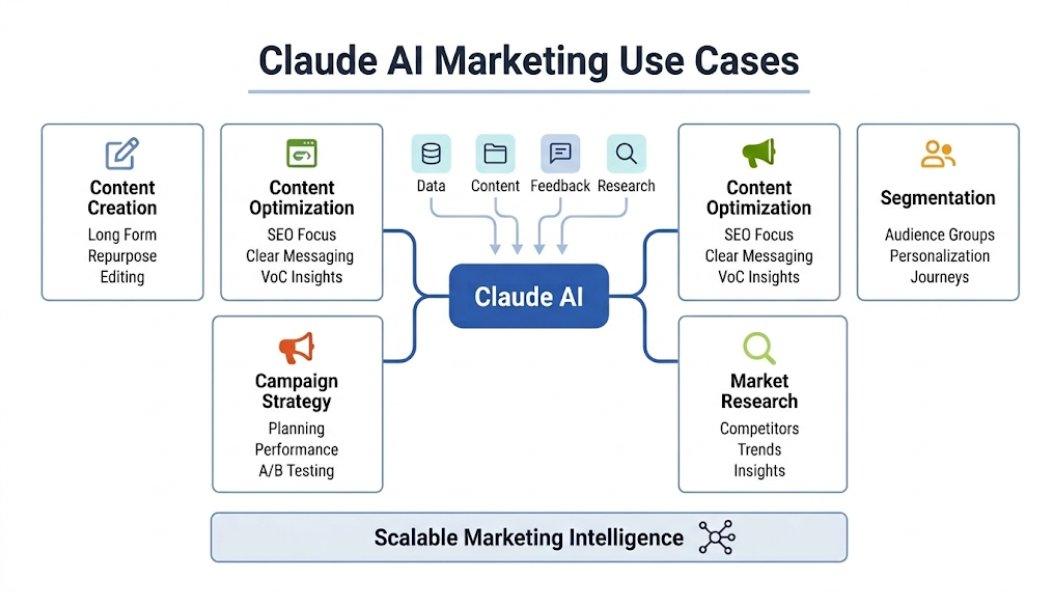
I will focus on five major use cases:
- Content creation
- Content optimization
- Customer segmentation and personalization
- Campaign strategy and optimization
- Market research and trend analysis
Each of these areas represents a common marketing challenge where Claude can add measurable value.
Content Creation and Content Operations
Long-Form Content Production
Many marketing teams struggle to maintain a consistent publishing schedule for high-quality content.
Producing blog articles, reports, whitepapers, and case studies requires significant time from writers and subject matter experts.
Claude can accelerate this process.
My typical workflow looks like this:
- Upload background material such as product documentation and research notes.
- Ask Claude to generate an outline aligned with the target audience and search intent.
- Review and refine the outline manually.
- Ask Claude to draft each section.
- Edit and expand the draft with expert insights.
This process reduces the time required to produce a detailed article while still allowing the marketing team to maintain editorial control.
Claude performs particularly well with long-form writing because it retains context across multiple sections.
Repurposing Content Across Channels
Content teams rarely produce a single asset.
A webinar, for example, might become:
- a blog article
- several LinkedIn posts
- a newsletter section
- short social media updates
- an internal sales enablement document
Claude handles this transformation efficiently.
After uploading the webinar transcript, I can ask Claude to create multiple content formats. The model extracts key insights and adapts them to different channels.
This capability helps teams extend the value of each content asset.
Editorial Assistance and Editing
Claude also functions well as an editorial assistant.
I frequently use it to:
- simplify technical explanations
- tighten paragraphs
- improve clarity
- adjust tone for different audiences
- restructure messy drafts
Because Claude understands context, it can suggest structural improvements rather than simply rewriting sentences.
For example, it might recommend reorganizing sections of an article to improve logical flow.
Human editors still play a critical role, but Claude reduces the amount of mechanical editing work required.
Content Optimization
SEO-Aware Content Development
Search visibility remains one of the main drivers of inbound traffic, especially for teams investing in SEO-driven content marketing.
Claude can assist with SEO in several ways.
First, it can help develop content outlines based on target keywords and search intent. Instead of generating shallow keyword stuffing, Claude can structure content around user questions and informational needs.
Second, it can identify missing subtopics.
For example, if I provide a draft article and ask Claude to evaluate it for completeness, the model may suggest additional sections addressing related questions users often search for.
This process improves content depth and relevance.
Improving Messaging Clarity
Another valuable application involves messaging clarity.
Marketing teams sometimes struggle to explain complex products in simple language.
Claude excels at translating technical descriptions into accessible explanations.
I often provide the model with product documentation and ask it to rewrite explanations for a specific audience.
For instance:
- enterprise buyers
- technical engineers
- small business owners
Claude adjusts the tone and level of detail accordingly.
This flexibility allows marketing teams to produce tailored messaging without rewriting content from scratch.
Voice of Customer Analysis
One of the most powerful ways to improve marketing messaging involves understanding how customers actually talk about problems.
Claude can analyze customer feedback at scale.
For example, I may upload hundreds of product reviews and ask the model to extract:
- the language customers use to describe benefits
- the most common frustrations
- emotional triggers behind purchasing decisions
These insights help shape messaging that resonates with real users rather than internal assumptions.
In several projects I have seen conversion rates improve simply by aligning landing page copy with phrases customers naturally use.
Customer Segmentation and Personalization
Personalization has become one of the central pillars of modern marketing. The challenge, however, is not understanding that personalization matters. The challenge is executing it consistently at scale.
Most marketing teams possess more customer data than they can realistically interpret. CRM systems store purchase histories, email engagement, support interactions, and behavioral data from websites and apps. Despite all this information, segmentation strategies often remain shallow.
Claude can significantly improve this process when used correctly.
Analyzing Customer Data to Identify Meaningful Segments
Customer segmentation often begins with quantitative analysis. Marketers use dashboards to group customers based on demographics, purchase value, or engagement metrics.
However, numbers rarely explain motivations.
Claude becomes valuable when I combine quantitative data with qualitative inputs such as:
- support tickets
- customer reviews
- interview transcripts
- survey responses
- community discussions
By providing Claude with these datasets, I can ask it to identify patterns in how customers describe their problems, expectations, and decision criteria.
The model often reveals segments that traditional analytics miss.
For example, a SaaS company might initially categorize customers by company size. After analyzing support conversations, Claude may identify three behavioral segments instead:
- Efficiency seekers who want faster workflows
- Power users who care about advanced features
- Low-engagement users who primarily value simplicity
These insights lead to far more effective messaging than basic demographic segmentation.
Generating Personalized Marketing Content
Once segments are defined, Claude can help produce tailored messaging for each group.
Instead of writing one campaign and slightly modifying it for multiple audiences, I can ask Claude to generate fully differentiated messaging.
For example, a single product launch email could become three distinct versions:
- one emphasizing productivity improvements
- one focusing on advanced technical capabilities
- one highlighting ease of use
Claude adapts tone, examples, and value propositions for each audience.
When used alongside marketing automation platforms, this capability allows teams to scale personalization without multiplying content production workload.
Personalizing Customer Journeys
Segmentation becomes more powerful when applied across the entire customer journey.
Claude can help design messaging sequences that adapt to different lifecycle stages:
- awareness
- consideration
- purchase
- onboarding
- expansion
For instance, early-stage prospects may respond better to educational content. Existing customers may care more about feature updates and optimization tips.
Claude can generate communication frameworks for each stage, ensuring consistent messaging across email, landing pages, and content campaigns.
The result is a more coherent customer experience.
Campaign Planning and Optimization
Marketing campaigns often involve dozens of interconnected decisions.
Teams must choose:
- target audiences
- messaging angles
- distribution channels
- budget allocations
- testing strategies
Claude can support each of these decisions by synthesizing available information.
Developing Campaign Strategies
When preparing for a campaign, I often provide Claude with:
- campaign objectives
- audience personas
- product positioning documents
- previous campaign performance data
I then ask Claude to help develop a structured campaign plan.
The model can propose elements such as:
- messaging themes
- creative concepts
- content calendar ideas
- channel strategies
- key performance indicators
This process does not replace strategic thinking. Instead it accelerates the planning phase by generating structured frameworks that the marketing team can refine.
Claude acts like a brainstorming partner who can immediately connect ideas to supporting rationale.
Interpreting Campaign Performance Data
Campaign analysis represents another area where Claude provides strong value.
Marketing teams often rely on dashboards filled with metrics such as:
- click-through rates
- conversion rates
- cost per acquisition
- engagement metrics
- retention figures
While dashboards show what happened, they rarely explain why.
Claude can analyze summarized performance data and propose explanations for trends.
For example, if a campaign shows rising traffic but declining conversions, Claude might suggest investigating:
- audience targeting changes
- landing page load times
- messaging alignment with audience intent
- competitive offers entering the market
The model structures this reasoning in a way that helps teams investigate the problem more efficiently.
Designing A/B Testing Strategies
Testing represents one of the most reliable methods for improving marketing performance.
However, teams often struggle to design meaningful experiments.
Claude can assist by proposing structured A/B testing frameworks.
For example, I might ask:
We want to improve email open rates for our weekly newsletter. What variables should we test?
Claude may recommend testing elements such as:
- subject line framing
- emotional vs informational language
- personalization tokens
- send time variations
- preview text optimization
It can also suggest hypotheses for each test.
This approach helps teams move beyond random experimentation toward more deliberate testing strategies.
Market Research and Competitive Analysis
Strategic marketing decisions depend heavily on understanding the broader market environment.
Traditional research methods require significant time and resources. Claude can accelerate many of these tasks by synthesizing large amounts of textual information.
Competitor Messaging Analysis
Competitive positioning often becomes clearer when examining how other companies communicate their value.
Claude can analyze competitor materials such as:
- website copy
- product pages
- marketing emails
- blog articles
- public presentations
By feeding these materials into Claude, I can ask the model to identify:
- key value propositions competitors emphasize
- messaging themes across the industry
- positioning gaps in the market
This analysis helps marketing teams refine their differentiation strategy.
Extracting Insights from Customer Discussions
Another valuable source of insight comes from community discussions.
Forums, social media threads, and product review platforms often contain detailed conversations about products and problems, which reflects the broader shift toward search everywhere optimization.
Claude can analyze these conversations and identify:
- recurring frustrations customers experience
- emerging trends in customer expectations
- unmet needs within the market
These insights often influence content strategy, product messaging, and campaign themes.
Synthesizing Research Reports
Marketers frequently rely on external research reports to understand industry developments.
However, these reports can span dozens or even hundreds of pages.
Claude can summarize and synthesize such reports quickly.
Instead of reading entire documents, teams can ask Claude to extract:
- key trends affecting the industry
- strategic implications for marketing teams
- potential opportunities or risks
This capability allows marketers to stay informed without sacrificing productivity.
Strategic Decision Support
Perhaps the most underrated use of Claude in marketing involves strategic thinking.
When faced with complex decisions, I often use Claude as a structured sounding board.
For example, I may ask:
- How might this product positioning resonate with different customer segments?
- What potential objections could prospects raise about this offer?
- Which messaging angles might resonate in this market category?
Claude generates thoughtful responses that force me to consider perspectives I might otherwise overlook.
The model does not replace strategic expertise. Instead it broadens the conversation and helps surface additional possibilities.
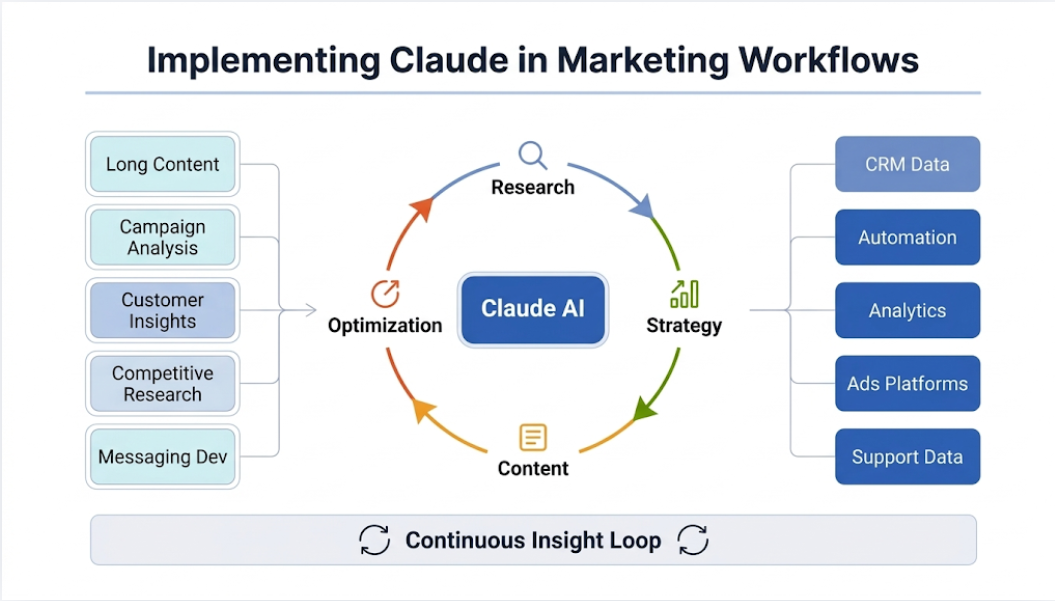
Implementing Claude AI in Marketing Workflows
Understanding Claude’s capabilities is only the first step. Real value appears when marketing teams integrate the tool into daily workflows.
Many organizations experiment with AI but fail to operationalize it. The tool remains an occasional brainstorming assistant instead of becoming a strategic asset.
Successful adoption requires deliberate integration into existing processes.
Identifying High-Impact Use Cases
Before introducing Claude across an entire marketing department, I recommend identifying a few areas where the tool can deliver immediate value.
In my experience, the highest impact entry points tend to be:
- long-form content development
- campaign performance analysis
- customer feedback analysis
- competitive research
- messaging development
These tasks share one important characteristic. They involve large amounts of unstructured information that humans must interpret.
Claude excels in those environments.
By focusing on these use cases first, teams quickly demonstrate tangible improvements in productivity and insight generation.
Building an AI-Assisted Marketing Workflow
Claude works best when incorporated into structured workflows rather than isolated prompts.
A typical AI-assisted marketing process might look like this.
Research Phase
The team collects relevant information such as:
- customer insights
- competitor messaging
- industry reports
- product documentation
Claude analyzes these materials and extracts key insights.
Strategy Phase
The marketing team uses those insights to refine:
- positioning statements
- audience segments
- campaign messaging frameworks
Claude contributes by challenging assumptions and generating alternative perspectives.
Content Development Phase
Writers and strategists collaborate with Claude to produce:
- article outlines
- campaign messaging
- landing page drafts
- email sequences
Humans remain responsible for final editorial quality and brand alignment.
Optimization Phase
After campaigns launch, Claude assists in analyzing performance data and identifying areas for improvement.
This cycle creates a continuous feedback loop where insights inform future campaigns.
Integrating Claude With Marketing Technology Stacks
Claude becomes significantly more powerful when connected to existing marketing infrastructure.
Depending on the organization, this infrastructure may include:
- CRM systems
- marketing automation platforms
- analytics dashboards
- advertising platforms
- customer support systems
Through APIs and integrations, Claude can interact with these data sources.
For example, a marketing team could:
- analyze CRM exports to identify customer segments
- review advertising performance data to detect patterns
- summarize support ticket trends to inform messaging
The more context Claude receives, the more valuable its insights become.
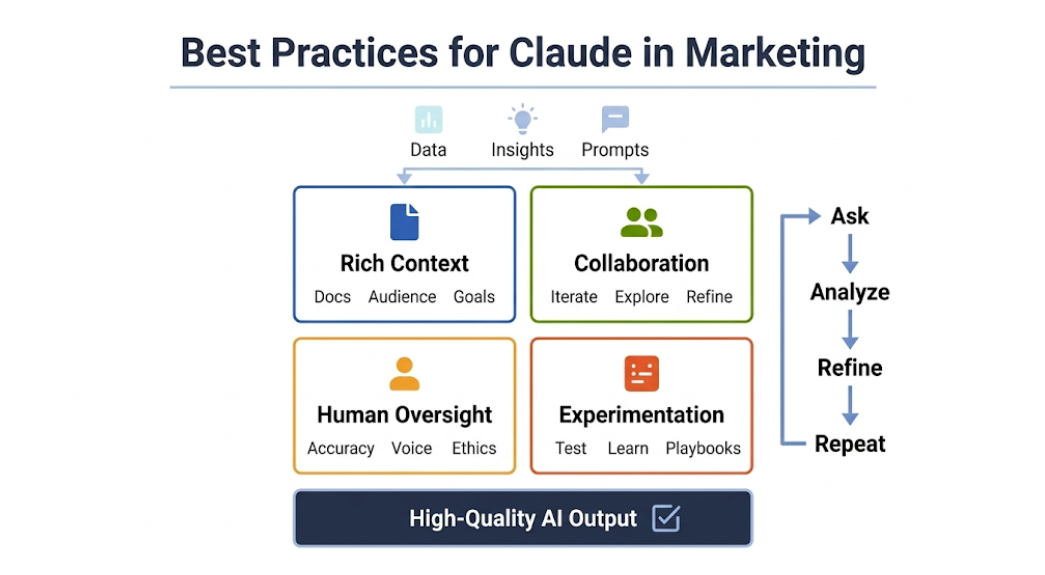
Best Practices for Using Claude in Marketing
After working extensively with AI systems in marketing contexts, I have identified several practices that consistently improve results.
Provide Rich Context
Claude produces its best work when it understands the environment surrounding the task.
Instead of short prompts, I often provide:
- brand positioning documents
- audience descriptions
- campaign objectives
- relevant research materials
This context allows Claude to generate responses that align with the broader marketing strategy.
Treat Claude as a Collaborative Partner
The most productive interactions with Claude resemble conversations with a knowledgeable colleague.
Rather than asking for a final answer immediately, I often explore a topic through multiple questions.
For example:
- Ask Claude to analyze a dataset.
- Ask follow-up questions about specific findings.
- Request alternative interpretations of the results.
- Refine the conclusions collaboratively.
This process often leads to deeper insights than a single prompt.
Maintain Human Editorial Oversight
AI should support marketing teams, not replace them.
Human experts must remain responsible for:
- factual accuracy
- brand voice consistency
- ethical considerations
- strategic decisions
Claude can accelerate analysis and drafting, but the final judgment should always remain with experienced professionals.
Encourage Internal Experimentation
Organizations that extract the most value from AI tend to create cultures of experimentation.
Marketing teams should feel encouraged to explore new ways of using Claude.
Some teams create internal documentation where employees share useful prompts, workflows, and discoveries.
Over time, this shared knowledge becomes an internal AI playbook.
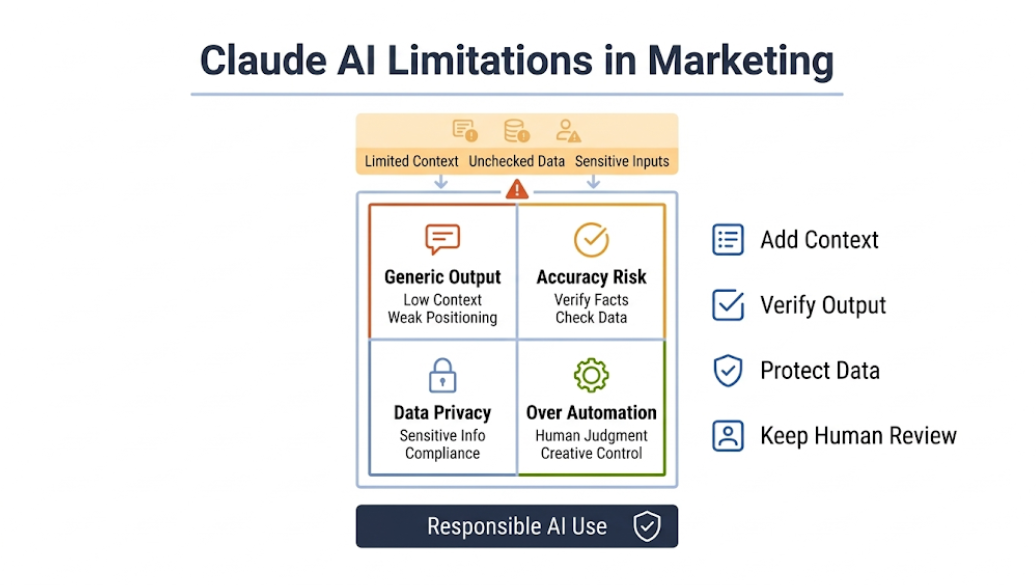
Challenges and Limitations Marketers Should Understand
While Claude offers impressive capabilities, it is not a perfect system. Marketers must understand its limitations in order to use it responsibly.
Risk of Generic Messaging
Without sufficient context, AI models often produce generic marketing language.
This happens when prompts lack information about:
- brand identity
- audience characteristics
- competitive positioning
Providing richer context reduces this problem significantly.
Accuracy and Fact Verification
Claude generally avoids confident hallucinations more effectively than many models, but errors can still occur.
Marketing teams should verify:
- statistics
- historical references
- product claims
- industry data
Treat AI output as a well-informed draft rather than an authoritative source.
Data Privacy Considerations
When using AI systems, organizations must consider how customer data is handled.
Sensitive information such as:
- personal identifiers
- confidential sales information
- proprietary strategy documents
should be handled carefully and in accordance with company policies.
Many organizations establish guidelines specifying which data can be shared with AI systems.
Over-Reliance on Automation
AI can accelerate marketing work, but it should not replace human creativity or judgment.
Marketing ultimately depends on understanding human motivations, emotions, and cultural context.
AI can assist in analyzing information and generating ideas. Human professionals must still shape the final narrative.
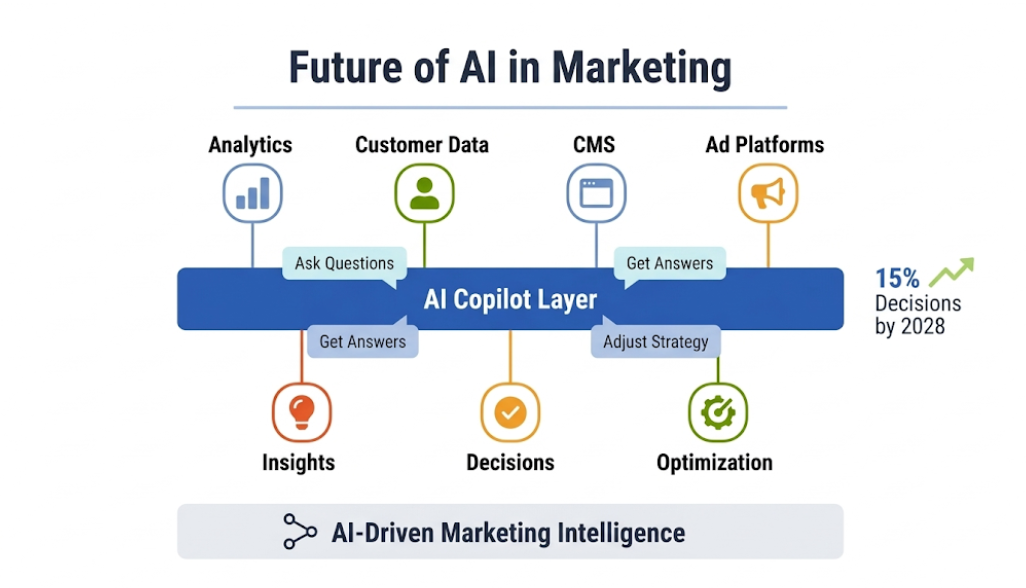
The Future Role of AI in Marketing
AI tools like Claude represent an early stage in a broader transformation of marketing workflows.
Over the next several years, I expect AI systems to become deeply embedded in the marketing technology stack. This shift is not speculative. According to Gartner projections reported by Reuters (2025), AI agents like Claude are expected to influence 15% of daily business decisions by 2028, including areas such as marketing automation and analytics.
Rather than existing as standalone tools, they will function as intelligent layers across:
- analytics platforms
- customer data systems
- content management systems
- advertising tools
Marketing teams will interact with these systems conversationally.
Instead of navigating dozens of dashboards, marketers may simply ask questions such as:
- Which customer segments show the highest lifetime value this quarter?
- What messaging themes resonate most strongly with enterprise buyers?
- How should we adjust our campaign strategy based on current performance?
AI systems will synthesize the necessary information and produce actionable insights.
In that environment, tools like Claude will operate less as writing assistants and more as strategic copilots for marketing teams.
FAQ: Claude AI for Marketing
1. How much does Claude AI cost for marketing teams?
Pricing varies by usage tier and API consumption. Teams typically pay based on token usage, with enterprise plans offering higher limits and support.
2. Can Claude AI be integrated directly with CRM and marketing automation tools?
Yes, through APIs. Claude can connect with CRM systems, analytics tools, and automation platforms to analyze data and generate insights within workflows.
3. How does Claude AI handle multilingual marketing content?
Claude supports multiple languages and can generate or adapt content for different regions, though human review is recommended for cultural nuance.
4. Is Claude AI suitable for real-time marketing tasks like live chat or customer support?
It can be used for support workflows, but latency and integration setup determine whether it’s suitable for real-time applications.
5. How secure is customer data when using Claude AI?
Security depends on implementation. Teams should follow data governance policies and avoid sharing sensitive or personally identifiable information without safeguards.
6. Can Claude AI replace human marketers in content and strategy roles?
No. Claude enhances productivity and analysis, but human expertise is required for strategy, creativity, and final decision-making.
7. How long does it take to implement Claude AI into a marketing workflow?
Basic use can start immediately, while full integration into systems and processes may take weeks depending on complexity.
8. What types of companies benefit most from using Claude AI?
Companies with large volumes of content, data, or complex marketing operations, such as SaaS, e-commerce, and enterprise organizations, see the greatest impact.
9. Does Claude AI require prompt engineering skills to be effective?
Yes, to an extent. Better results come from structured inputs, clear context, and iterative interaction rather than simple prompts.
10. How does Claude AI perform compared to human analysts in marketing research?
Claude accelerates data synthesis and pattern recognition, but human analysts provide deeper contextual judgment and business understanding.
Final Thoughts
Claude AI does not replace marketing expertise. It amplifies it.
The tool becomes valuable when marketers approach it with clear objectives, rich context, and thoughtful questions.
When used properly, Claude can:
- accelerate research
- clarify messaging
- analyze complex datasets
- generate structured insights
- assist with content development
These capabilities allow marketing teams to focus more energy on strategy, creativity, and customer understanding.
The organizations that benefit most from AI will not be the ones that automate everything. They will be the ones that combine intelligent tools with experienced human judgment.
Claude represents a powerful step in that direction.

How We Help Companies Apply AI-Driven Marketing at RiseOpp
At RiseOpp, we work with companies that are navigating exactly the challenges discussed throughout this article. AI tools like Claude are changing how marketing teams research markets, develop messaging, produce content, and analyze campaigns. The opportunity is enormous, but most organizations struggle with implementation. Tools alone do not create results. Strategy, systems, and execution do.
This is where our team comes in.
At RiseOpp, we work directly with leadership teams as a Fractional CMO partner, helping organizations modernize their marketing strategy for the AI era. We help both B2B and B2C companies build scalable marketing engines that combine human expertise with AI-powered tools. That includes everything from brand positioning and messaging development to hiring and structuring internal marketing teams and executing campaigns across multiple channels.
One of our core areas of expertise is SEO, where we apply our proprietary Heavy SEO methodology. Instead of chasing isolated keywords, our approach focuses on systematically building authority and content depth so that companies can rank for tens of thousands of keywords over time. When combined with AI-assisted content development and market analysis tools like Claude, this approach allows organizations to build durable organic growth engines rather than relying only on paid acquisition.
Beyond SEO, we help companies execute across the full modern marketing stack, including:
- SEO and GEO (Generative Engine Optimization)
- PR and authority building
- Google Ads, Meta Ads, LinkedIn Ads, and TikTok Ads
- Email marketing and lifecycle automation
- Affiliate marketing and partnerships
- Marketing analytics and growth strategy
Our focus is simple. We help companies turn marketing from a collection of disconnected tactics into a coherent growth system that works in an AI-driven landscape.
If your organization is exploring how to integrate AI tools like Claude into your marketing strategy or looking to scale your growth through a more sophisticated SEO and demand generation strategy, we would be happy to talk.
Comments are closed