- Digital content strategy is a business operating system that defines positioning, audience intent, architecture, governance, distribution, and measurement to drive measurable outcomes.
- Digital content strategy maps granular audience intent to journey stages and builds structured SEO, internal linking, proof standards, and conversion pathways into the architecture.
- Digital content strategy requires lifecycle management, modular production systems, clear ownership, and continuous optimization tied to revenue, activation, retention, and support efficiency.
I don’t treat digital content strategy as a content calendar or a publishing cadence. I treat it as a growth system: a set of decisions and operating rules that determine what you say, who you say it to, where it lives, how it gets discovered, and how it drives measurable outcomes over time.
In this piece, I’ll break down how I build digital content strategies that hold up in professional environments. I’ll cover how I define the discipline, tie it to business goals, model audience intent, audit and architect content, operationalize production and governance, engineer distribution, and measure performance without falling into attribution theater. The aim is practical: give you a framework you can use to diagnose your current program, design a content system that compounds, and scale execution without sacrificing quality or credibility.
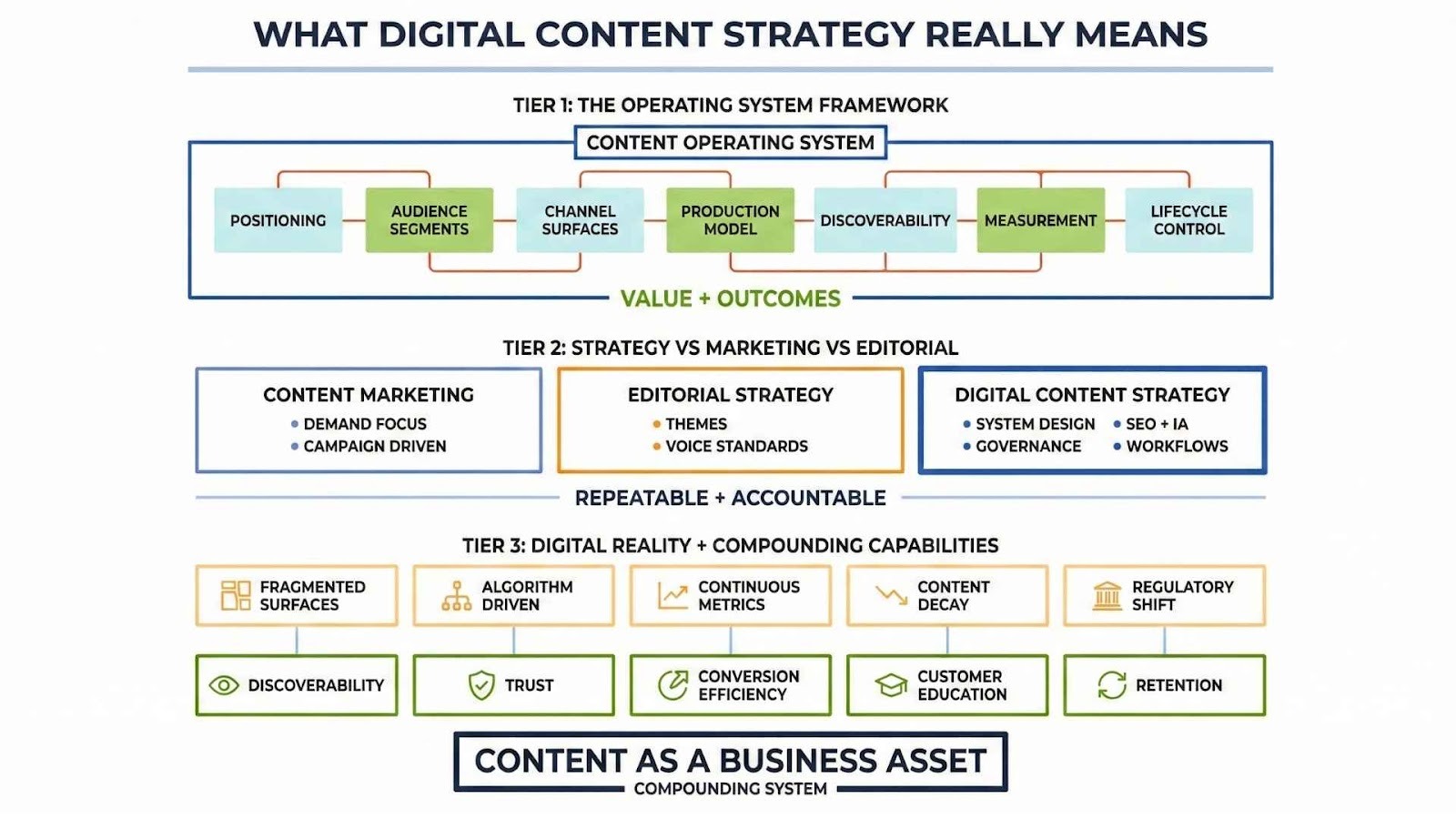
What I Mean by Digital Content Strategy
Digital content strategy is the operating system behind how an organization uses content to create value for an audience and measurable outcomes for the business. According to SEO.com research, 70% of marketers report content marketing increases leads and engagement.
I’m not talking about “content marketing” as a channel activity, and I’m not talking about “a blog plan.” I mean the full set of decisions and systems that determine:
- What you will say (positioning, narrative, messaging, points of view).
- Who you will say it to (audience segments, needs, jobs-to-be-done, intent states).
- Where it will live (web properties, product surfaces, social, email, partners, communities).
- How it will be produced (people, workflow, governance, tooling).
- How it will be found (search architecture, distribution, demand capture).
- How it will perform (measurement, experimentation, optimization loops).
- How it will stay true and current over time (maintenance, lifecycle, knowledge management).
When you do it well, content stops being a stream of assets and becomes a portfolio of compounding business capabilities: discoverability, trust, conversion efficiency, customer education, and retention.
Digital content strategy vs. content marketing vs. editorial strategy
Professionals often use these terms interchangeably, and that’s where programs get messy, especially when teams blur the line between content strategy vs content marketing.
- Content marketing typically focuses on using content to drive demand and revenue outcomes. It’s often campaign-driven and channel-focused.
- Editorial strategy focuses on what you publish: themes, cadence, voice, story formats, and standards.
- Digital content strategy subsumes both. It includes editorial decisions, but it also includes governance, information architecture, SEO systems, content design, operational workflows, and measurement frameworks.
I treat digital content strategy as the discipline that makes content repeatable, scalable, and accountable. According to Content Marketing Institute research, 97% of marketers now have a documented content strategy.
What “digital” changes
“Digital” introduces constraints and opportunities that print-era content strategy never had to solve at scale:
- Content fragments across surfaces: web pages, app UI, help centers, newsletters, social, partner marketplaces.
- Distribution engines shape outcomes: search algorithms, recommendation systems, inbox filtering, social ranking, and even small changes in click-through behavior can materially affect results..
- Measurement becomes continuous: you can instrument performance, iterate fast, and prove impact.
- Maintenance matters: content decays, products change, SERPs shift, regulations evolve.
If you want content to function like a business asset, you have to design for these realities.
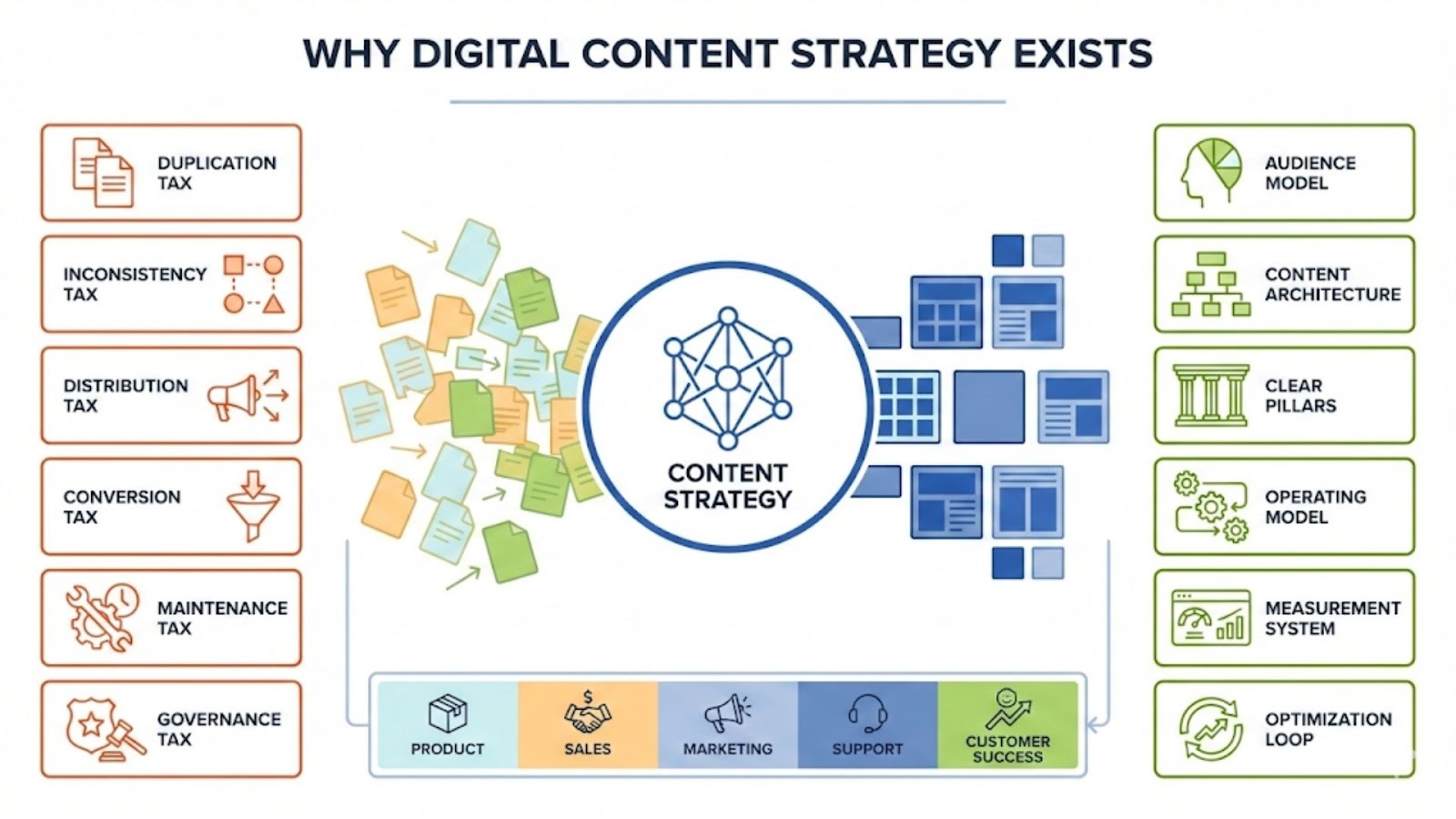
Why Digital Content Strategy Exists and What It Solves
When I get pulled into a program, I rarely start by asking “what should we publish?” I start by diagnosing what content is failing to do. Content strategy exists to solve a set of recurring organizational problems.
The hidden costs of “random acts of content”
Without a strategy, teams pay predictable taxes:
- Duplication tax: multiple assets covering the same thing with different answers.
- Inconsistency tax: mismatched voice, claims, terminology, and promises.
- Distribution tax: content gets made but never earns reach because nobody engineered discoverability, or because teams never align SEO and content from the start
- Conversion tax: content generates traffic that does not progress toward pipeline, activation, or retention.
- Maintenance tax: old content misleads users, increases support burden, and erodes trust.
- Governance tax: approvals become politics, and publishing becomes slow and brittle.
A strategy prevents these taxes by making explicit decisions and building systems around them.
What a good strategy produces in practice
In mature organizations, a content strategy produces tangible outcomes:
- A shared audience and intent model that informs everyone’s priorities.
- A content architecture that maps to the user journey and the product.
- A set of content pillars and narratives tied to positioning.
- A scalable operating model: roles, workflows, standards, governance.
- A measurement system that links content activity to business outcomes.
- A continuous optimization loop that improves performance over time.
I care less about how many posts you publish and more about whether your content behaves like a coherent system.
Where content strategy shows up beyond marketing
Professionals often confine content strategy to marketing, but in advanced programs, it spans:
- Product: onboarding, in-app education, release comms, templates, UI copy.
- Customer success: enablement content, renewal narratives, expansion education.
- Support: knowledge base architecture and deflection.
- Sales: battlecards, one-pagers, proof libraries, vertical kits.
- Brand: narrative consistency, claims substantiation, trust signals.
If you build strategy only for marketing, you’ll miss the compounding value that comes from aligning content across the lifecycle.
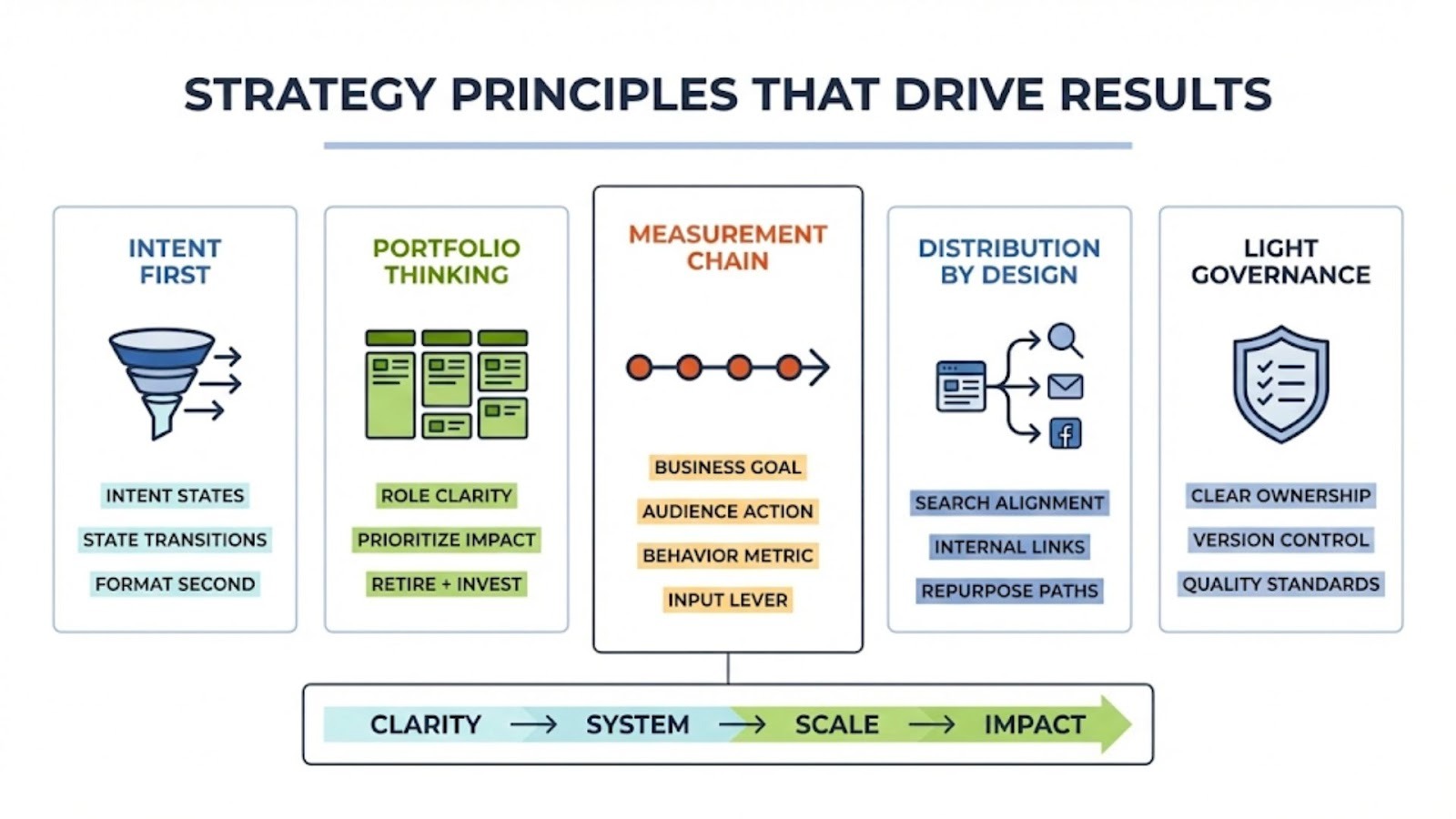
Principles I Use to Build Strategies That Actually Work
I use a few principles as guardrails. They keep strategy grounded in real operations and real outcomes.
Principle 1: Start with audience intent, not formats
Formats are output. Intent is the driver.
I model intent states such as:
- Unaware or problem-framing
- Solution exploration
- Shortlisting and evaluation
- Implementation planning
- Operational mastery
- Expansion and advocacy
Then I map the content system to move people between states.
Principle 2: Treat content as a product portfolio
Every piece of content has a role: acquire, educate, convert, retain, reduce support load, build trust. Content teams should manage content like product managers manage features:
- Prioritize based on impact and cost.
- Maintain quality and accuracy.
- Retire what no longer serves.
- Invest in platforms and systems, not just outputs.
Principle 3: Build a measurement chain from business outcomes to content inputs
If I can’t connect content to outcomes, I can’t defend investment or improve it, which is why I anchor decisions in analytics metrics that actually change behavior.
I built a measurement chain like this:
Business goal → audience action → content behavior metric → content input lever
Example:
- Goal: increase qualified pipeline
- Action: request demo from target segment
- Behavior metric: landing page conversion rate for segment-specific paths
- Lever: improve comparative pages, proof modules, internal linking, email sequences
Principle 4: Design for distribution from the first draft
Discoverability and reach are not afterthoughts, strong outcomes usually come from disciplined on-page execution and routing. I design content with:
- Search architecture and intent alignment
- Internal linking and navigational pathways
- Repurposing for social and email
- Partner syndication and co-marketing surfaces
Principle 5: Make governance lightweight but real
Governance does not mean bureaucracy. It means:
- Clear ownership
- Standard definitions
- Versioning and review cycles
- Quality controls
- Approved claims and proof references
If governance is unclear, teams compensate with endless approvals and slow publishing.
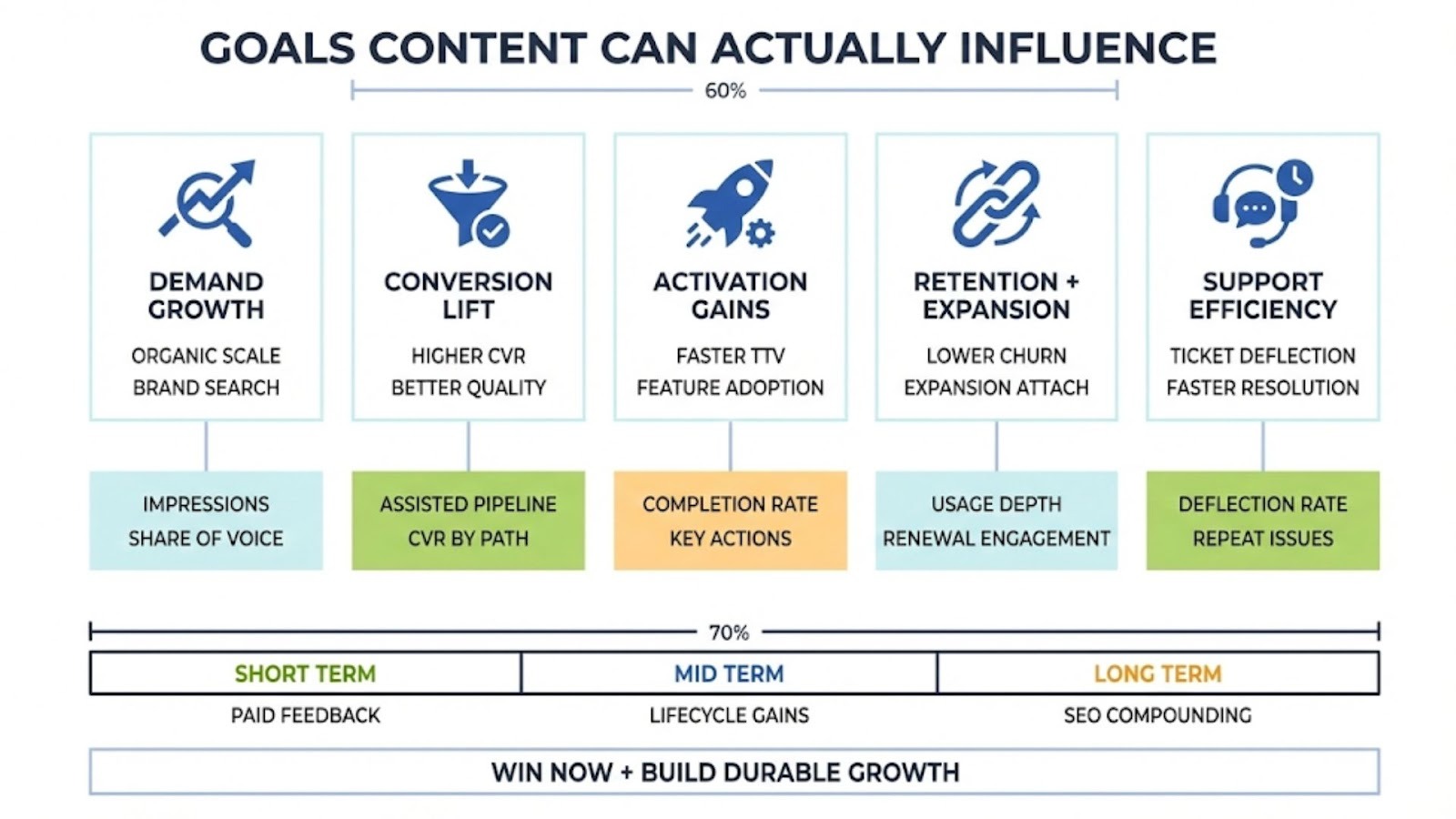
Setting Goals That Content Can Actually Influence
A common failure mode is setting goals content cannot realistically drive. I anchor goals to where content truly moves the needle.
Goal categories I use
- Demand creation and capture
- Organic growth, email growth, brand search lift, direct traffic
- Conversion efficiency
- Higher CVR, better lead quality, lower CAC, shorter sales cycles
- Activation and adoption
- Faster time-to-value, feature adoption, onboarding completion
- Retention and expansion
- Reduced churn drivers, higher expansion attach, better NPS drivers
- Support cost reduction
- Deflection, fewer tickets, faster resolution
Turning goals into measurable content outcomes
I translate high-level goals into content-relevant metrics:
- Awareness goals map to: impressions, reach, branded search, share of voice, engaged sessions.
- Conversion goals map to: assisted conversions, CVR by intent path, pipeline influenced.
- Activation goals map to: completion rates, activation milestones, adoption of key actions.
- Retention goals map to: usage depth, renewal education engagement, expansion content consumption.
- Support goals map to: ticket deflection rate, help center success rate, repeat issue volume.
Choosing the right time horizon
Professionals often under-estimate time.
- SEO-led programs compound over months. I plan 6 to 18 months for meaningful maturity.
- Lifecycle content can show impact faster if instrumentation exists.
- Paid distribution gives immediate feedback but demands strong conversion assets.
A good strategy mixes time horizons so teams can win now and build durable growth.
Audience Research and Segmentation I Actually Trust
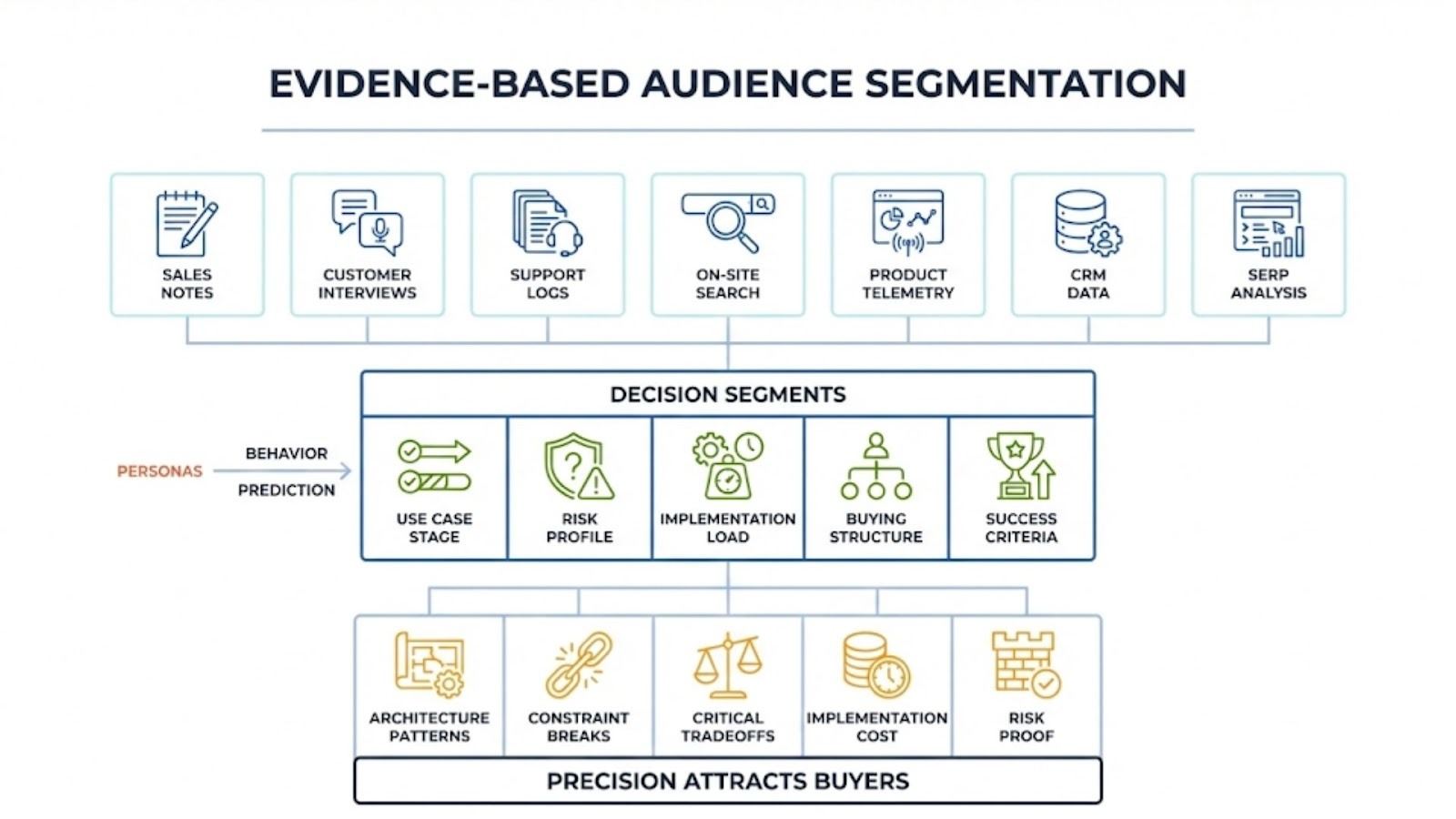
I don’t rely on personas built from assumptions or workshop vibes. I use evidence. For professionals writing for professionals, you need sharper segmentation than “SMBs vs enterprise.”
Inputs I use for professional-grade audience understanding
- Sales call notes and discovery transcripts
- Customer interviews focused on decision process, not preferences
- Support tickets and chat logs
- On-site search queries
- Product telemetry (activation paths, drop-offs)
- CRM and opportunity data (industry, use case, sales cycle patterns)
- SERP analysis for intent clusters and competitive framing
- Community conversations and objections
From personas to decision segments
Personas often describe people. Strategy needs segments that predict behavior.
I define segments using variables like:
- Use case maturity: first-time buyer vs switching vs scaling
- Risk tolerance: conservative vs experimental
- Implementation complexity: light vs heavy integration
- Buying committee composition: single-threaded vs multi-stakeholder
- Success criteria: speed, compliance, cost, performance, extensibility
Then I align content to each segment’s evaluation logic.
Intent modeling for experts
Expert audiences do not respond to generic advice. They respond to precision.
I map intent into granular questions such as:
- What architecture patterns work for this problem?
- What constraints break common approaches?
- What tradeoffs matter under compliance and scale?
- What does implementation really cost in time and risk?
- What proof reduces perceived risk?
If your content does not answer these questions, you will attract beginners and miss buyers.
Content Audit and Opportunity Analysis
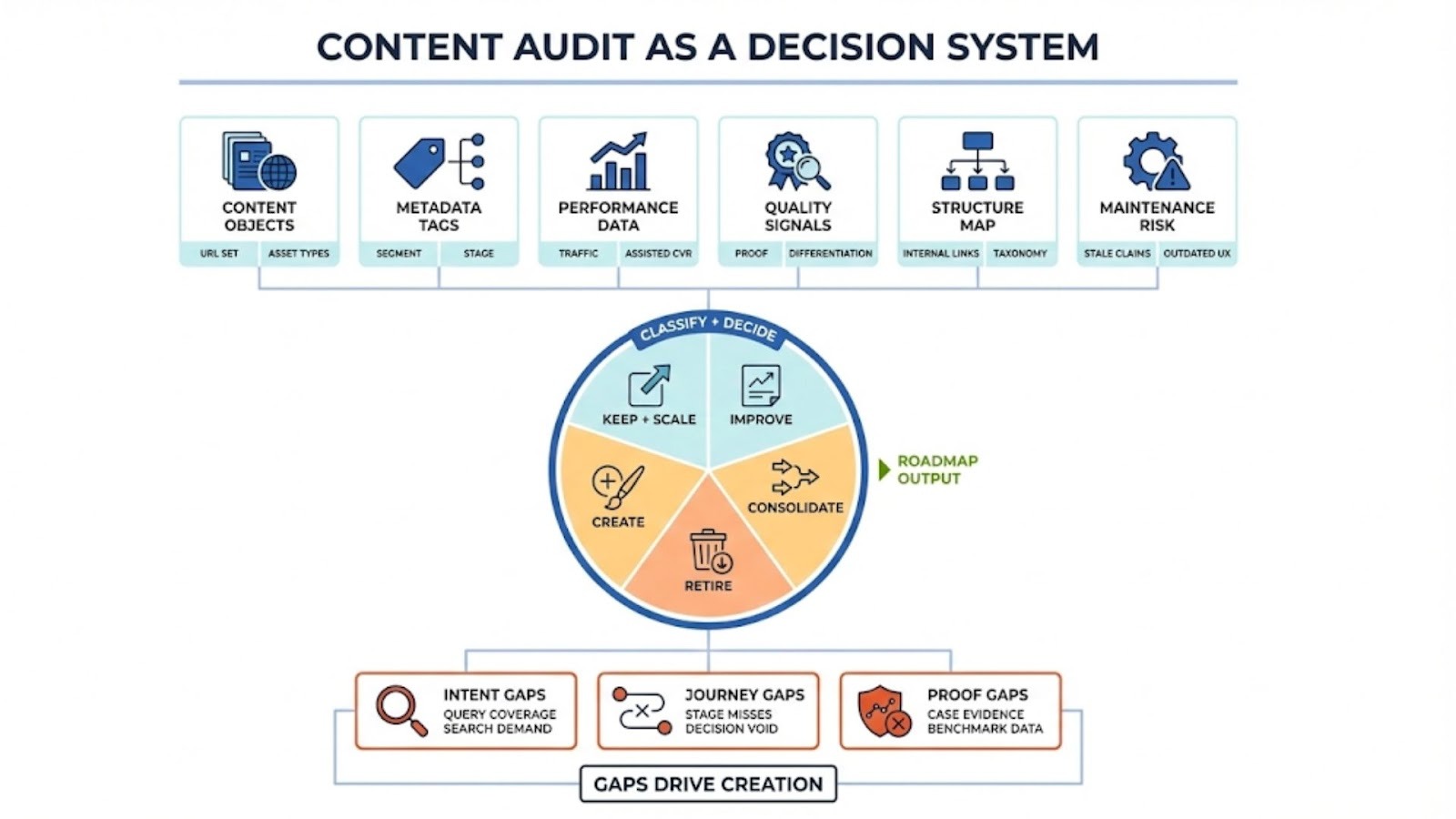
I treat the audit as a decision tool, not a catalog.
What I inventory in a serious audit
- Every meaningful URL and content object: blog, landing pages, docs, templates, videos, PDFs
- Metadata: purpose, segment, journey stage, owner, last updated
- Performance: traffic, engagement, conversions, assisted conversions, search queries
- Quality: accuracy, completeness, clarity, proof, differentiation
- Structure: internal linking, taxonomy alignment, cannibalization risk
- Maintenance risk: stale claims, outdated screenshots, broken processes
How I categorize outcomes
I typically classify content into:
- Keep and scale: strong performance and strategic fit
- Improve: high potential but weak execution
- Consolidate: overlap and cannibalization
- Retire or redirect: obsolete, low value, or brand risk
- Create: missing assets needed for intent coverage
This classification becomes the roadmap.
Opportunity mapping: gaps, not guesses
I look for gaps in three places:
- Intent gaps: high-value queries and questions with no strong answer
- Journey gaps: missing assets in consideration and decision stages
- Proof gaps: claims without evidence, missing case studies, missing benchmarks
For professional audiences, proof gaps kill performance more than writing quality.
Content Architecture and Information Design
A high-performing content program feels easy to navigate. That does not happen by accident.
Content pillars, clusters, and narrative layers
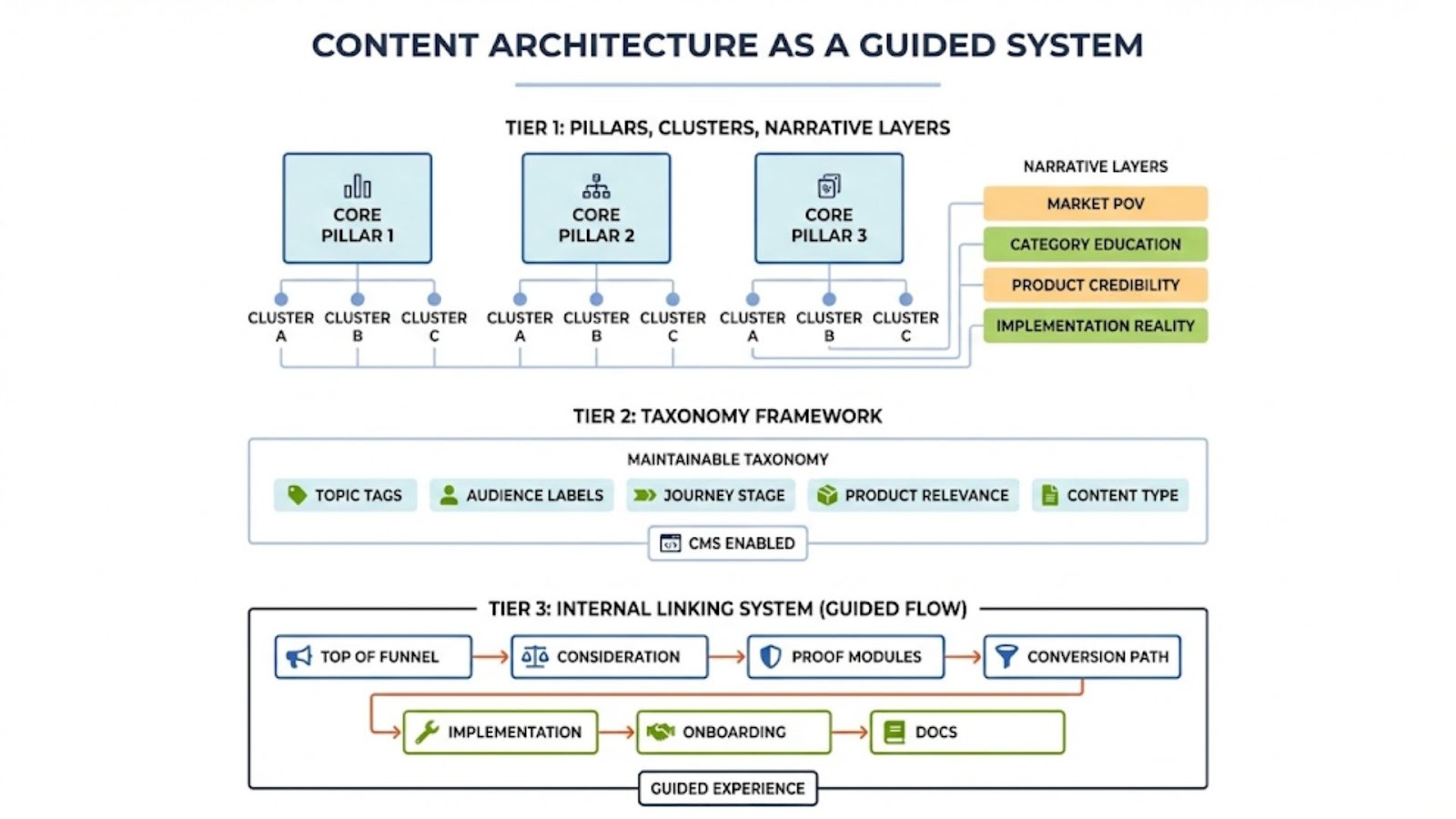
I structure content into:
- Pillars: core themes tied to positioning and enduring problems
- Clusters: supporting content that covers subtopics and intent variations
- Narrative layers:
- Market POV: how we see the problem differently
- Category education: what matters and why
- Product credibility: how we solve it, with proof
- Implementation reality: what it takes to succeed
This structure supports SEO, conversion, and trust simultaneously.
Taxonomy and tagging that teams can maintain
I design a taxonomy that editorial, SEO, and ops teams can actually use:
- Topic tags that align with pillars
- Audience segment labels
- Journey stage labels
- Product relevance labels
- Content type labels
Then I make sure the CMS supports it cleanly.
Internal linking as a strategic system
Internal linking is not an SEO hack. It is user guidance.
I define linking rules such as:
- Every top-of-funnel piece must route to one or more consideration assets.
- Every consideration asset must route to proof modules.
- Proof assets must route to conversion paths.
- Implementation content must route to onboarding or docs.
This turns content into a guided experience instead of a pile of pages.
Editorial Strategy: Voice, Standards, and Differentiation
For professional audiences, editorial strategy must produce authority without sounding like posturing.
Voice and tone: how I keep it credible
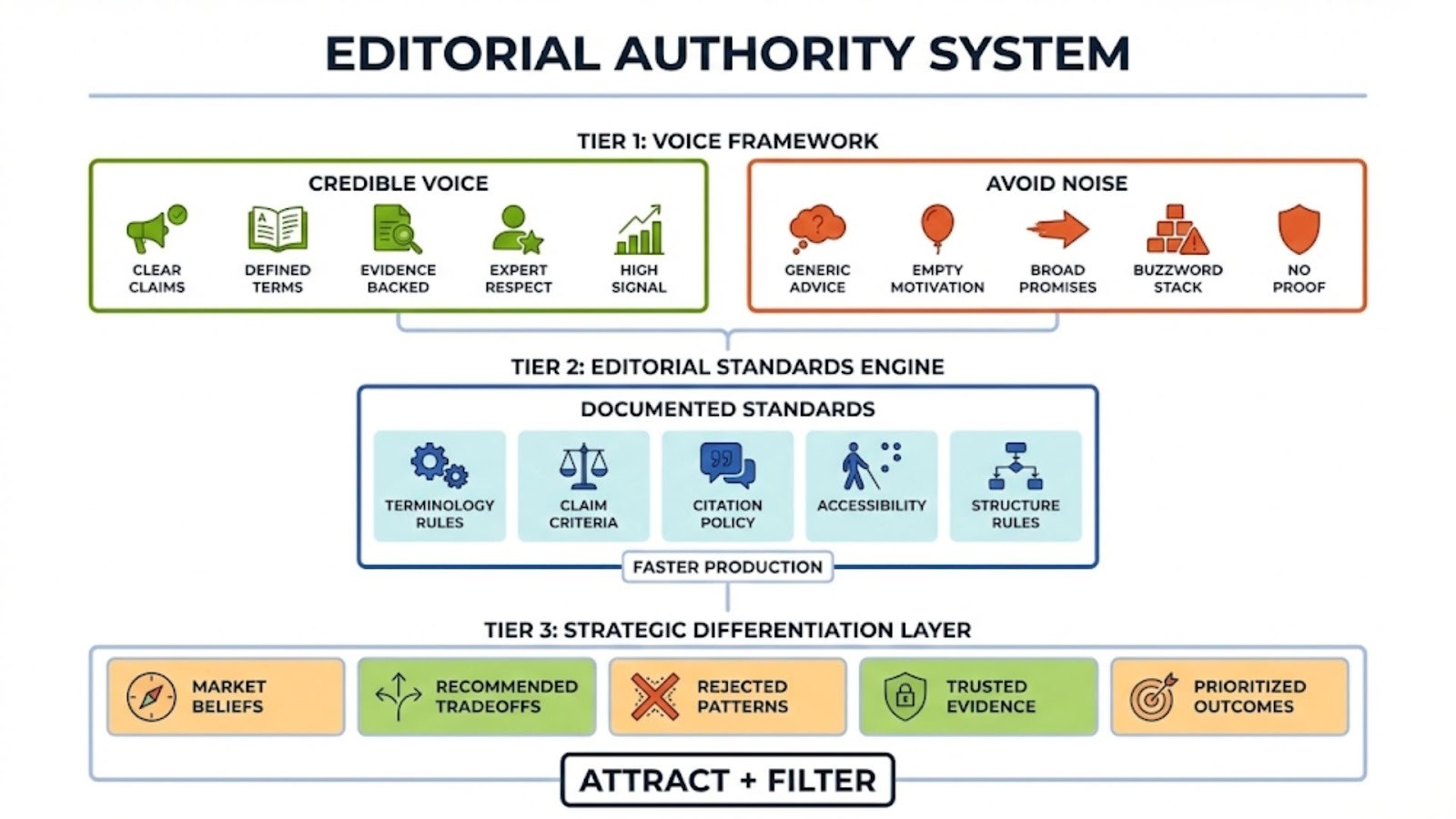
I aim for:
- Clear claims with boundaries
- Precise language and definitions
- Confident POV backed by evidence
- Respect for reader expertise
- Minimal fluff, maximum signal
I avoid:
- Overgeneralized “best practices”
- Empty motivational framing
- Broad promises with no proof
- Buzzword stacking
Standards I document
I create standards for:
- Terminology and naming conventions
- Claim requirements and proof expectations
- Citation rules for data and benchmarks
- Accessibility and inclusive language
- Style rules for headings, scannability, and structure
These standards reduce editorial debate and speed production.
Differentiation: your strategy must decide what you will not say
Most brands sound the same because they refuse to take a position.
I establish:
- What we believe about the market
- What tradeoffs we recommend
- What patterns we reject and why
- What evidence we trust
- What outcomes we prioritize
Your best content should make the right readers nod and the wrong readers self-select out.
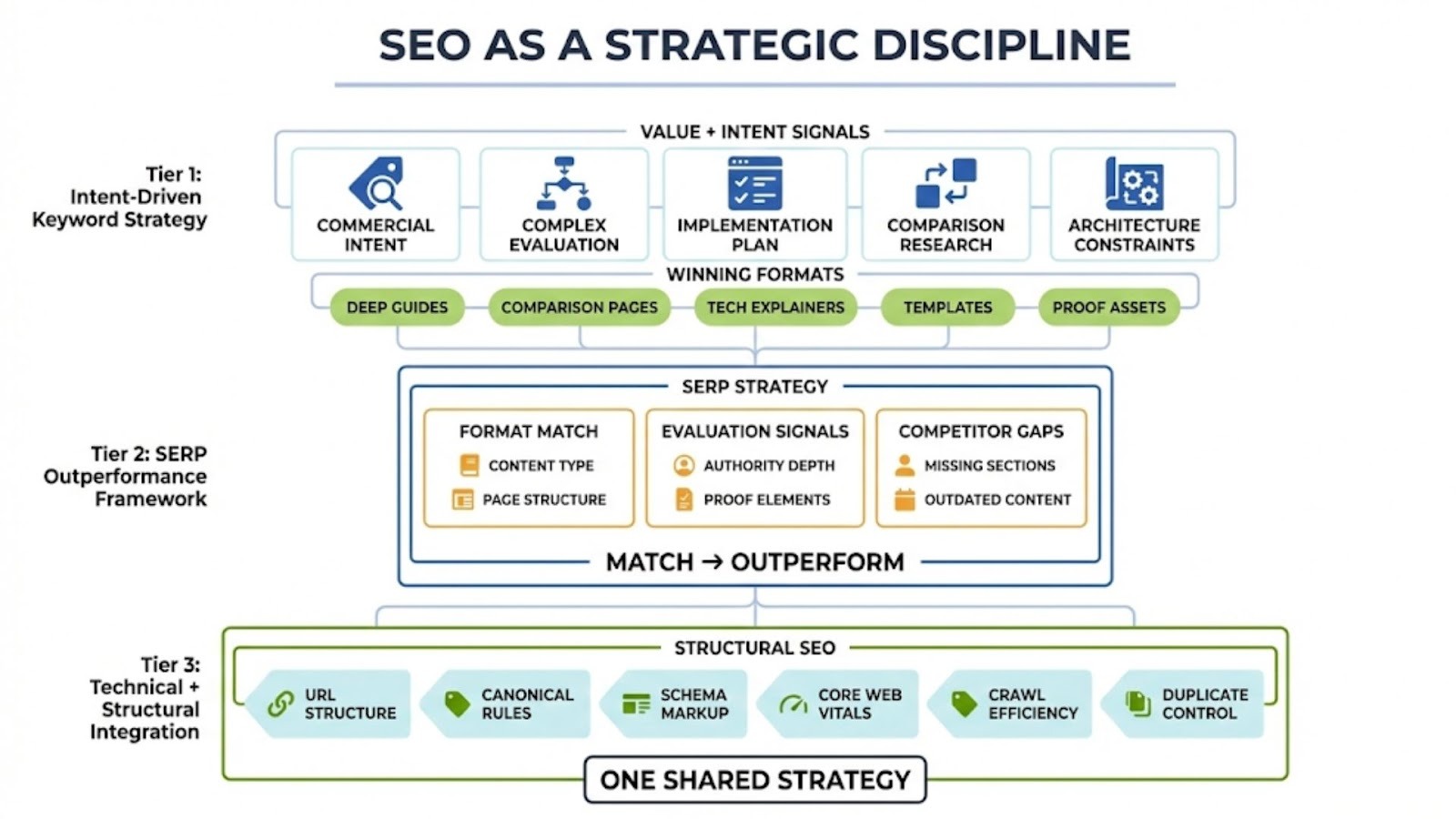
SEO and Discoverability as a Strategic Discipline
SEO sits inside content strategy, not beside it.
How I do keyword research for experts
I do not chase volume. I chase value and intent.
I prioritize keywords that signal:
- High commercial intent
- Complex evaluation needs
- Implementation planning
- Comparison and alternatives research
- Compliance, performance, and architecture constraints
Then I map those keywords to content types that actually win: deep guides, comparison pages, technical explainers, templates, and proof assets.
SERP strategy: match format, then outperform substance
I analyze:
- Dominant content format in the SERP
- The implicit evaluation criteria Google rewards
- Competitor gaps: missing sections, shallow proof, outdated guidance
Then I build content that matches the expected format and adds depth, structure, and credible examples.
Technical and structural SEO in the content strategy scope
Content strategy should influence:
- URL structure and taxonomy
- Canonicals and consolidation rules
- Schema markup opportunities
- Core Web Vitals and UX constraints
- Indexation and crawl efficiency
- Duplicate content prevention
If you separate content and technical teams without a shared strategy, performance suffers, and you miss chances to automate repeatable SEO work responsibly.
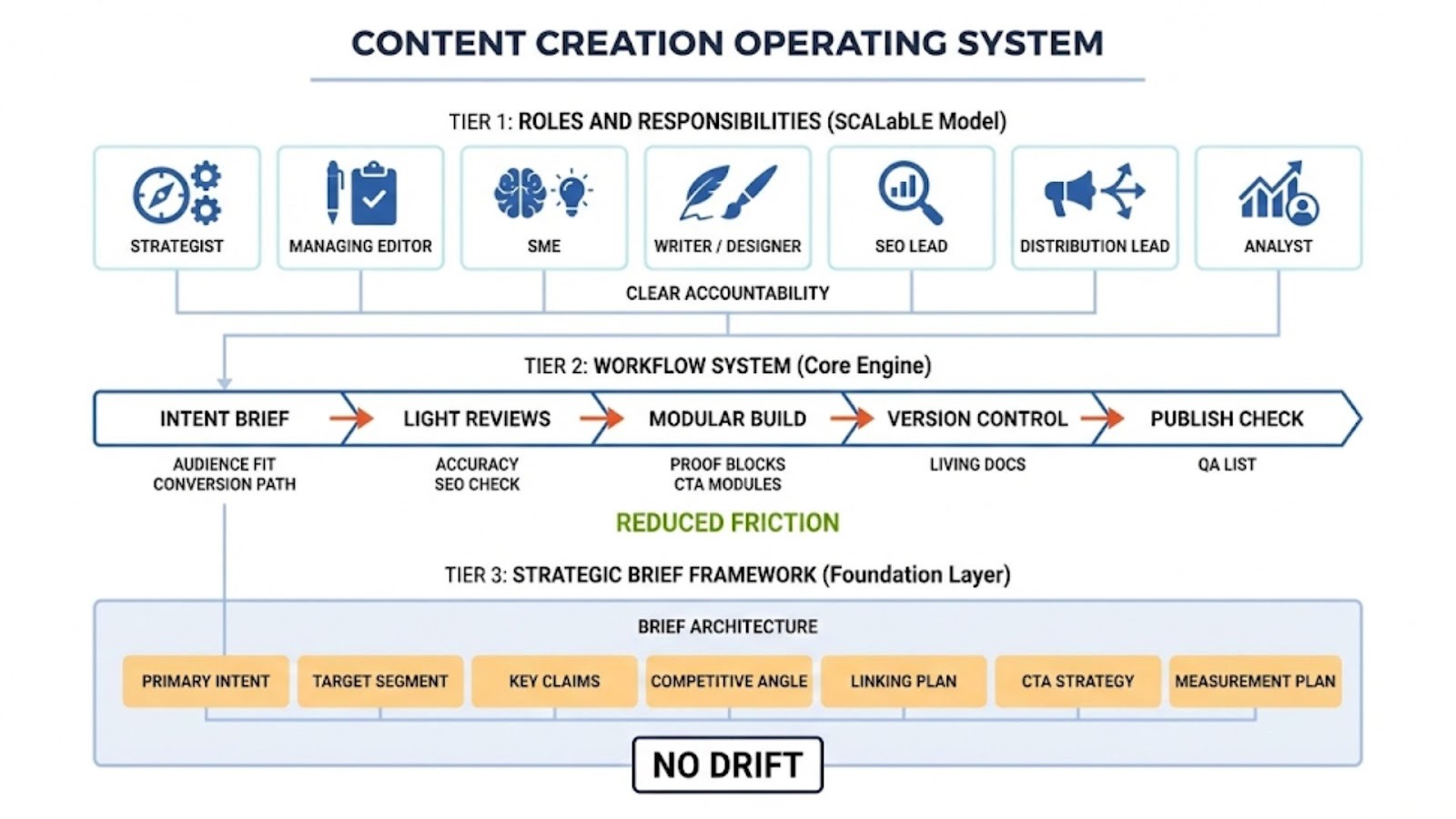
Content Creation Systems and Workflow
Professional-grade output requires professional-grade operations.
Roles and responsibilities that scale
A mature model often includes:
- Content strategist: architecture, prioritization, governance
- Managing editor: editorial standards, calendars, quality control
- Subject matter experts: technical truth and credibility
- Writers and content designers: execution and structure
- SEO lead: intent models, on-page standards, performance insights
- Distribution lead: email, social, partnerships, syndication
- Analyst: dashboards, attribution, experimentation
Small teams can combine roles, but they cannot skip the responsibilities.
Workflow I implement to reduce friction
I design workflows around:
- Clear briefs tied to intent, audience, and conversion pathways
- Lightweight reviews: accuracy, compliance, brand, SEO
- Component-based content: reusable proof modules, CTAs, comparison blocks
- Version control for living documents
- Publication checklists that prevent avoidable mistakes
Content briefs that experts respect
My briefs include:
- Primary intent and secondary intents
- Target segment and decision context
- Key claims and required proof
- Competitive angle and differentiation
- Internal linking requirements
- CTA strategy and next-step design
- Measurement plan
If the brief lacks these, the draft will drift.
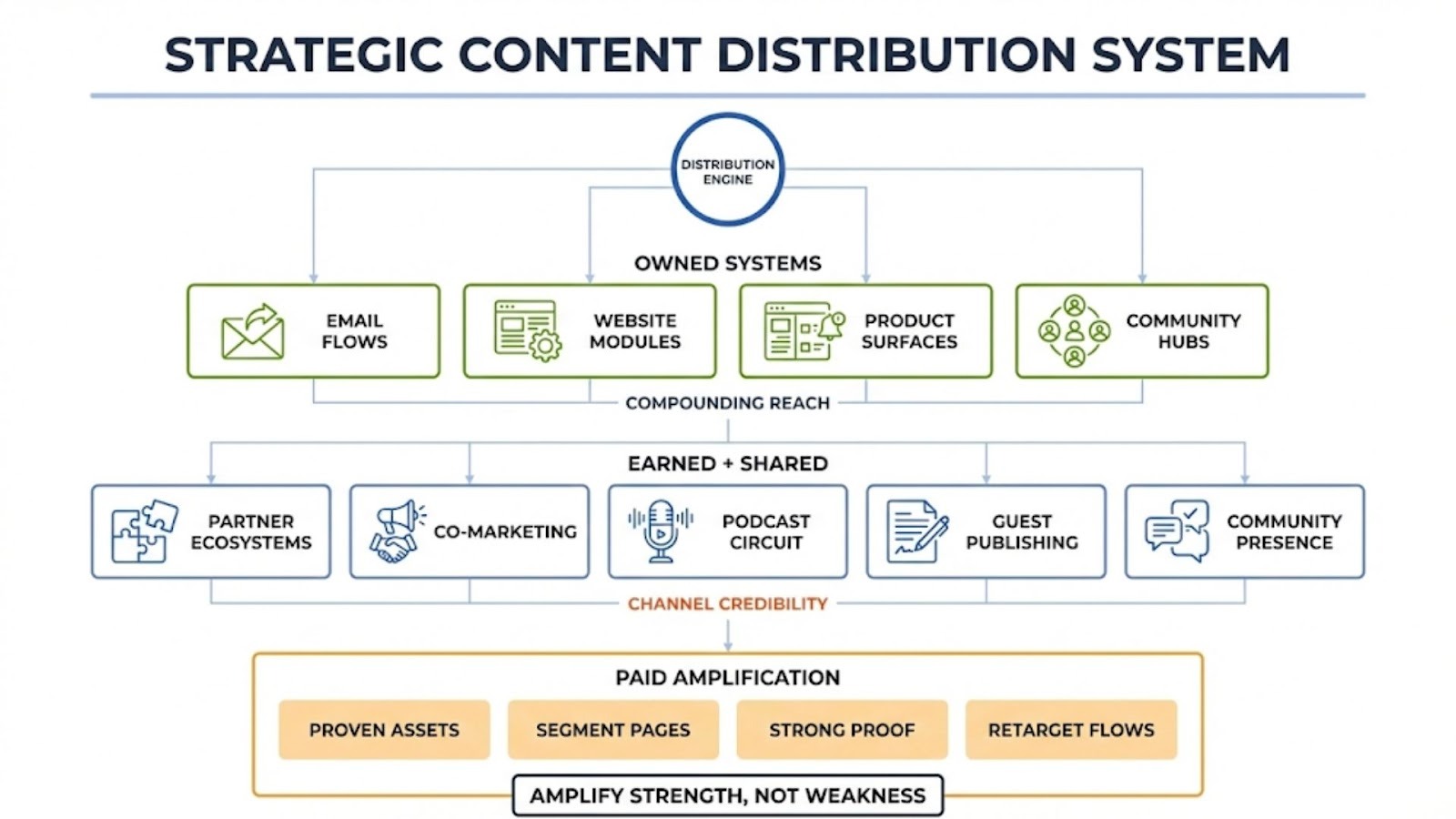
Distribution and Promotion as Part of the Strategy
Distribution is how content earns attention.
Owned distribution systems
- Email: newsletters, nurture sequences, lifecycle triggers
- Website modules: recommended content, navigation, resource centers
- Product surfaces: in-app education, release notes, templates
- Community: events, forums, peer groups
Owned systems compound when you design them intentionally.
Earned and shared distribution
- Partner ecosystems and integrations
- Co-marketing with credible peers
- Podcast and webinar circuits
- Guest publishing and syndication
- Community participation and thought leadership
For professionals, credibility of the distribution channel matters as much as the content.
Paid distribution where it makes strategic sense
Paid works best when you have:
- Proven conversion assets
- Segment-specific landing pages
- Strong proof modules
- Retargeting flows aligned to intent
If you do not have these, paid will amplify weak conversion systems.
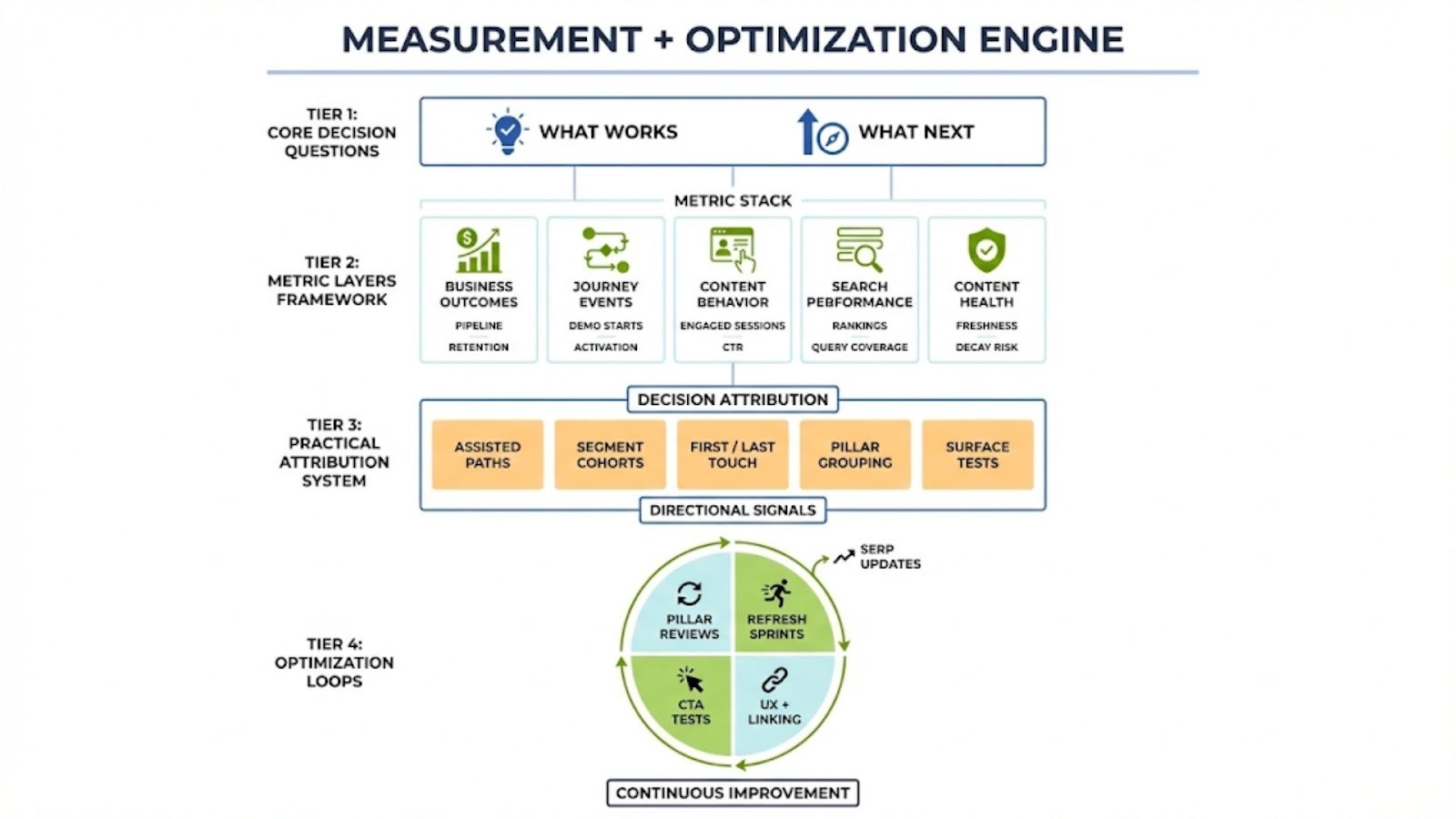
Measurement, Attribution, and Optimization
I build measurement to answer two questions:
- What is working and why?
- What should we do next?
Metric layers I use
- Business outcomes: revenue, pipeline, activation, retention, support cost
- Journey outcomes: demo requests, trial starts, key activation events
- Content behavior: engaged sessions, scroll depth, CTR, return rate
- Search performance: rankings, CTR, impressions, query coverage
- Content health: freshness, accuracy, broken links, decay risk
Attribution: practical, not ideological
Perfect attribution does not exist. I use what helps decisions:
- Assisted conversions and path analysis
- Segment-level performance and cohort views
- First-touch and last-touch as directional signals
- Content grouping performance by pillar and intent cluster
- Experimentation for high-traffic conversion surfaces
Optimization loops I run
- Monthly performance reviews by pillar and segment
- Content refresh sprints for decaying assets
- Internal linking and UX improvements
- CTA tests and landing page experiments
- SERP-driven updates when competitors shift
Optimization is where mature teams separate from busy teams.
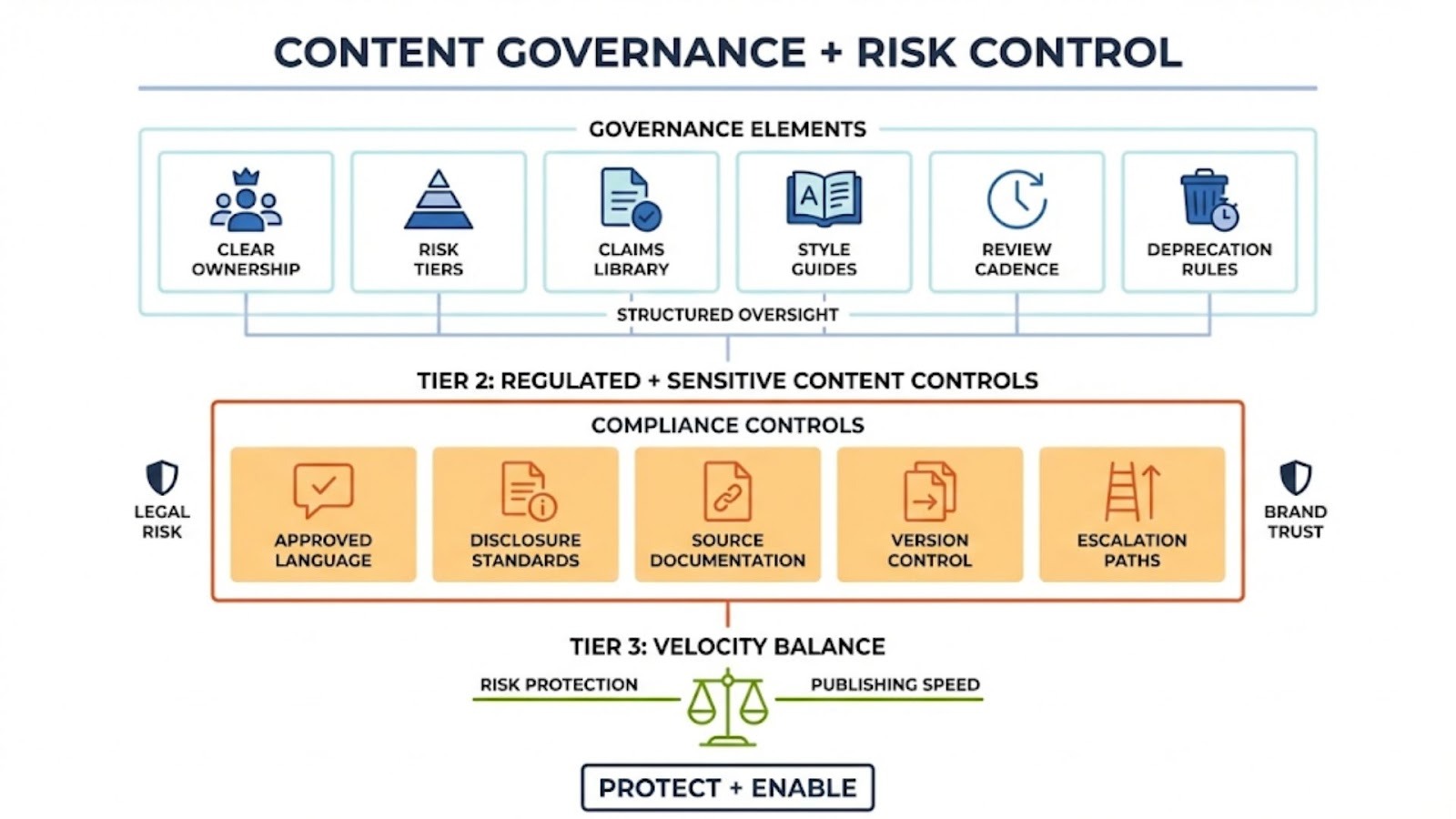
Content Governance, Risk, and Quality Control
Professionals underestimate content risk. In many industries, content creates legal, brand, and trust exposure.
Governance elements I put in place
- Ownership per content area
- Approval rules based on risk tier
- Claims substantiation library
- Style and terminology guides
- Review cadence by content type
- Deprecation policy and redirect rules
Managing regulated and sensitive content
If you operate under compliance constraints, you need:
- Pre-approved language patterns
- Disclosure standards
- Source documentation for claims
- Versioning and audit trails
- Clear escalation paths
Governance should protect the business without killing velocity.
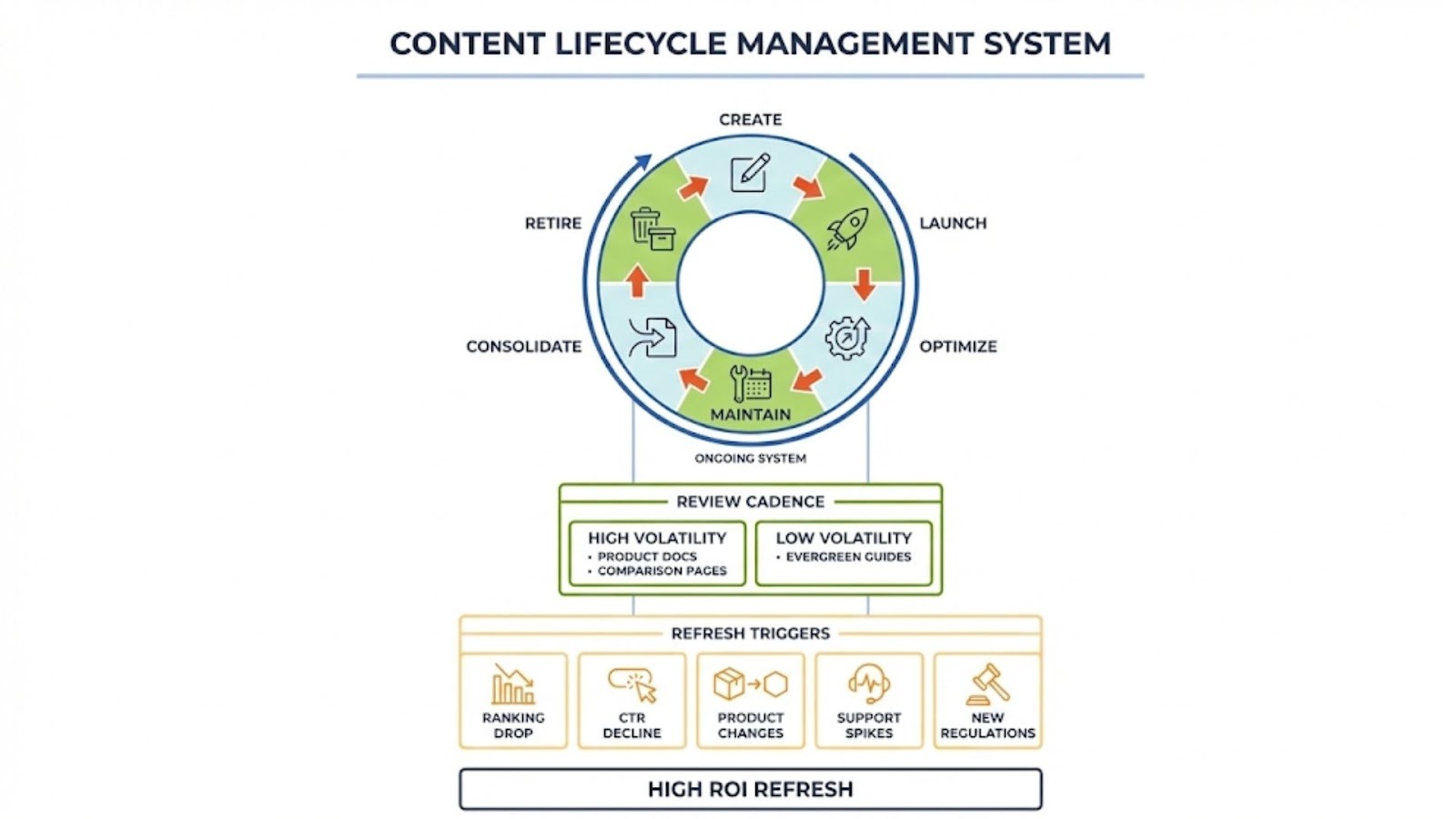
Content Lifecycle Management and Maintenance
Content that performs today can become a liability next quarter.
Lifecycle stages
- Create
- Launch
- Optimize
- Maintain
- Consolidate
- Retire
I assign review cycles based on risk and volatility. Product docs and comparison pages change often. Evergreen conceptual guides change less.
Refresh strategy
I use refresh triggers like:
- Ranking drops and CTR decline
- Competitor leapfrogging in SERPs
- Product changes that invalidate guidance
- Support ticket spikes related to outdated instructions
- New regulations or standards
Refresh work often produces some of the highest ROI in the program.
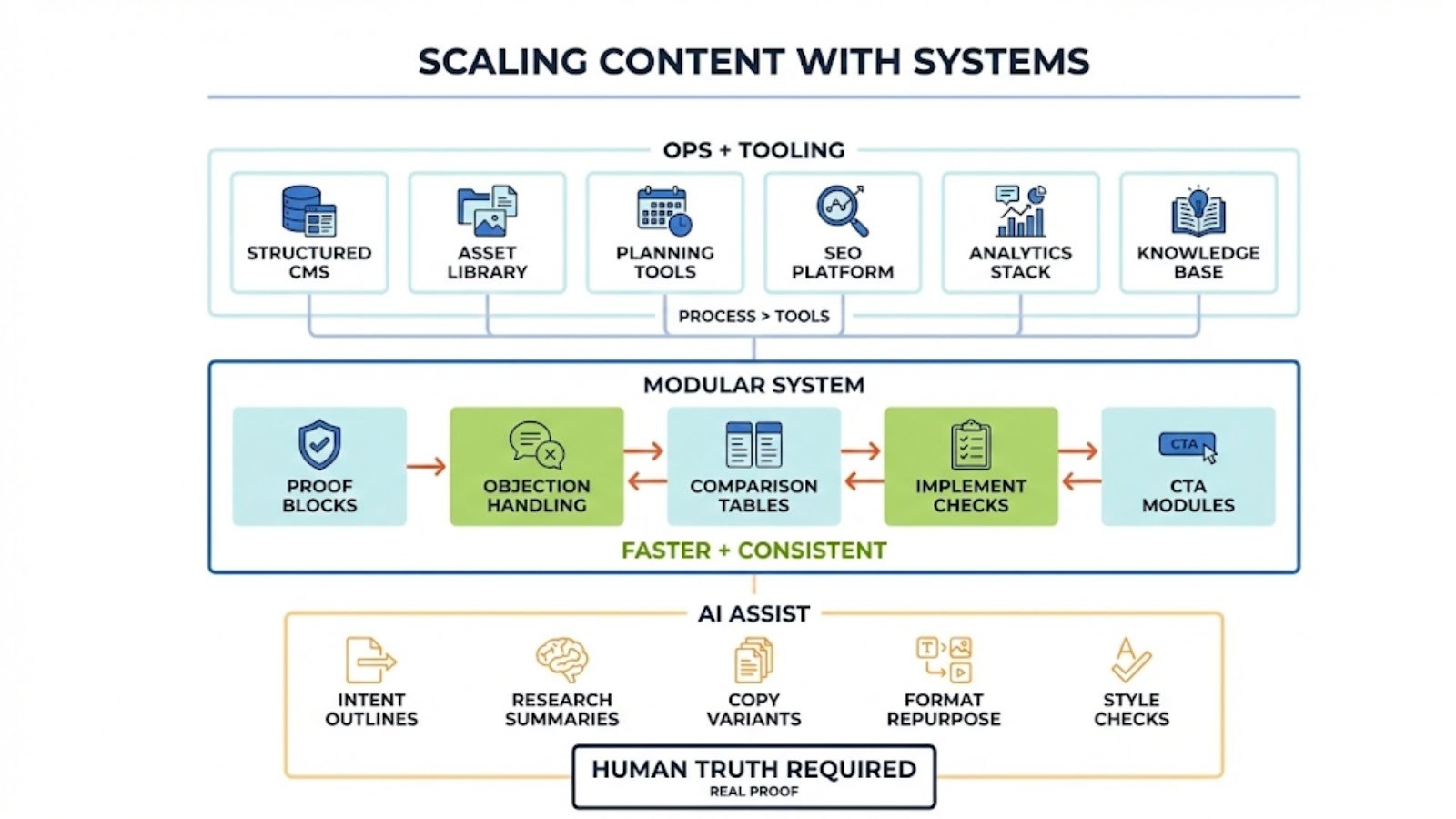
Scaling Content Strategy with Ops, Tooling, and Systems
Scaling is not “hiring more writers.” Scaling means building systems that increase output quality and throughput without chaos.
Content operations and tooling
Common components:
- CMS with structured content capabilities
- DAM and asset libraries
- Editorial planning tools
- SEO platforms and SERP tracking
- Analytics dashboards and reporting pipelines
- Knowledge bases for claims, proof, and reuse
Tooling matters, but process matters more.
Modular content and reuse
I push teams toward modular components:
- Proof blocks: metrics, quotes, outcomes
- Objection handling blocks
- Comparison tables
- Implementation checklists
- CTA modules by intent stage
Modularity reduces production time and improves consistency.
AI in content strategy: where I actually use it
AI can help with:
- Drafting outlines aligned to intent
- Summarizing research inputs
- Generating variants for distribution copy
- Content repurposing across formats
- Quality checks for style consistency
AI should not replace subject-matter truth, real examples, or proof. Expert audiences spot synthetic authority quickly.
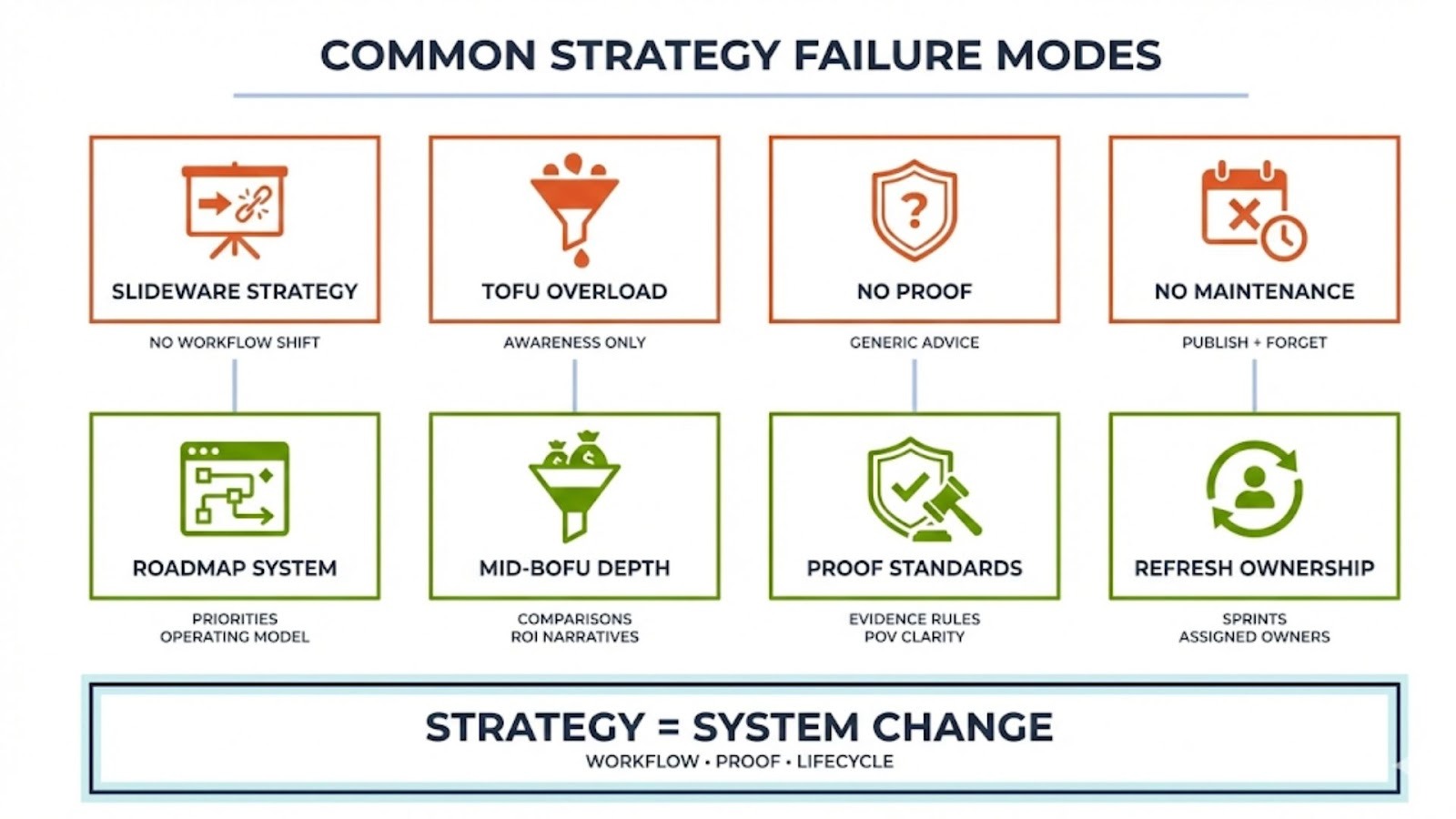
Common Failure Modes and How I Prevent Them
Failure mode 1: Strategy as a slide deck
If your strategy does not change workflow, governance, and priorities, it does nothing.
I always deliver strategy as:
- A prioritized roadmap
- A content architecture and taxonomy plan
- Operating model and workflow documentation
- Measurement dashboards and review cadence
Failure mode 2: Over-indexing on top-of-funnel
Many teams publish endless awareness content and wonder why pipeline does not move.
For professionals, I build heavy coverage in:
- Comparison and alternatives
- Implementation planning
- Proof and case evidence
- Objection handling
- ROI framing and total cost narratives
Failure mode 3: No proof, no differentiation
Expert readers do not want generic advice. They want credible guidance with constraints and evidence.
I fix this by enforcing proof requirements and POV standards.
Failure mode 4: Ignoring maintenance
Teams treat publishing as done. Content strategy treats publishing as the beginning of lifecycle ownership.
I schedule refresh sprints and assign owners.
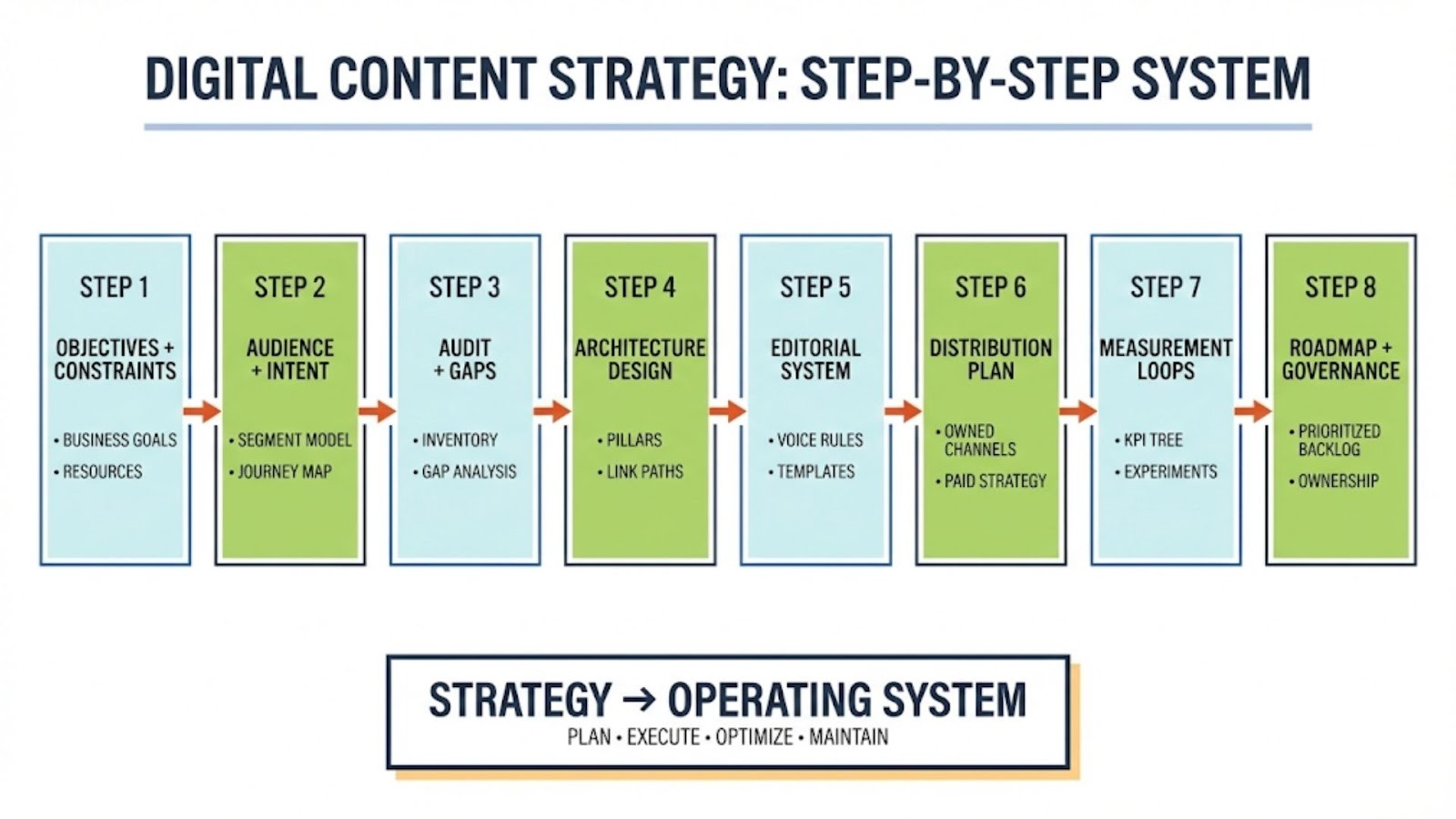
How I Build a Digital Content Strategy Step by Step
This is the process I run in most client engagements, adapted to scope and maturity.
Step 1: Establish objectives and constraints
- Business goals, segments, and product priorities
- Brand and compliance constraints
- Resourcing and timeline realities
Step 2: Build audience and intent models
- Segment definitions tied to behavior and buying context
- Intent mapping across journey stages
- Priority use cases and objections
Step 3: Audit existing content and performance
- Inventory and classification
- Gap analysis by intent and journey stage
- Technical and structural issues
Step 4: Define content architecture
- Pillars, clusters, and narrative structure
- Taxonomy and tagging
- Internal linking pathways and conversion routes
Step 5: Create the editorial system
- Voice, standards, proof requirements
- Content templates for repeatability
- Brief structure and review workflow
Step 6: Plan distribution systems
- Owned and partner channels
- Repurposing frameworks
- Paid strategy where appropriate
Step 7: Build measurement and optimization loops
- KPI tree and dashboards
- Reporting cadence
- Experimentation plan
Step 8: Execute roadmap and operationalize governance
- Prioritized backlog
- Resource plan and production cadence
- Ownership and maintenance schedule
This is how strategy becomes a working system, not a one-time plan.
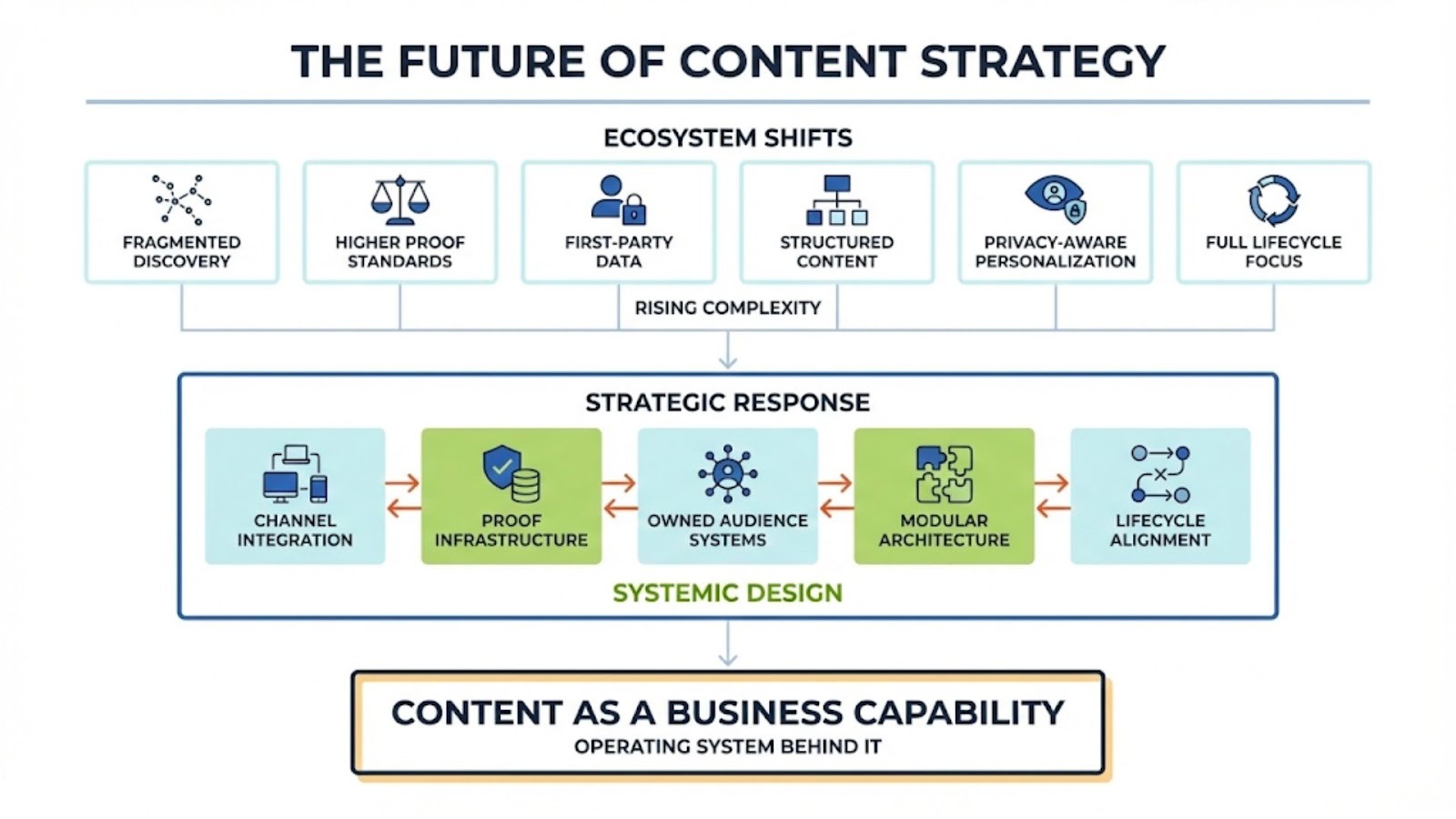
Where the Discipline Is Heading
Content strategy continues to evolve because the ecosystem changes.
Trends I plan for
- More fragmented discovery: search, social, communities, AI assistants, marketplaces
- Higher standards for proof and trust
- Increased importance of first-party data and owned channels
- Greater need for structured content and modular reuse
- Personalization that respects privacy and consent
- Content that supports the full customer lifecycle, not just acquisition
The teams that win will treat content as a business capability with an operating system behind it.
FAQ: Digital Content Strategy Questions Professionals Still Ask
What does a “great” digital content strategy deliver in the first 30 to 60 days?
In the first 30 to 60 days, I look for operational traction more than outcome spikes. A strong strategy should deliver a prioritized roadmap, clarified ownership, tighter briefs, improved internal linking and conversion pathways on key pages, and a measurement baseline you can trust. You may see early wins from quick fixes and refreshes, but the real indicator is whether the team now executes with focus and consistency.
How do I decide whether to build a content team in-house or lean on an agency?
Make the decision based on what needs to be true for your business. If content sits close to product truth, compliance, or deep subject matter, in-house usually wins for accuracy and speed of iteration. If you need scale, specialized distribution, or a fast reset of systems, an external partner can move quicker. Many mature programs run a hybrid model: strategy and subject matter leadership in-house, with external production and distribution support.
What’s the right ratio of “brand POV” content to “search intent” content?
There is no universal ratio, but there is a right sequencing. Search-intent content captures demand that already exists. POV content creates demand and changes how buyers frame the problem. In most categories, I start by stabilizing demand capture with intent coverage and conversion assets, then layer POV into the system so it amplifies distribution, PR, partnerships, and sales enablement. The ratio should shift as your market maturity and competitive landscape change.
How do I build a proof library without leaking confidential customer data?
Treat proof as a structured asset, not a last-minute scramble. Build a library of approved outcomes, metrics ranges, anonymized patterns, and repeatable narratives that legal and customer success can support. Use aggregated insights, de-identified case patterns, and benchmark ranges when you can’t publish logos or exact numbers. The goal is credible evidence, not exposure.
How do I plan content when my product changes every month?
You separate content into two categories: volatile and durable. Volatile content needs strict review cadences and modular structure so updates are cheap. Durable content anchors your long-term discovery and education. Then you connect them: durable pieces link to “current state” modules that you can update without rewriting the whole asset.
How do I protect content quality when subject matter experts have no time?
You stop asking SMEs to write. Instead, you create a system that extracts truth efficiently: structured interviews, annotated outlines, SME review checklists, and a “claims and proof” worksheet that writers can operationalize. Also, limit SME time to high-leverage moments: approving claims, validating technical accuracy, and stress-testing recommendations.
What’s the most reliable way to prioritize content when everything feels urgent?
I use a scoring model that forces tradeoffs. The simplest version weights: business impact, audience value, intent strength, strategic differentiation, production cost, and maintenance risk. If you cannot rank work with a model like this, the team will prioritize by internal politics or anxiety.
How do I build content for multiple industries without diluting positioning?
You keep the core narrative consistent and vary the application layer. Your pillars and POV stay stable, but you create vertical “translation” assets: industry-specific problem frames, proof modules, implementation constraints, and examples. Positioning should not fragment. Only the relevance layer should.
What should I do if my brand voice conflicts with what converts?
Resolve the conflict at the level of messaging rules, not tone preferences. If conversion requires clarity you think your brand voice can’t accommodate, your voice guidelines are the problem. Mature brands stay recognizable while still being direct, explicit, and useful. If your voice cannot support clarity, it will eventually cost you pipeline.
How do I know whether my content problem is strategy, execution, or distribution?
Diagnose in order:
- If content is strong but nobody sees it, you have a distribution or discoverability problem.
- If content gets traffic but does not move users forward, you have an architecture, conversion, or intent mismatch problem.
- If content performs inconsistently and feels scattered, you have a strategy and governance problem.
- If content is consistently weak in quality, you have an execution capability problem.
How do I make content strategy work when marketing and product teams disagree?
You establish shared definitions and shared metrics. Agree on audience segments, intent stages, and the outcomes you care about. Then build a governance model where product owns product truth, marketing owns narrative and distribution, and both share responsibility for lifecycle outcomes like activation and retention. The fastest path to alignment is a joint roadmap tied to measurable outcomes.
What’s the most overlooked risk in professional content programs?
Misleading precision. Teams publish confident claims, implementation guidance, or benchmarks without clarifying constraints, tradeoffs, and applicability. Expert readers punish that quickly, and internal teams end up carrying the cost through support tickets, sales friction, and churn. Precision must include boundaries.
Closing Perspective
If you work with professional audiences, you cannot rely on volume, generic advice, or superficial “thought leadership.” You need a strategy that engineers trust, discoverability, and conversion through a coherent system: intent-driven architecture, differentiated POV, credible proof, operational discipline, and continuous optimization.
That’s what I mean by digital content strategy. If you build it that way, content becomes one of the few growth assets that compounds month after month instead of resetting every quarter.
How We Help at RiseOpp
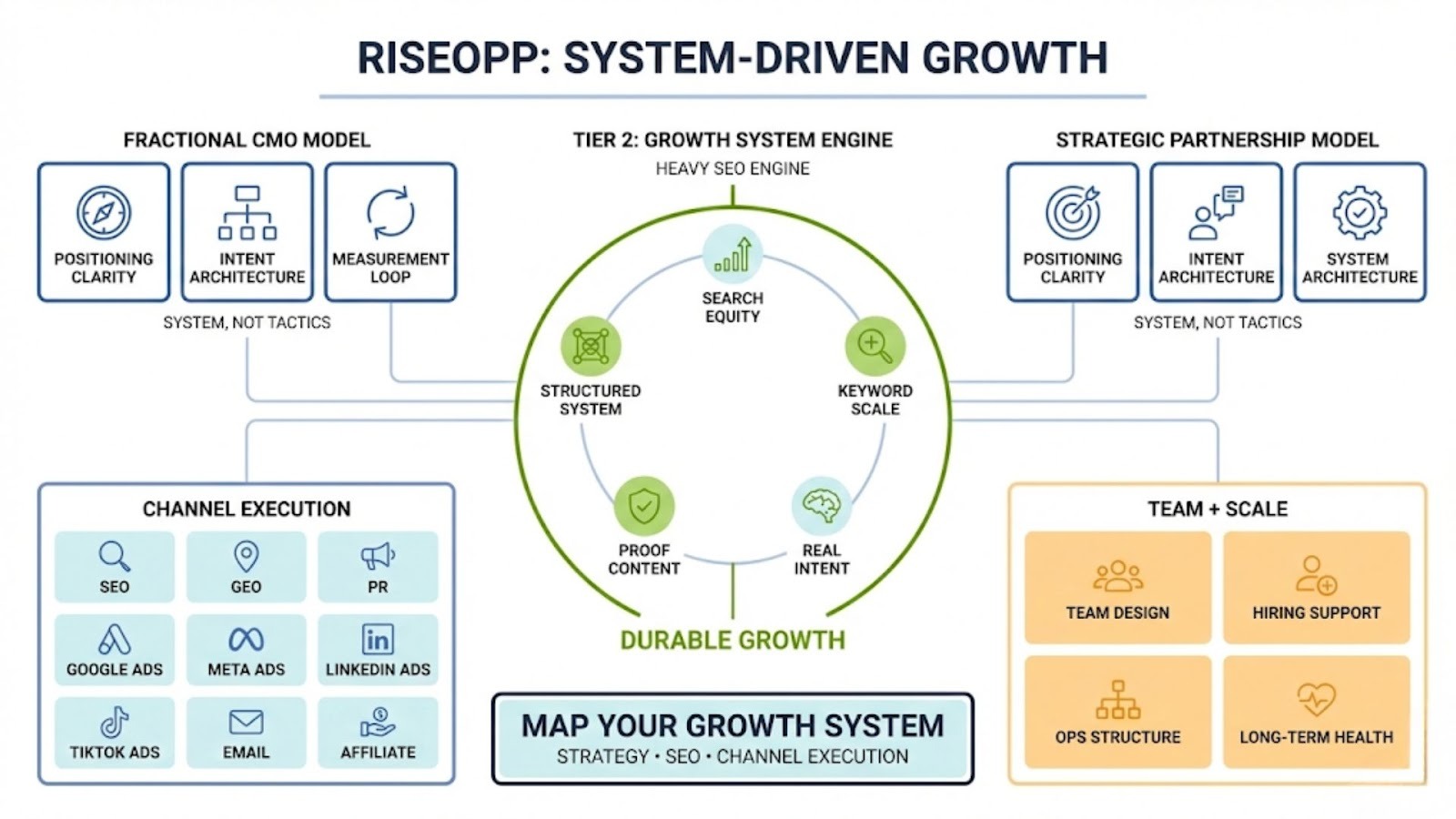
If you made it this far, you already understand the core truth behind digital content strategy: content only compounds when you treat it like a system. That’s exactly how we work at RiseOpp.
We operate as a fractional CMO partner and execution team for B2B and B2C companies that want modern growth in the age of AI. That means we help you translate strategy into an operating model: positioning and messaging that hold up under scrutiny, a content architecture built around real intent, and a measurement loop that forces focus and prevents “random acts of content.”
On the organic side, our proprietary Heavy SEO methodology focuses on building durable search equity by ranking a site for tens of thousands of keywords over time, not just chasing a handful of trophy terms. We pair that with execution across the channels that actually move the business, including SEO, GEO, PR, Google Ads, Meta Ads, LinkedIn Ads, TikTok Ads, email marketing, and affiliate marketing. When you need it, we also help you hire and structure the right marketing team so the system stays healthy after the initial build.
If you want a digital content strategy that drives measurable growth and a team that can implement it end to end, work with us at RiseOpp. Start by reaching out for a strategy conversation, and we’ll map your biggest opportunities across content, SEO, and channel execution.
Comments are closed