- A content distribution strategy must align with business goals to achieve measurable outcomes such as lead generation and customer retention.
- Effective content distribution relies on audience segmentation by behavior and intent to deliver personalized, high-engagement content.
- The PESO model (Paid, Earned, Shared, Owned) is crucial in a content distribution strategy to maximize reach across diverse channels.
In the world of digital marketing, creating high-quality content is just the first step. To truly succeed, businesses need a content distribution strategy that drives measurable outcomes. Whether you’re aiming to increase brand awareness, generate leads, or improve customer retention, a well-executed strategy ensures your content reaches the right audience and delivers results.
As a content strategist, I’ve learned that distribution only works when it ties directly to business outcomes. Content cannot operate as an isolated effort. It must support strategic objectives such as awareness, lead generation, retention, or revenue growth.
This guide will walk you through the key elements of building an effective content distribution plan that ties directly to business goals, increases engagement, and drives growth.
How to Build a Content Distribution Strategy Aligned with Business Goals
As a content strategist, I’ve come to learn that a distribution strategy is only effective when it’s deeply tied to business outcomes. Without clear, measurable goals, content distribution risks being a futile exercise. Content should never be treated as an isolated effort, it must be connected to strategic business objectives that drive real results.
The reality is that content marketing itself is no longer optional for most organizations. According to the Content Marketing Institute, 91% of B2B marketers already use content marketing as part of their overall strategy. That level of adoption means simply producing content is no longer a competitive advantage. The real differentiator is how effectively organizations distribute and amplify the content they create.
Aligning Content Distribution with Business Objectives
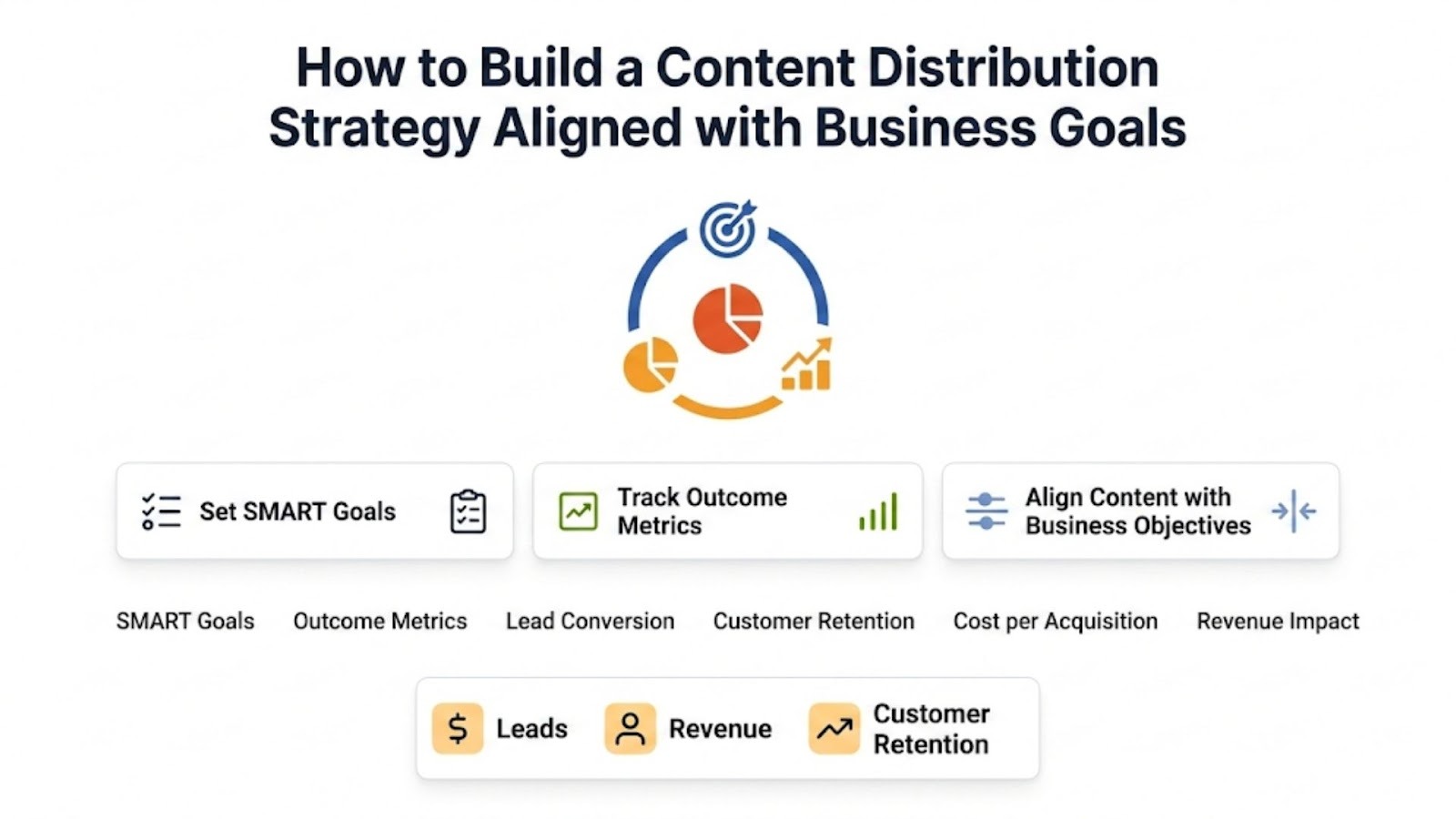
The first step in creating a successful distribution strategy is determining the business goals you are trying to achieve. Each content piece should have a specific purpose. Whether it’s to increase brand awareness, generate leads, drive engagement, or improve customer retention, the approach will differ accordingly. For example, awareness-focused content may prioritize broad reach and general interest, whereas lead generation content will be more targeted and action-oriented.
Set SMART Goals:
Without SMART (Specific, Measurable, Achievable, Relevant, Time-bound) goals, there’s no way to track success or make data-driven decisions. For instance, a goal like “increase brand awareness by 30% in Q2” is clear and measurable. On the other hand, goals like “generate more traffic” are vague and lack direction.
Outcome Metrics vs. Activity Metrics
Activity metrics like impressions, clicks, and shares can be misleading. Sure, they look good on paper, but they don’t always translate into real business outcomes. Instead, focus on metrics that show how your content is impacting revenue, lead generation, customer retention, or other critical business outcomes.
For example, you could track:
- Lead Conversion Rate: The percentage of visitors who take a desired action.
- Cost per Acquisition (CPA): The cost to acquire each customer through content.
- Customer Retention: How well your content helps retain customers over time.
These outcomes matter far more than simply how many people saw or interacted with your content. As a content strategist, my primary goal is to ensure that every piece of content within the content distribution strategy drives measurable business results, whether it’s increasing leads, improving customer retention, or boosting revenue.
The Role of Audience Segmentation in a Winning Content Distribution Strategy
Audience segmentation is critical to ensuring that content distribution efforts are effective. The days of treating your entire audience as a homogeneous group are long gone. Understanding your audience at a granular level allows for more tailored, personalized content experiences.
Beyond Demographics: Behavioral and Intent-Based Segmentation
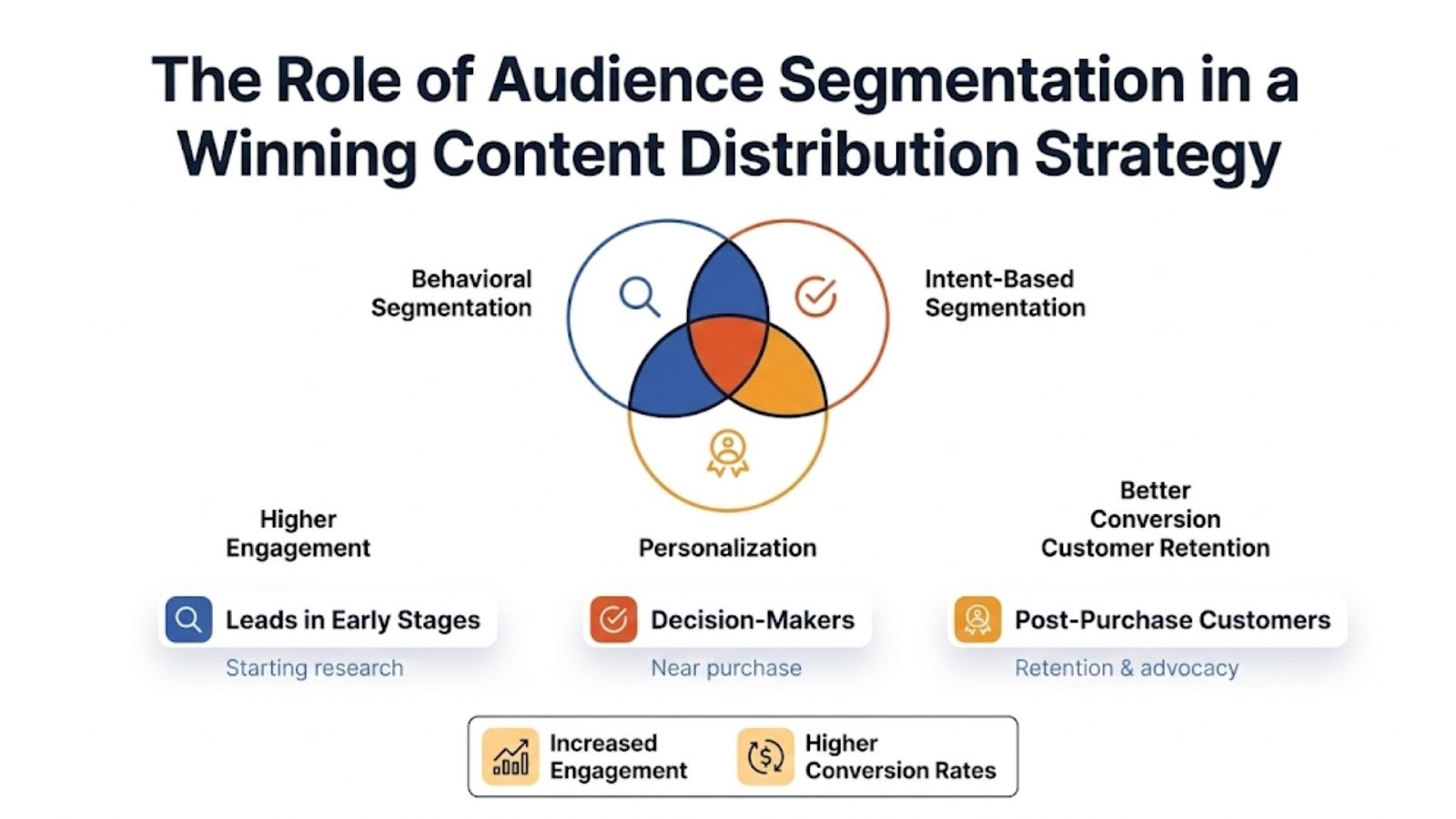
While demographic segmentation (age, gender, location, etc.) is still useful, it doesn’t tell the full story. Today, behavior and intent are the most powerful ways to segment your audience. What actions do people take on your site? What content are they engaging with? Are they in the research stage of the buying cycle, or are they already decision-makers?
For example, consider dividing your audience into these segments:
- Leads in Early Stages: Prospects who are just starting their research process.
- Decision-Makers: People who are closer to making a purchase decision.
- Post-Purchase Customers: Those who have already made a purchase, focusing on retention and advocacy.
By understanding how these groups behave and what their needs are, you can create content that resonates with them on a deeper level.
How Segmentation Drives Personalization
Once you segment your audience, you can personalize content to ensure it meets the specific needs of each group. Personalization leads to better engagement because people are more likely to interact with content that speaks directly to their current situation.
For example:
- For a technical audience, deliver deep-dive whitepapers and product demos.
- For a general audience, use easy-to-consume content like infographics and blog posts.
This personalized approach ensures your content reaches the right people, driving higher engagement and conversion rates.
Choosing the Right Distribution Channels for Maximum Impact
Now that you’ve segmented your audience, it’s time to decide on the distribution channels. This is where many content strategies fall short. Relying on a single channel, be it social media, email, or organic search, limits the reach and impact of your content. A multi-channel approach is essential for effective content distribution.
The PESO Model: Paid, Earned, Shared, and Owned Media
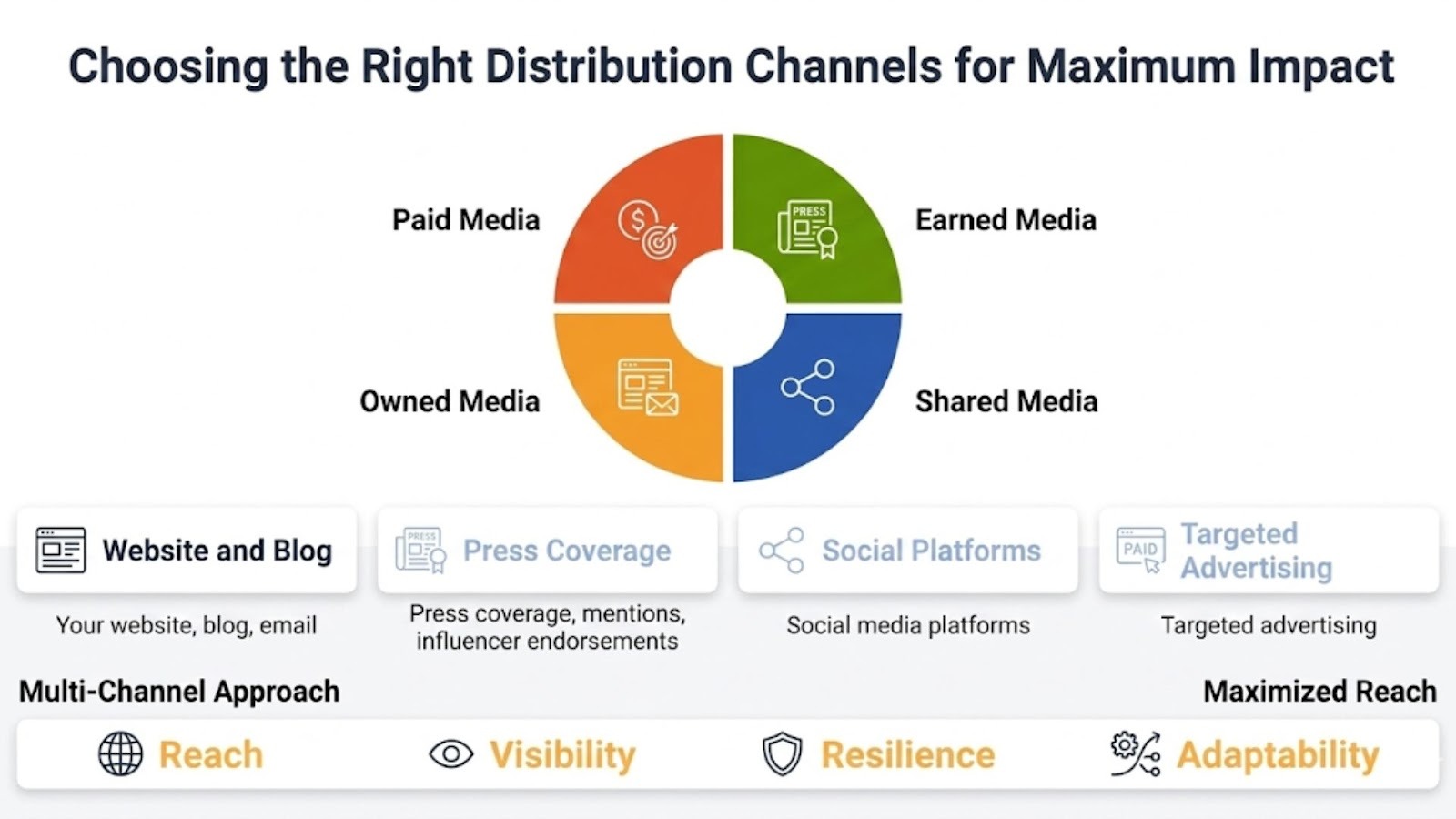
A proven framework for balancing channels is the PESO model, Paid, Earned, Shared, and Owned. Each channel has its own strengths and plays a critical role in a well-rounded distribution strategy.
- Owned Media: Your website, blog, email list, and social media channels that you control.
- Earned Media: Press coverage, mentions, and influencer endorsements that you gain organically.
- Shared Media: Social media platforms where your content can be shared by followers, fans, or partners.
- Paid Media: Targeted advertising on platforms like Google Ads, Facebook, or LinkedIn to increase reach and visibility.
A great distribution strategy doesn’t over-rely on any one channel. Instead, it leverages the power of all four, creating a balanced and efficient distribution system.
Why a Multi-Channel Approach Works
When using a combination of these channels, you can ensure maximum reach and impact. For example, paid media can drive traffic to your owned media (such as your website or blog), where visitors can consume long-form content. Meanwhile, earned and shared media amplify your message by building credibility and fostering conversations in your industry.
Ultimately, combining these channels ensures a more resilient and diversified distribution strategy, much like how leveraging Fractional CMO Services can enhance strategic marketing efforts If one channel’s performance drops, others are still driving value, making your strategy more adaptable and long-lasting.
Crafting Content That Resonates: The Importance of Format and Channel Fit
Every content piece should be strategically designed with its format and channel in mind. It’s crucial to recognize that a whitepaper, a blog post, and a social media post are not interchangeable. The right format is key to optimizing content consumption and engagement.
Mapping Content Formats to Channels
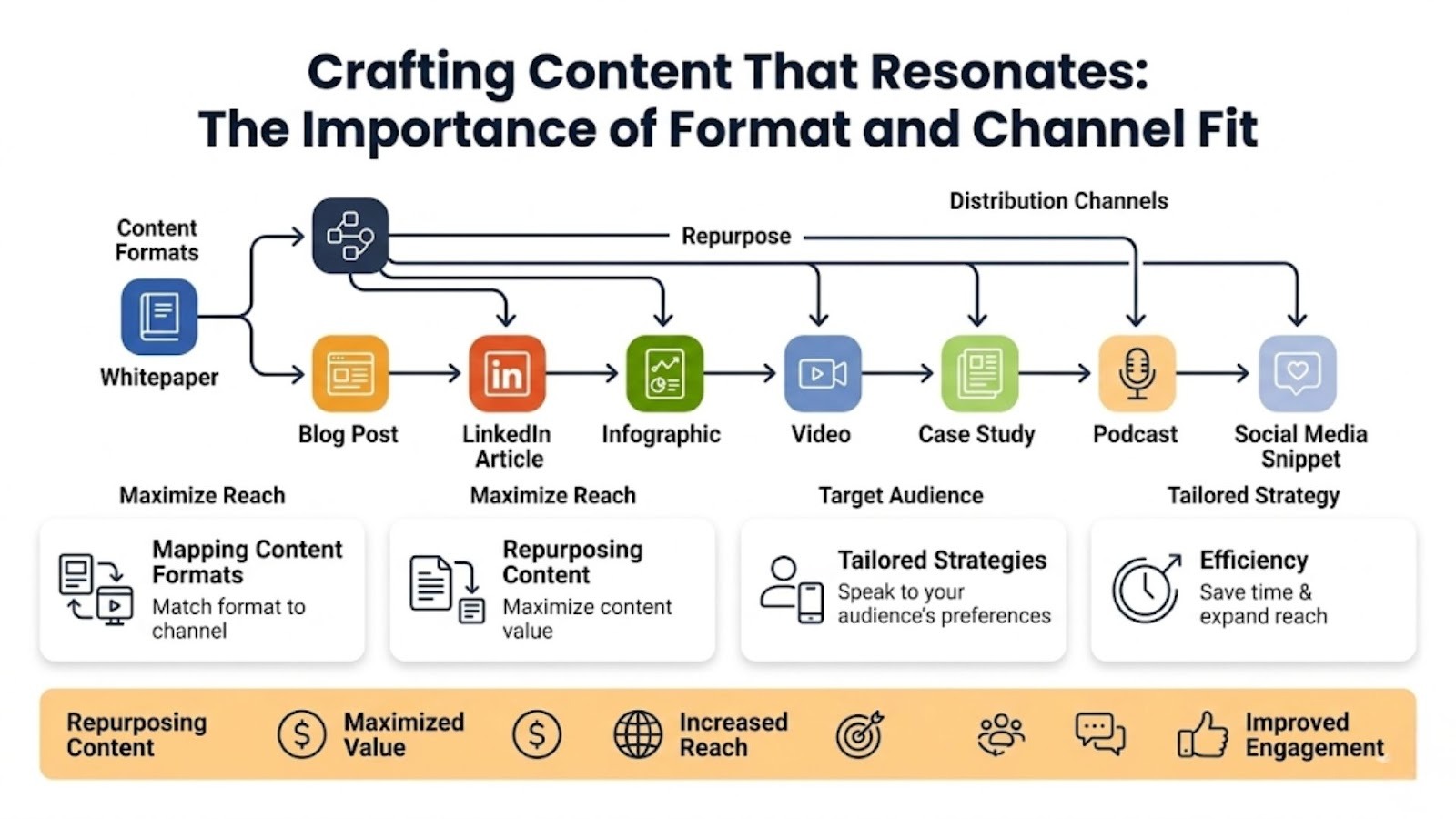
Certain formats perform better on specific channels. For instance, LinkedIn is ideal for long-form articles and professional content, while Instagram excels with short-form visual content like infographics and carousels. The content format must match the consumption behavior of your target audience on each platform.
A single asset, such as a whitepaper, can be repurposed across different formats for various channels. For example:
- Whitepaper → Blog post, LinkedIn article, Infographic, or Video
- Case Study → Blog post, Webinar, Podcast episode, or Social Media Snippet
By repurposing your content, you maximize its value and increase the likelihood of it being discovered by various audience segments across different platforms.
Repurposing Content: Getting More from Your Assets
A strong content distribution strategy involves repurposing assets to make the most of them. Instead of constantly producing new content, identify high-performing assets and find ways to reuse them in different formats. Ross Simmonds’ work on content distribution emphasizes this practice. For example, a webinar can be turned into several blog posts, a podcast episode, and short clips for social media.
Repurposing saves time, stretches your content’s reach, and ensures that you are speaking to your audience in the way they prefer to consume content, just as B2B content marketing focuses on tailoring strategies to targeted business needs.
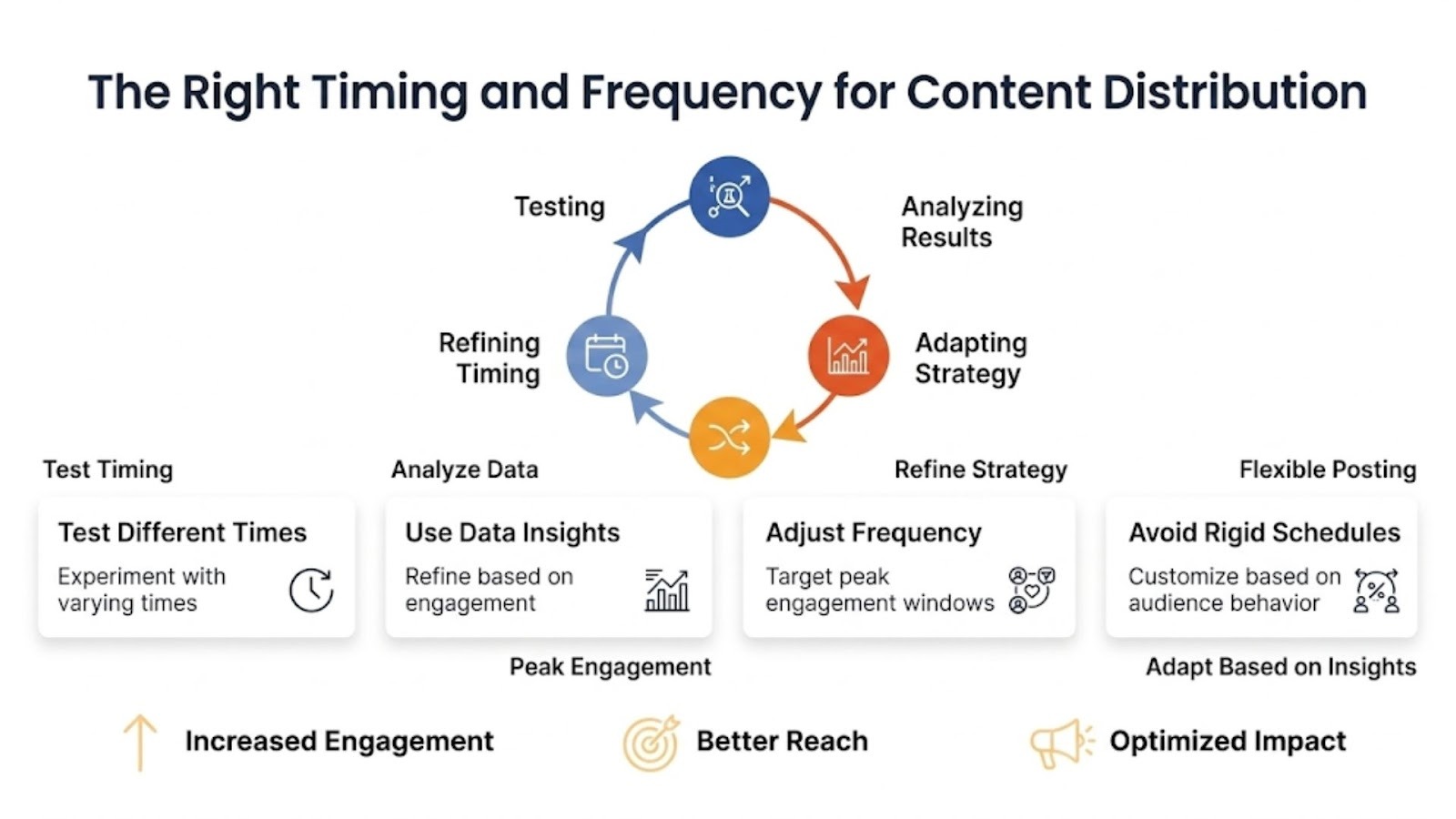
The Right Timing and Frequency for Content Distribution
Many content strategies rely on universal “best time to post” advice, but this can be misleading. The key to successful distribution timing lies in testing, adapting, and using data to refine your strategy.
The Pitfalls of Rigid Posting Schedules
Every brand and audience is different. What works for one might not work for another. Content Marketing Institute suggests that optimal posting times should be based on real audience data rather than industry-wide advice. For example, while general wisdom might say that posting on Tuesday mornings is best, your audience may engage more frequently on Thursday afternoons.
How to Adjust Based on Audience Behavior
Instead of relying on generic advice, I recommend Using data-driven insights to test different posting schedules is crucial, much like how growth marketing strategies benefit from continuous testing and adaptation.Experiment with varying times and analyze the response to identify patterns. If your audience tends to engage more on weekends, schedule your content accordingly. If they are more active during specific work hours, target those times for maximum visibility.
Once you’ve tested different strategies, refine your timing based on audience feedback, engagement metrics, and platform-specific insights.
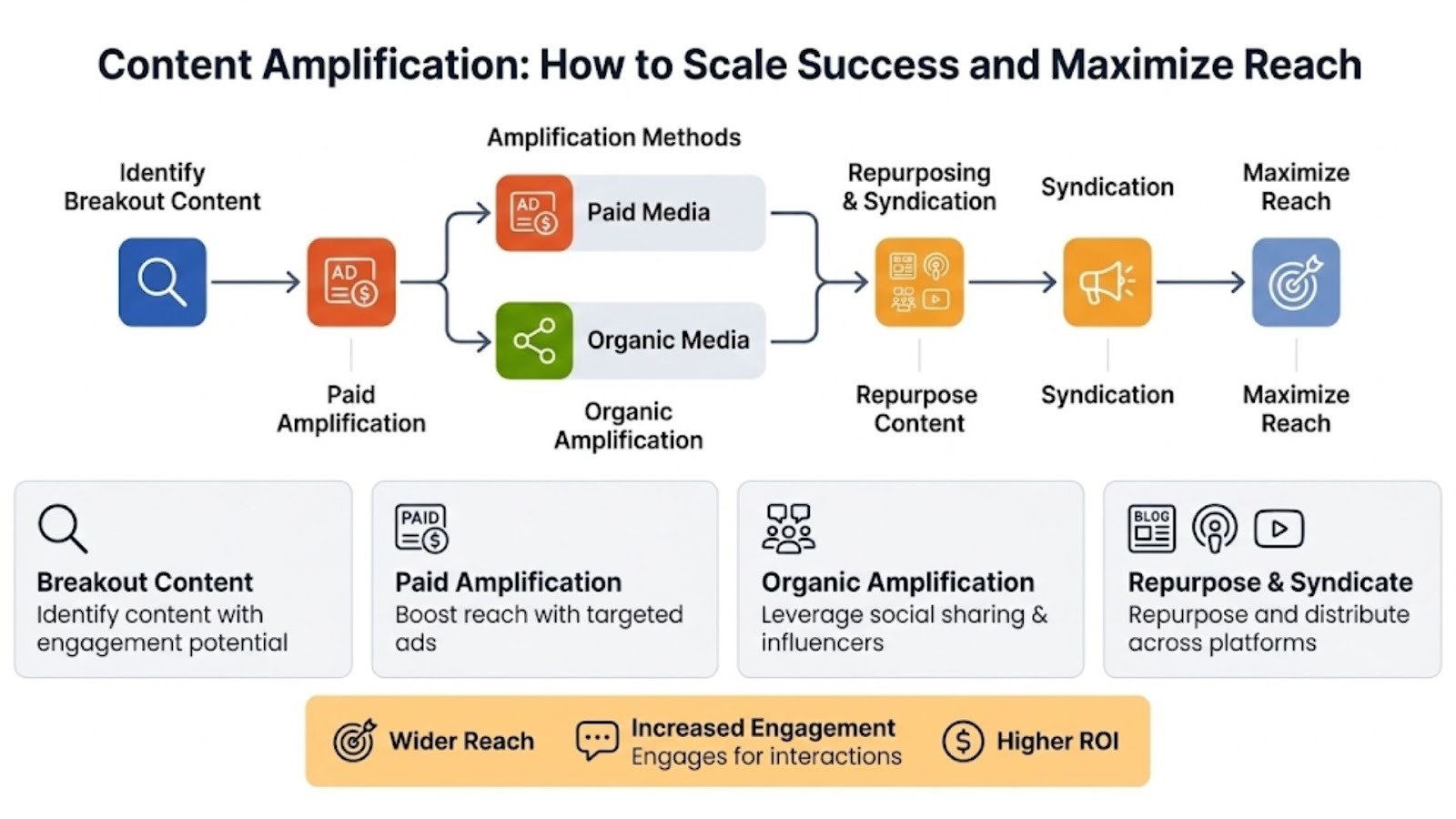
Content Amplification: How to Scale Success and Maximize Reach
Amplification is the stage where content begins to scale beyond its initial audience. Many organizations invest heavily in creating content but fail to push their highest-performing assets far enough.
That is a missed opportunity. As reported in Hubspot, 74% of marketers say content marketing generates demand and leads, which means high-performing content can become a powerful growth driver when it is properly amplified. Instead of treating amplification as optional promotion, teams should treat it as a strategic lever for expanding the reach of proven content.
Identifying Breakout Content
Not every piece of content deserves the same level of amplification. The most efficient content distribution strategies focus on amplifying high-performing content. Breakout content is the type of content that resonates well with your audience, drives engagement, and has the potential to be repurposed for greater reach.
HubSpot’s content amplification strategy emphasizes the importance of identifying content that is already showing signs of success. For example, a blog post that generates significant organic traffic should be promoted on social media channels, repurposed into email newsletters, or even turned into a paid ad campaign.
Paid and Organic Amplification
Amplification isn’t just about paid media. While paid ads can help give a piece of content an initial boost, organic amplification through social sharing, influencer outreach, or syndication plays a huge role in getting your content in front of a wider audience.
I suggest a balanced approach that combines both. If a piece of content has already gained some traction organically, investing in paid promotion can help scale its reach. Paid amplification works best when content already demonstrates value and engagement, reducing the risk of wasted spend.
Repurposing and Syndication
Repurposing content and syndicating it on other platforms is one of the best ways to amplify its reach without creating new content from scratch. A blog post can be repurposed as a LinkedIn article, podcast episode, or video tutorial. You can also syndicate the content to other websites or media outlets that reach your target audience.
Syndication and content repurposing help you tap into new audiences while maintaining the integrity of the original content.
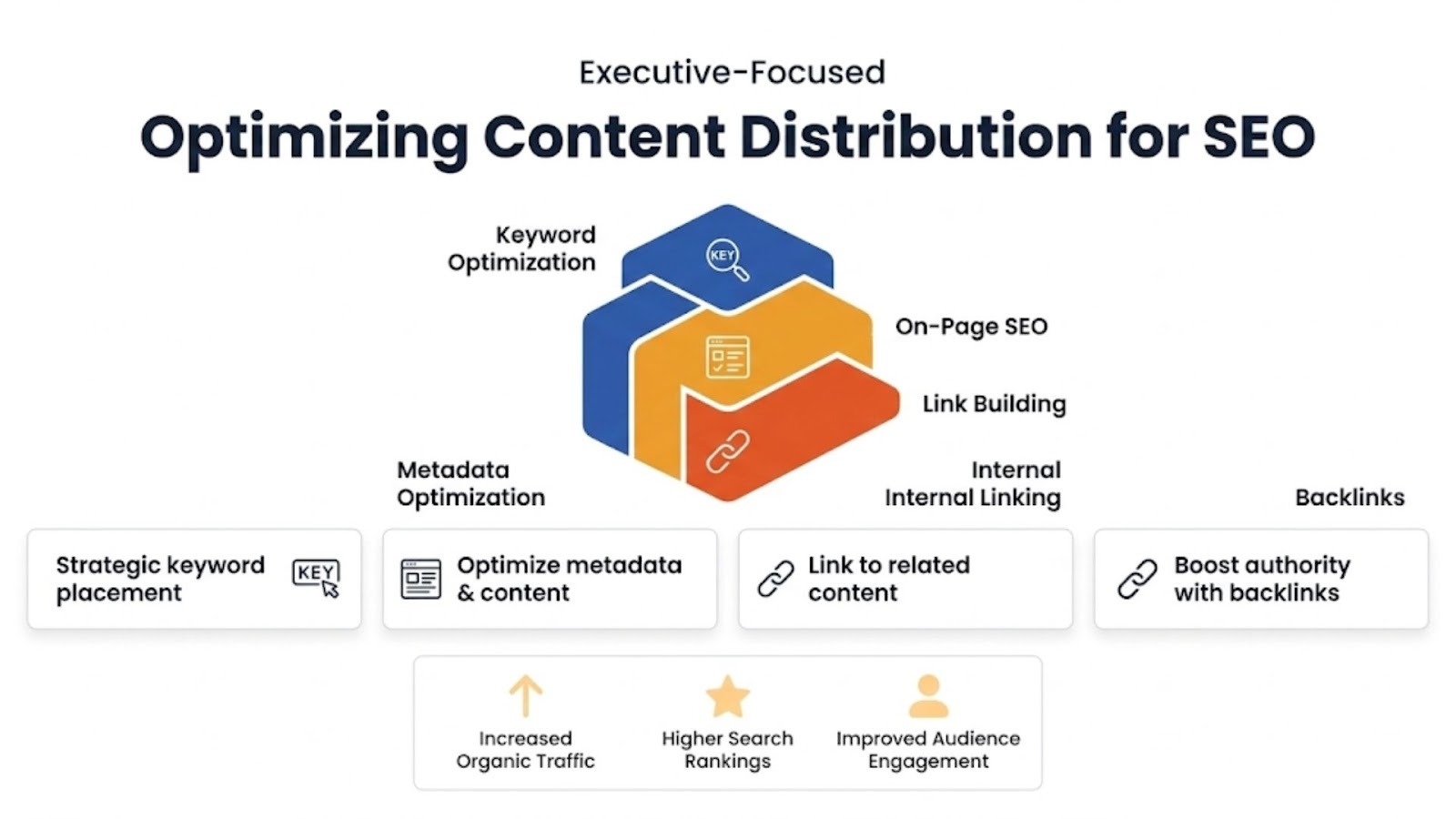
Optimizing Content Distribution for SEO
A well-executed content distribution strategy can significantly boost your content’s reach. But without proper search engine optimization (SEO), your content might not achieve its full potential in terms of visibility and audience engagement. SEO is one of the most important factors in increasing organic traffic, ensuring that your content can be found by the right people at the right time. This is especially true when you optimize your content for search engines. Below are key tactics to ensure your content distribution strategy is optimized for SEO.
Keyword Optimization
The foundation of any solid SEO strategy is effective keyword optimization. When distributing content, it’s essential to ensure your target keywords are naturally integrated into the content. For example, if you are focusing on the phrase “content distribution strategy,” ensure this keyword appears strategically throughout your content in the following places:
- Title: Make sure the keyword appears in the title of the article or webpage.
- Headers: Use the keyword in at least one header (H2, H3) to highlight its relevance.
- Content: Distribute the keyword evenly throughout your body copy. Avoid keyword stuffing, as this can hurt readability and SEO performance.
- Meta Description: The meta description should also include your target keyword. This short snippet of content influences both search rankings and click-through rates.
In addition to your primary keywords, use variations of your main keyword to make the content more natural and less repetitive. For instance, instead of repeating “content distribution strategy” in every paragraph, use terms like “distributing content,” “content promotion methods,” and “strategic content sharing.”
On-Page SEO
On-page SEO refers to the techniques used directly within the content of a webpage to improve its ranking. The more attention you pay to on-page SEO, the more likely your content is to rank higher in search engine results pages (SERPs).
Here are some critical on-page SEO tactics to consider:
- Metadata: Ensure each piece of content has a relevant, keyword-optimized meta title and meta description. The title should ideally be under 60 characters, and the description should be around 160 characters.
- Alt Text for Images: Search engines can’t “see” images, but they can read alt text. Use descriptive alt text for all images, incorporating keywords where relevant. For example, an image showcasing a graph on content distribution strategy can have alt text like “SEO-optimized content distribution strategy graph.”
- Internal Linking: Link to other relevant pages or blog posts on your website within your content. Internal links help spread link equity across your site, keeping users engaged and improving rankings. For instance, if you’re discussing content distribution in this article, linking to a related post about SEO or social media strategy will encourage users to spend more time on your site.
By following these on-page SEO best practices, you help search engines understand your content’s relevance and improve the likelihood of ranking higher for your targeted keywords.
Link Building
Link building is another vital aspect of SEO, as backlinks from reputable sites contribute significantly to your site’s SEO authority. The more high-quality links pointing to your content, the more trust and credibility search engines place on it. Here are some ways to gain backlinks and enhance your SEO:
- Promote on Social Media: Share your content across your social media channels, encouraging users to link back to it. While social shares don’t directly impact SEO rankings, they can help boost visibility and increase the likelihood of others linking to your content.
- Influencer Outreach: Partner with industry influencers to help promote your content. When influencers share your content with their audience, it’s a great way to gain backlinks from high-authority sites.
- Guest Posts: Contribute guest posts to reputable blogs and websites in your industry. In exchange, you can include backlinks to your content. This not only helps with SEO but also builds relationships with other content creators and expands your audience reach.
These link-building tactics help boost your site’s SEO by signaling to search engines that your content is valuable and authoritative within your industry.
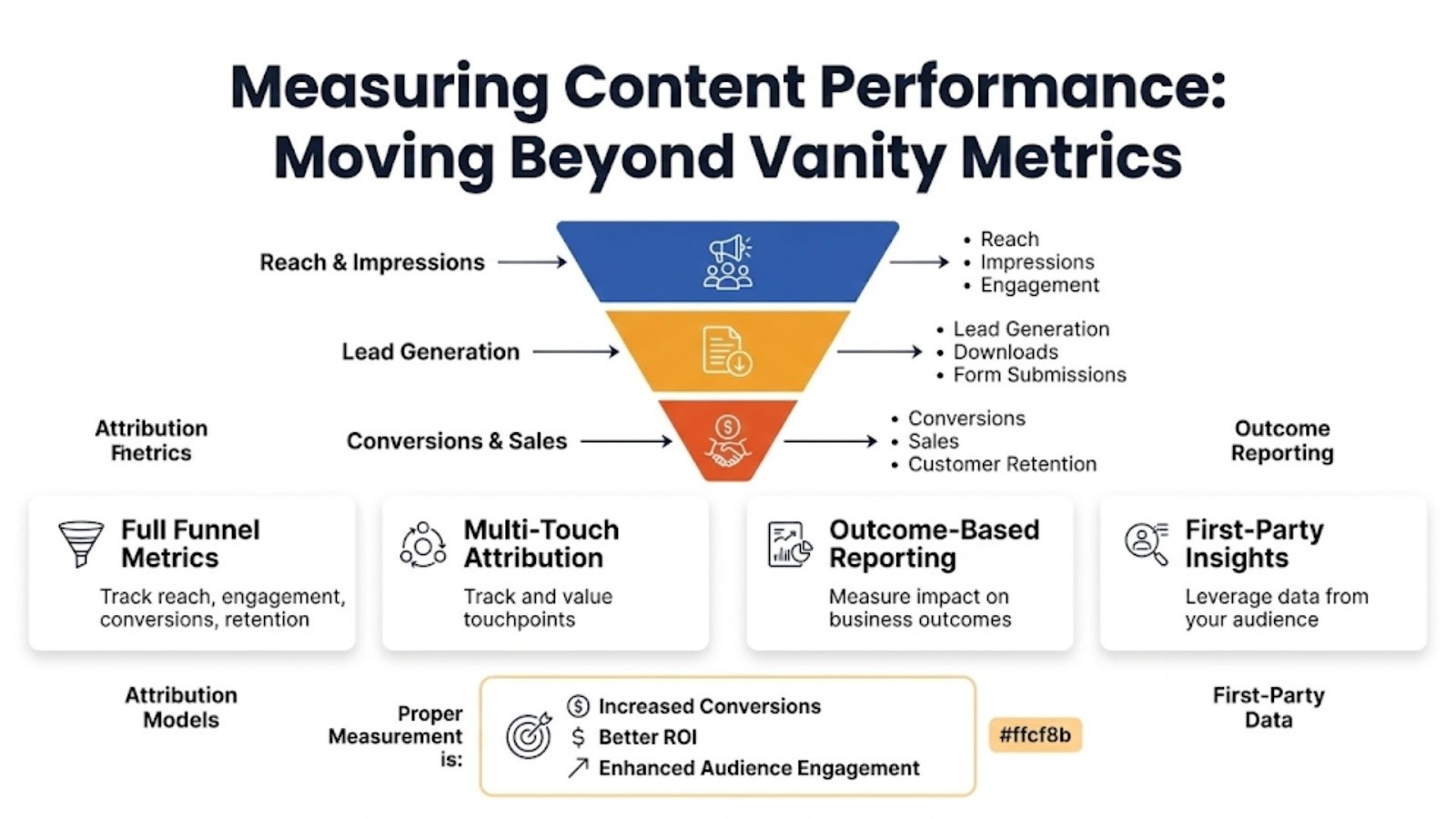
Measuring Content Performance: Moving Beyond Vanity Metrics
Measurement is the backbone of a content distribution strategy, and using the right SEO metrics can ensure that content reaches the intended audience effectively. Without the right tools in place to measure the success of your distribution efforts, you cannot optimize, adapt, or prove your content’s value to stakeholders.
The Full Funnel Measurement Model
Effective measurement goes beyond basic engagement metrics like clicks and shares. I recommend adopting a full-funnel measurement approach that tracks content performance at each stage of the customer journey. From awareness (reach) to engagement (interactions), conversion (leads), and ultimately to retention (lifetime value), every step of the funnel should be measured and optimized.
- Top of the Funnel (TOFU): Metrics related to reach, impressions, and engagement.
- Middle of the Funnel (MOFU): Metrics like lead generation, downloads, or form submissions.
- Bottom of the Funnel (BOFU): Metrics related to conversions, sales, and customer retention.
These metrics together tell a story about how well content is driving business outcomes at each stage of the customer journey.
Multi-Touch Attribution
Attribution models allow you to understand how various touchpoints contribute to conversions. Multi-touch attribution is essential for content strategies that span across multiple channels. By assigning value to each touchpoint, you can identify which channels are most effective at different stages of the customer journey.
However, attribution is becoming more complex due to the fragmented nature of digital journeys, stricter privacy regulations, and the challenge of tracking cross-channel engagement. It’s essential to combine attribution data with first-party insights, experiments, and outcome-based reporting.
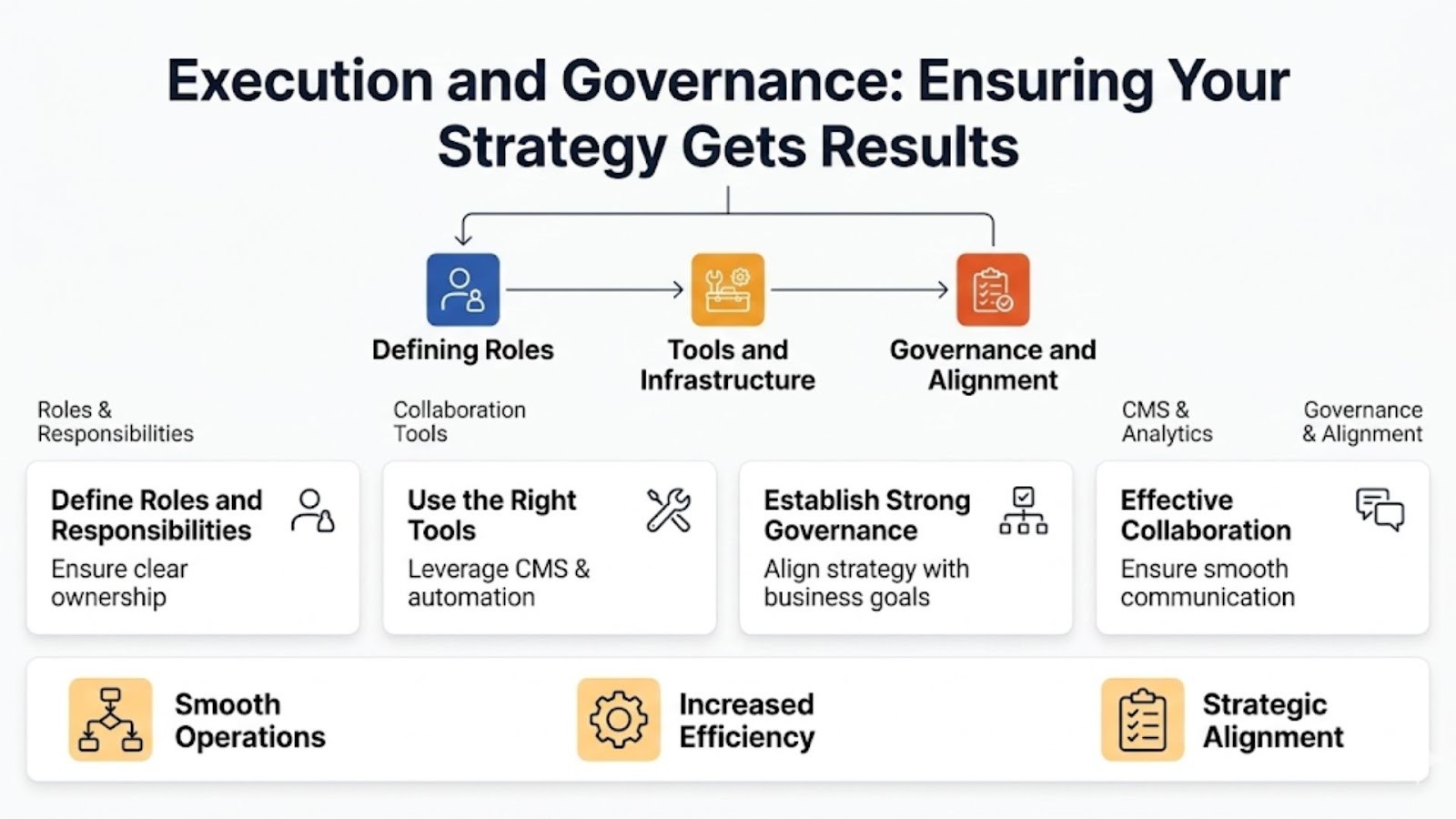
Execution and Governance: Ensuring Your Strategy Gets Results
Execution is the part where many strategies fail. Without proper governance, roles, and tools in place, even the best distribution plan can fall apart. Execution requires the infrastructure, clear roles, and processes to ensure that everything runs smoothly.
Defining Roles and Responsibilities
Clear ownership of tasks is crucial for the smooth execution of a content distribution strategy. For example, roles like content traffic managers, campaign coordinators, or content marketers can ensure that everything moves through the pipeline efficiently, with no delays or confusion.
Content Marketing Institute highlights the importance of assigning clear ownership within the team. Without this structure, campaigns risk falling through the cracks or getting stuck in approval cycles.
Tools and Infrastructure
Having the right tools in place is vital for efficient content distribution. Content Management Systems (CMS), analytics platforms, automation tools, and collaboration tools are all integral parts of the distribution ecosystem. Additionally, a solid content delivery infrastructure ensures that content reaches the audience quickly and reliably.
However, tools alone are not enough. They need to be paired with strong governance to ensure alignment with your content strategy and business goals.
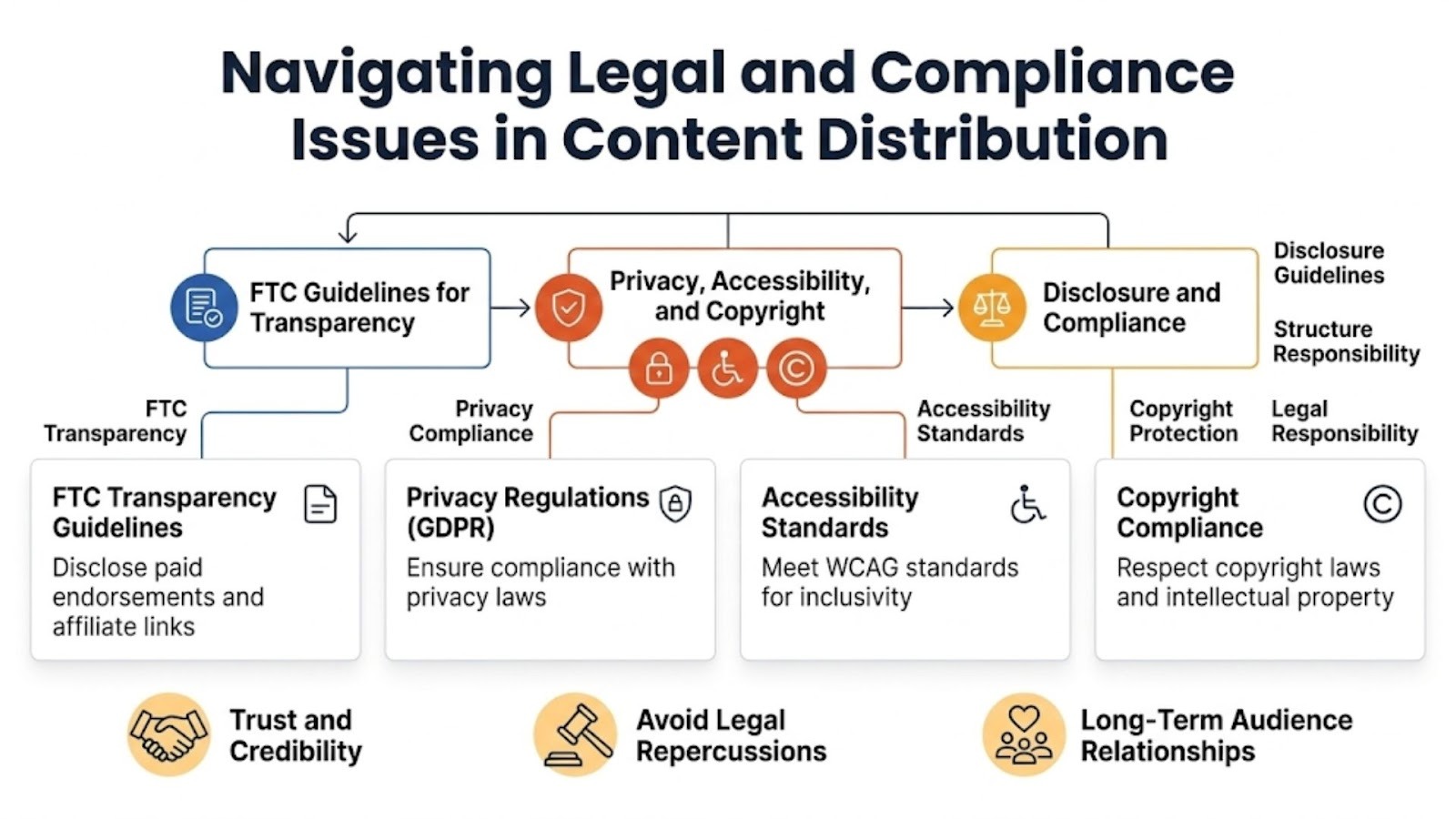
Navigating Legal and Compliance Issues in Content Distribution
Finally, no content distribution strategy is complete without considering legal and compliance factors. Content that is distributed at scale runs the risk of encountering issues with privacy, copyright, and disclosure. Ensuring that your content complies with legal guidelines is essential to protecting your brand and avoiding costly fines or reputation damage.
FTC Guidelines for Transparency
If your content includes paid promotions, influencer endorsements, or affiliate marketing, you must be transparent with your audience. According to the Federal Trade Commission (FTC), clear disclosures must be made whenever content includes paid endorsements, sponsorships, or affiliate links.
Transparency builds trust with your audience, while non-compliance could lead to legal repercussions and loss of credibility.
Privacy, Accessibility, and Copyright
In addition to FTC guidelines, privacy regulations like GDPR and accessibility standards should be at the forefront of your content distribution process. As digital content becomes more pervasive, respecting user privacy and ensuring content is accessible to all are not just legal obligations, they’re also a best practice for building long-term relationships with your audience.
FAQ: Content Distribution Strategy
1. What is content distribution, and why is it important?
Content distribution refers to the process of delivering content to your target audience through various channels, platforms, and formats. It is a critical aspect of content marketing because it ensures that your content reaches the right people at the right time. Without an effective distribution strategy, even the best content can go unnoticed, limiting its potential to drive engagement, conversions, and ultimately, business outcomes.
2. How do I choose the right distribution channels?
The right distribution channels depend on where your target audience spends their time. Consider conducting audience research to identify which platforms they frequent. For example, LinkedIn might be ideal for B2B content, while Instagram could be better for visually engaging B2C content. You can also experiment with a multi-channel approach (PESO model) to test which channels resonate best with your audience and adjust your strategy accordingly.
3. How can I measure the success of my content distribution strategy?
Success can be measured using both activity metrics and outcome-based metrics. While activity metrics (such as impressions, shares, and comments) provide insights into engagement, outcome-based metrics (such as conversions, sales, leads, and customer retention) are a more accurate measure of whether your content distribution is meeting business objectives. Tools like Google Analytics, social media insights, and customer relationship management (CRM) platforms can help you track these metrics.
4. What is the PESO model, and how does it help in content distribution?
The PESO model, Paid, Earned, Shared, and Owned, helps organize content distribution by categorizing the types of media you use to distribute content. This model prevents over-reliance on any single channel and ensures a well-rounded strategy. Paid media (advertisements), Earned media (press coverage), Shared media (social media), and Owned media (your website, blog) all play unique roles in creating a balanced and effective distribution strategy.
5. How often should I post or distribute content on social media?
There is no one-size-fits-all answer, as posting frequency should be driven by data and audience behavior. Use benchmark studies as a guide, but optimize based on how your audience responds. Tools like Hootsuite and Buffer allow you to analyze engagement metrics and identify when your audience is most active. It’s essential to balance consistency with relevance, posting too frequently can lead to audience fatigue, while posting too rarely can make your content go unnoticed.
6. Can I reuse old content, or should I always create new content for distribution?
Repurposing old content is an excellent strategy for maximizing the value of your assets. Rather than constantly creating new content, you can update and repurpose high-performing content to fit different formats or audiences. For example, a successful blog post can be turned into a video, infographic, or podcast episode. Repurposing also helps reinforce key messages and increases content lifespan.
7. How do I ensure my content remains compliant with legal standards?
Compliance is crucial, especially when your content includes paid promotions, endorsements, or affiliate marketing. The Federal Trade Commission (FTC) requires clear disclosures when content contains these elements. Additionally, you must follow privacy regulations (like GDPR), copyright laws, and accessibility standards to ensure your content distribution doesn’t violate legal guidelines. It’s essential to stay updated on the latest regulations and incorporate these compliance measures from the outset.
8. How do I handle content distribution for a global audience?
When distributing content globally, it’s important to localize the content for different languages, cultures, and regional preferences. Use geo-targeting for paid ads and consider adjusting content formats or messaging to suit the cultural context of each region. Collaborate with local influencers or partners to enhance engagement, and be mindful of local compliance laws related to privacy and advertising.
9. What tools or platforms can I use to automate content distribution?
There are several tools available to automate and streamline content distribution. Some of the most popular ones include:
- Hootsuite and Buffer for social media scheduling and analytics.
- Mailchimp for email marketing and distribution.
- Zapier for automating workflows across various platforms.
- CoSchedule for content calendar management and distribution.
These tools help ensure that content is distributed consistently, efficiently, and at the optimal time.
10. How can I incorporate user-generated content (UGC) into my distribution strategy?
User-generated content (UGC) is a powerful way to boost engagement and build community. You can incorporate UGC into your distribution strategy by encouraging users to share their experiences, feedback, or content related to your brand. UGC can be shared on social media, featured on your website, or repurposed into marketing campaigns. Additionally, leveraging UGC increases authenticity and can enhance the credibility of your content.
11. What role does personalization play in content distribution?
Personalization plays a crucial role in content distribution by tailoring content to individual audience segments based on their behavior, preferences, and past interactions. Personalization can increase engagement and conversion rates, as people are more likely to consume content that feels relevant to them. This can be achieved through dynamic content recommendations, personalized email campaigns, and targeted advertising based on user data.
Final Thoughts: Turning Content Distribution Into a Managed Growth System
A successful content distribution strategy isn’t just about pushing content out into the world, it’s about creating a system that moves content from creation to measurable performance. By aligning your distribution strategy with business goals, segmenting your audience, leveraging the right channels and formats, and amplifying successful content, you can turn content into a driver of business results.
The most effective content distribution strategies integrate audience insights, a mix of media channels, data-driven optimization, governance, and compliance. When these elements come together, content distribution becomes a managed growth system that helps brands drive real, sustainable business outcomes.
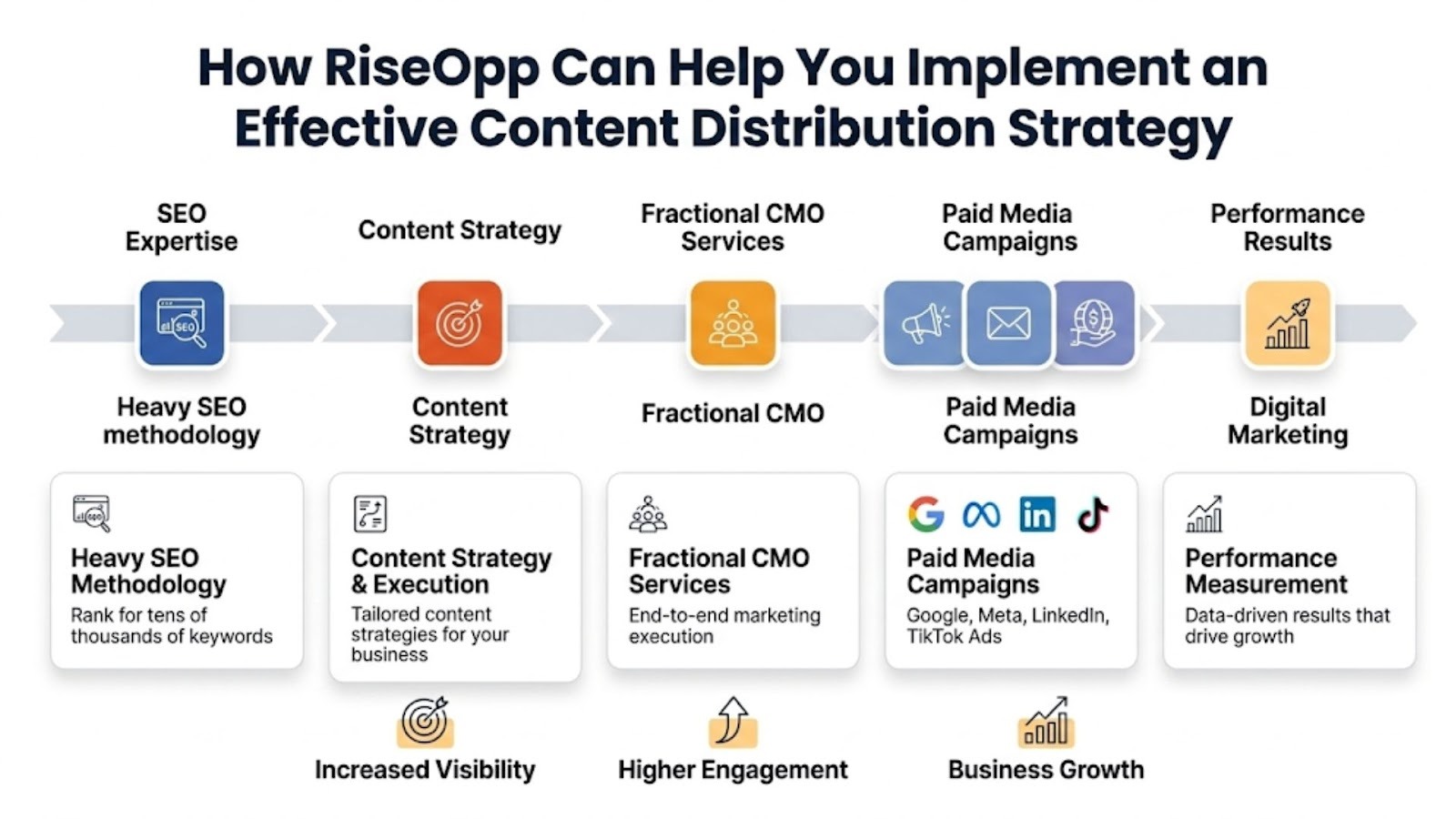
How RiseOpp Can Help You Implement an Effective Content Distribution Strategy
At RiseOpp, we understand that content distribution is not just about creating great content; it’s about strategically pushing that content to the right audience, at the right time, across the right channels. With our expertise in Fractional CMO and SEO services, we help businesses like yours develop and execute comprehensive content strategies that not only drive traffic but also deliver measurable business results.
Our proprietary Heavy SEO methodology is designed to help you rank for tens of thousands of keywords over time, ensuring that your content is visible and discoverable by the right people. Whether you’re aiming to build brand awareness, generate leads, or drive sales, we leverage SEO alongside other powerful digital marketing strategies to ensure your content gets the attention it deserves.
As part of our Fractional CMO services, we work closely with both B2B and B2C companies to develop marketing strategies, craft compelling branding and messaging, and implement end-to-end marketing execution. We manage everything from SEO and GEO targeting to paid media campaigns (Google Ads, Meta Ads, LinkedIn Ads, TikTok Ads), email marketing, and even affiliate marketing.
If you’re looking to take your content distribution strategy to the next level and drive tangible results, we’re here to help. Contact us today to learn how RiseOpp can transform your content strategy, helping you connect with the right audience and achieve your marketing goals.
Let’s work together to turn your content into a performance engine that drives real growth for your business.
Comments are closed